
Emotionally Focused Therapy (EFT) and the Gottman Method are two of the best-studied approaches to couples therapy, and research does not show that one beats the other overall. The real difference is where they start. The Gottman Method begins with behaviors: how you fight, repair and build everyday habits. EFT begins with the emotional bond underneath: the fear, hurt and longing that drive the fights.
If you are trying to choose, this guide walks through both models in plain language, shows what the evidence says, and gives you a way to decide. You do not need to be an expert. You only need to know what is going on in your relationship right now.
Both models want the same thing: a relationship where you feel safe, understood and close. They take different roads.
| Gottman Method | Emotionally Focused Therapy (EFT) | |
|---|---|---|
| Starting point | Specific behaviors and conflict patterns | Emotional bond and attachment needs |
| Core idea | Build the “Sound Relationship House”: friendship, trust, commitment | Break the negative cycle, then restructure how you connect |
| Style | Structured, with checklists and exercises | Process-oriented, focused on what happens in the room |
| Homework | Frequent | Lighter, more emphasis on emotional awareness day to day |
| Assessment | Relationship Checkup and interviews at the start | Early sessions map your cycle |
| Often a good fit when | Arguments escalate, communication breaks down, you want tools | You feel distant, disconnected or stuck in the same fight |
That table is a simplification. Good therapists of either type pay attention to both behavior and emotion. But it gives you a feel for the difference.
The Gottman Method grew out of decades of observational research on couples. Its framework, the Sound Relationship House, rests on 40+ years of observation of thousands of couples, and it uses standardized questionnaires, such as the Gottman Relationship Checkup, to map your strengths and the places you struggle.
In practice, therapy often starts with a joint session and individual sessions, then a feedback session where your therapist shares what the assessment shows. From there you work on targeted skills. A few of the best known:
If you want to see how a typical course unfolds, our guide on the Gottman Method, including session counts and what research shows covers it in detail.
Emotionally Focused Therapy for couples is a brief, evidence-based approach built on attachment theory. The idea is that partners are each other’s main source of emotional safety. When that safety feels threatened, couples fall into painful loops: one pursues and criticizes, the other withdraws and shuts down. Both are really asking the same thing: “Are you there for me?”
EFT is organized into three stages, as described in a research review of the model:
The same review reports that around 70 to 75% of distressed couples move into recovery and about 90% report significant improvement, and that gains can keep growing for up to two years after therapy ends. Those figures come from the model’s own research community, so read them as encouraging rather than guaranteed. Your result depends on your situation and your effort.
If EFT’s attachment lens sounds familiar, the same ideas appear in guides about calming emotional flooding in conflict, which is something both models address in their own ways.
The honest summary: both work, and neither has been shown to be clearly better.
What does this mean for you? Don’t pick a model because someone online said it “wins.” Pick the one you can imagine doing, with a therapist you trust.
The biggest practical difference is the rhythm of sessions.
Gottman tends to feel like a plan. You complete questionnaires, your therapist gives feedback on strengths and risks, and you leave with exercises. Clinicians describe it as highly structured, with many exercises, checklists and rituals practiced between sessions. If you like clear steps and measurable progress, that can be a relief.
EFT tends to feel like a conversation that slows down. Your therapist will often pause a heated moment and ask what is happening underneath it: “What was it like to hear that?” You may be asked to say something vulnerable directly to your partner. There is less traditional homework, though you are encouraged to notice your emotions between sessions.
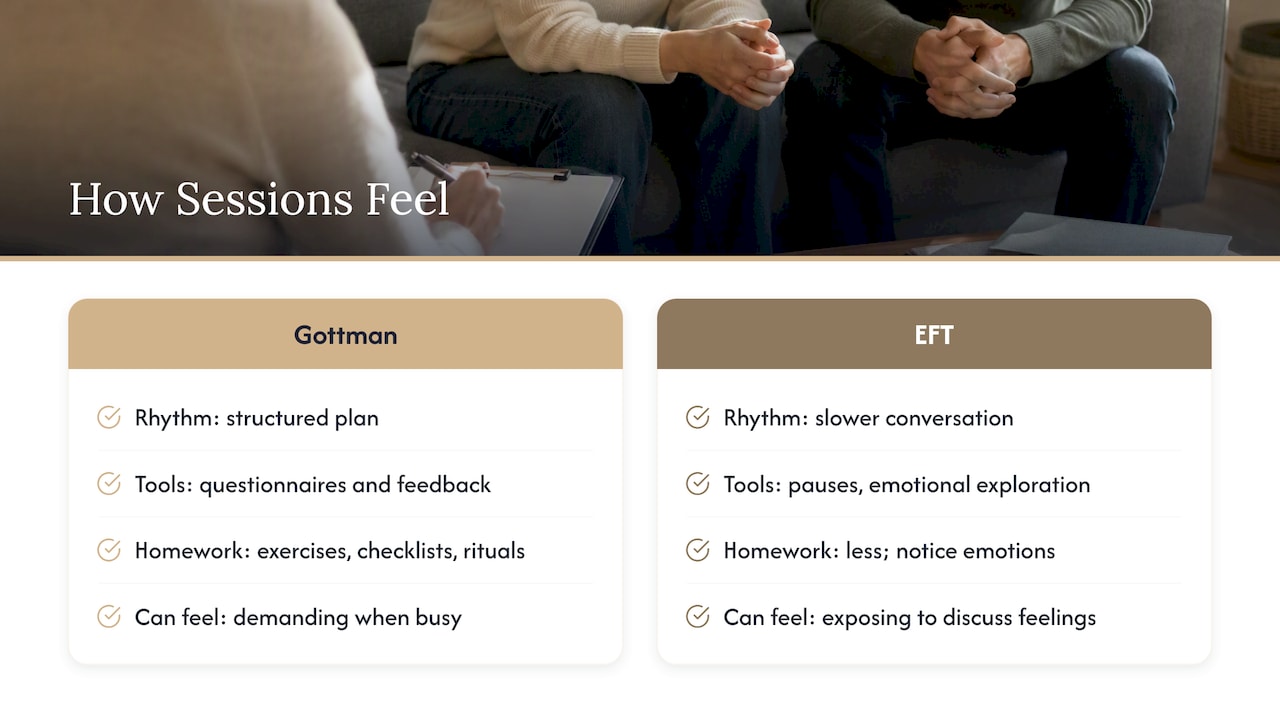
Neither is easier. Gottman can feel demanding if you are tired and busy. EFT can feel exposing if you are not used to talking about feelings.
Use these questions as a guide, not a diagnosis.
Neither approach is a stand-in for safety planning. If you feel afraid of your partner, or there is violence or coercive control, couples therapy may not be the right first step. Speak with a registered psychologist or counsellor individually, or call a local crisis line. Active addiction is another situation that needs particular care; a systematic review of both models in addiction-affected couples shows researchers are still working out how best to help. If either of you has trauma, individual work such as EMDR can sit alongside couples sessions. Our EMDR vs CBT guide explains how that works.
At Supporting Wellness, we see couples in Calgary, Red Deer and Cold Lake, and we rarely see a couple whose problem is neatly one type. Most arrive with a mix: arguments that escalate fast, and a quieter hurt underneath.
Our practice works with the Gottman Method, and we value how it gives couples something concrete to hold onto from the first sessions. Many couples tell us they feel relief when the problem becomes specific: this is the pattern, here is the skill. At the same time, we pay close attention to what sits beneath the behavior, because a script only holds when both people feel safe enough to use it.
So our advice is to focus less on the acronym and more on three things. Does the therapist explain how they work in words you understand? Do both of you feel heard in the room? And does the plan fit your life, including the homework?
This is also why we offer a free 15-minute connection call with every therapist. You can ask about their training, their approach to conflict and distance, and whether evening or weekend times work. No physician referral is needed, and we direct bill to a wide range of insurers.
— Deane
A few practical steps help more than the model name.
That last point matters. People sometimes assume that after a bad experience, they are “the problem.” More often, the approach or the match was off.
You do not need to wait for an appointment to start. Two small practices borrow from both models:
For more ideas, see our communication exercises for couples, and read about how couples counselling improves communication and connection.
If you live in Calgary, Red Deer or Cold Lake, or prefer online sessions, our team offers marriage and couples counselling in Calgary with direct billing. Start with a free 15-minute connection call, ask your questions, and see whether it feels right. You can also browse all our services, including family counselling and EMDR.
The Gottman Method puts more weight on communication skills, such as softened startups, repair attempts and managing the Four Horsemen. That makes it a natural fit if your main problem is how conversations go wrong. EFT also improves communication, but it does so by changing the emotional dynamic underneath. Research has not shown a significant overall difference in outcomes.
Yes. Many couples therapists draw on more than one model, using Gottman assessments and conflict tools alongside attachment-focused work. Ask any therapist how they integrate approaches and what they would do first in your case. A good answer ties the choice to your specific pattern.
The Gottman Method usually involves more homework, including exercises, checklists and daily rituals. EFT is more process-oriented and relies on what happens in session, with less formal homework. If your schedule is packed, say so at the start so your therapist can plan realistic steps.
It varies by couple and by the issues involved. Our Gottman Method guide discusses typical session ranges, and EFT is described as a brief therapy. Your therapist should give you a rough timeline after the first few sessions and review it with you as you go.