
The most useful communication exercises for couples are small and specific: a short daily check-in, a gentler way to start hard conversations, listening without interrupting, and a planned pause when emotions run high. Each one takes minutes. Below are seven you can try this week, how to do them step by step, and how to tell when practice at home is enough and when a counsellor can help.
If you feel unsure about any of this, that is normal. Most couples were never taught how to talk to each other when it matters. It is a skill, and skills can be learned.
Relationship specialists often describe communication as the glue of a relationship. Utah State University Extension notes that creating healthy patterns helps relationships thrive, and that listening is an active, ongoing skill, not just waiting for your turn to talk.
There is research behind this. A 2024 experimental study of 20 married couples found that an uninterrupted listening intervention improved marital quality and communication patterns. A separate study on responsive listening looked at how listening to a partner during stressful conversations can promote closeness. These are small studies, so treat them as encouraging rather than a guarantee. They do match what we see in sessions: when people feel heard, the temperature of a conversation drops.
Many of the exercises below come from the Gottman Method, which draws on decades of observational research on couples. The Gottman Institute’s own list of communication exercises is a good companion read.
Exercises work best when both of you are calm, willing and safe. Three ground rules help.
If you are afraid of your partner, or one of you controls the other’s money, movements or contacts, do not start with communication exercises. Conflict-resolution exercises can be unsafe or counterproductive where there is intimate partner violence or coercive control. The Government of Canada’s guidance on special issues in separation and parenting points to professional assessment and safety planning in those situations. A family doctor, a counsellor who works with relationship safety, or your local crisis line can help you decide next steps on your own.
Pick a regular time, such as after dinner or while the kettle boils. Each of you takes a few minutes to share how your day went and how you are feeling, without the other solving, fixing or commenting.
The APA advises healthy couples to check in regularly and to talk about more than parenting and household logistics. Try finishing with one question: “Is there anything you need from me tonight?”
Once a week, sit down for about 20 minutes. Use the same three prompts each time:
Keep complaints specific and brief. Raising a specific concern respectfully is one of the healthier things a couple can do, and the APA notes it helps prevent resentment from building.
How a conversation begins strongly shapes how it ends. A softened startup means opening gently, without blame or sarcasm. The Gottman Institute recommends it especially when your fights tend to escalate quickly.
A harsh opening sounds like: “You never help with anything around here.”
A softened one sounds like: “I’m feeling overwhelmed with the evening routine. Could we look at how we split it?”
The formula is simple: I feel (an emotion), about (a specific situation), and I would like (a small, concrete request).
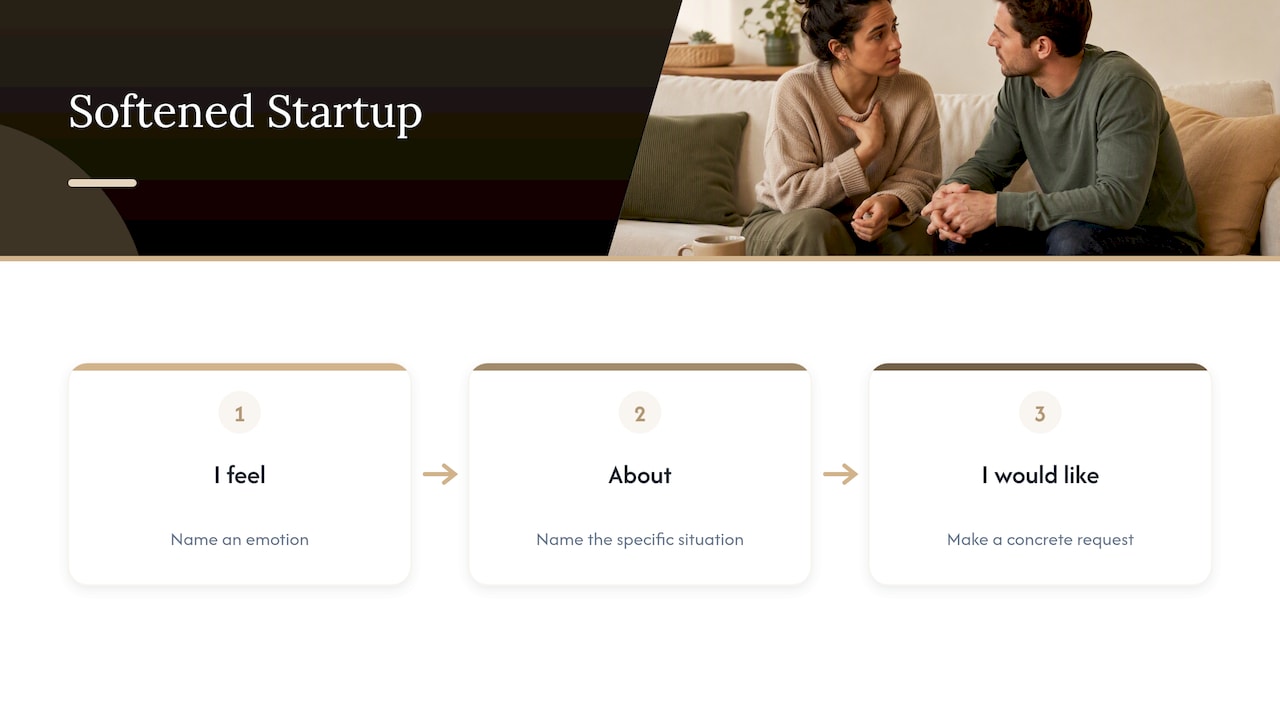
This is the same idea at the sentence level. “I feel dismissed when my phone call gets interrupted” is easier to hear than “You’re so rude.” Psychologists point out that it is a myth that a partner should just know what you think, even after many years together. Saying it out loud, with an “I” message, is a kindness to both of you.
Watch for the disguised version: “I feel like you don’t care.” That is a judgment about your partner, not a feeling. Try “I feel lonely” instead.
This is the uninterrupted listening practice in action.
The summary step is the hard part. Your job is to show you understood, not that you agree. Agreement can come later.
Love Maps is a Gottman exercise for staying curious about your partner’s inner world: their worries, hopes, friendships and small preferences. These change over the years, and most of us stop asking.
Try one open question a day:
Listen for details and ask a follow-up before you offer an opinion.
Sometimes the best communication exercise is stopping. University of Florida IFAS Extension reports that when a person’s heart rate goes above about 90 beats per minute, the logical part of the brain becomes harder to access. It recommends stepping away from an emotionally charged exchange for at least 25 to 30 minutes so the nervous system can settle.
How to do it well:
Trying all seven at once is a recipe for giving up. This sequence is easier to keep.
| Week | Focus | Time needed |
|---|---|---|
| 1 | Daily check-in | 5 to 10 minutes a day |
| 2 | Add the weekly 20-minute talk | 20 minutes once a week |
| 3 | Practise softened startups and “I” statements in real moments | No extra time |
| 4 | Try the speaker-listener exercise on one small topic, and agree on a pause signal | 15 minutes |
After four weeks, ask each other: what helped, what felt awkward, what do we keep? Keep what works and drop the rest. If you want a structured way to set shared goals, our guide on couples therapy goals shows how to turn everyday examples into a plan.
Exercises are a good start, but they do not solve everything. Gottman-based exercises are designed to be used at home between sessions, and they tend to work best with clinical guidance. Complex issues such as infidelity, addiction, or conflicts that have stayed gridlocked for years are hard to work through alone, and attempting it can raise tension.
Substance use is a good example. When alcohol is part of the picture, rebuilding trust involves more than conversation techniques. This overview of a 1 to 2 year plan for couples rebuilding trust after alcohol explains how structured communication can sit alongside recovery work.
Consider talking to a counsellor if:
Seeking help early is not a sign of failure. It is often what makes the difference. You can read more on how couples counselling helps improve communication and connection.
At Supporting Wellness, we use the Gottman Method with couples, and we see the same pattern often. Couples rarely come in because they lack love. They come in because their conversations have turned into cycles, and neither person knows how to step out of one.
We encourage couples to treat exercises as a way to rehearse, not a test to pass. A clumsy softened startup is still better than a harsh one. What we add in the room is a second set of ears: someone who can notice the moment a conversation tips, slow it down, and help each of you hear what the other actually meant.
We also want you to know that you do not need to be at the breaking point to book. Many couples come to build skills, and our team is family-oriented and multidisciplinary, so if stress, anxiety, trauma or parenting questions are part of the picture, we can look at those too.
— Deane
If you would like support, our marriage and couples counselling in Calgary uses evidence-based approaches including the Gottman Method. We offer a free 15-minute connection call with every therapist, so you can ask questions and see whether it feels like a good fit before you commit. You do not need a physician referral, we offer direct billing to a wide range of insurers, and we have evening and weekend availability. You can see everything we provide on our services page, including online sessions.
A short daily check-in and one 20-minute weekly talk are enough for most couples to notice a difference. Consistency matters more than length. Five calm minutes every day usually does more than a two-hour talk once a month.
Invite rather than push. Share one exercise, explain why it matters to you using an “I” statement, and offer a short trial period. If your partner stays unwilling, a counsellor can work with you individually, and sometimes that opens the door to joint sessions later.
Yes, but start with the planned pause and softened startup, and practise during calm moments. If arguments become frightening, or one of you feels unsafe, stop and speak with a professional before continuing. Exercises are not designed for relationships with violence or coercive control.
Not for every situation. They are a strong starting point and a good complement to therapy. For infidelity, addiction or long-standing, unresolved conflicts, guided support is more likely to help and less likely to raise tension.