
Couples therapy goals are the shared outcomes you and your partner agree to work toward, such as communicating better, rebuilding trust, growing closer, and having fewer painful arguments. The strongest goals are shared, specific, and measurable, because they tell you and your therapist where you are heading and how you will know you have arrived. This guide gives you examples you can adapt.
TL;DR:
- Choose one to three goals both partners care about, then review them every two to four sessions and adjust goals that repeatedly stall.
- Pair a short term habit, such as a weekly conversation that can show change within weeks, with longer work on trust or intimacy.
- Track behaviors or outcomes weekly, such as completed conversations, argument frequency, or satisfaction on a 1 to 10 scale; revise the plan when progress stalls.
- When violence or coercive control is present, therapists should pause joint sessions, prioritize safety planning, and arrange individual support before couples work resumes.
- A randomized trial involving 740 low income couples found reliable relationship satisfaction gains across online program versions with different levels of coach support.
Couples who arrive in therapy often say, “We just want things to be better.” That is a good starting point, but it is hard to act on. A shared goal turns a vague wish into a direction both partners can see.
Relationship therapists describe goal setting as co-creating a relationship culture, a roadmap that aligns your values, rhythms, and needs. The process itself matters. Sitting down together and naming what you want encourages vulnerability and shared accountability before any technique is taught. In many ways, the conversation about goals is already therapy.
Research points the same way. A research-driven flowchart for change in couples emphasizes that relationship distress is a systemic pattern both partners contribute to. Goals work best when each of you understands your own role in the negative cycle and you agree on shared priorities, rather than one person naming what the other needs to fix.
Clear goals also help in practical ways:
Short-term goals, such as a weekly check-in, give you quick wins within a few weeks. Long-term goals, such as rebuilding trust or reconnecting physically, can take longer. Pairing the two matters. The small wins show you that change is possible while the bigger work unfolds.
Every couple is different, but the same themes come up again and again. The examples below are written so they can be measured. Adapt the examples to what feels realistic for you.
Couples come to us for help with communication. Research on the OurRelationship program found that improvements in communication and emotional intimacy were linked to gains in relationship satisfaction, and that keeping negative communication low predicted whether those gains lasted over 12 months.
When trust has been broken, goals work best when they are staged. Instead of “we will trust each other again,” break the work into steps.
Intimacy goals often feel the most tender, so keep them gentle and concrete.
Some couples argue less about topics and more about a pattern, such as one partner pursuing while the other withdraws.
If these patterns sound familiar, our scripts for stopping Gottman’s Four Horsemen can support your conflict goals.
Pro Tip: Choose a manageable number of goals at a time. Couples who try to fix everything at once may feel overwhelmed.
SMART is a simple framework: Specific, Measurable, Achievable, Relevant, and Time-bound. It was not designed for relationships, but a few adjustments make it work well for couples.
Here are three worked conversions from vague to SMART:
Large goals also need smaller steps. Your therapist can turn each goal into session objectives, such as practicing a skill in the room, and home practice steps you try between visits.
A goal becomes real when it shows up in your sessions and your week. Here is a sample way to map one goal, say “reduce high-intensity arguments,” across 6 to 12 sessions:
Your therapist may draw on named, evidence-informed approaches to pursue these goals, following an integrated treatment plan creation guide for families. Emotionally Focused Therapy (EFT) helps partners access and share the feelings underneath conflict. Gottman Method skills build friendship, repair, and softer conflict conversations. Integrative Behavioral Couple Therapy (IBCT) analyzes recurring problems and builds acceptance alongside change. Research on web-based programs shows that both communication-focused and problem-focused interventions can succeed, so no single path is required.
Simple homework keeps the work alive between sessions:
Therapist-guided work is not the only option. A randomized trial of the OurRelationship online program with 740 low-income couples found reliable gains in relationship satisfaction across versions with different levels of coach support. Structured, goal-focused practice helps, whatever the format.
Goals should not be set and forgotten. Regular reviews keep you honest and encouraged.
Useful ways to check in:
If progress stalls, that is information, not failure. You can shrink the goal, add smaller steps in between, or ask your therapist to try a different approach. A goal of frequent check-ins that keeps failing might become a more manageable routine until the habit takes hold.
Over time, therapy may shift from intensive work to maintenance. Some couples gradually space out visits and schedule a follow-up later. This is a sign that the skills are becoming yours.
Not every relationship can safely do joint therapy. When intimate partner violence or coercive control is present, therapists put safety ahead of every other goal. As one Canadian clinic explains, therapists prioritize safety by pausing joint sessions, creating safety plans, and referring for individual, trauma-informed care before returning to joint work.
Clinicians typically take these steps:
Safety comes before every other goal. When violence or abuse is present, therapists pause joint couples sessions and focus on safety planning and individual care first. (AERCS Therapy)
In this situation, safety becomes the first goal, and it reshapes everything that follows. A measurable objective might be “complete a safety plan” or “begin individual sessions” long before communication exercises. If you are worried about your safety, tell your therapist or a trusted professional, and contact local emergency services if you are in danger.
At Supporting Wellness, we begin by asking each partner what they hope will change over time. From there, we help you co-create shared goals during intake, so that neither partner feels the goals belong to someone else. We draw on evidence-based methods, including the Gottman Method, and, where clinically indicated, approaches such as EMDR and Brainspotting.
We also try to make the first step easy. Every therapist offers a free connection call, we offer direct billing, and we have evening and weekend availability. For your first session, bring some priorities and a concrete example of a recent conflict. A real moment gives us something specific to work with. If you want a deeper look at our approach, read how couples counselling improves communication and connection.
A goal that works for one couple can feel wrong for another. Culture, faith, family structure, and life stage all shape what a healthy relationship looks like. In some families, direct conversation about feelings is normal. In others, care is shown through actions and duty, and a goal like “share our feelings every night” may need rewording.
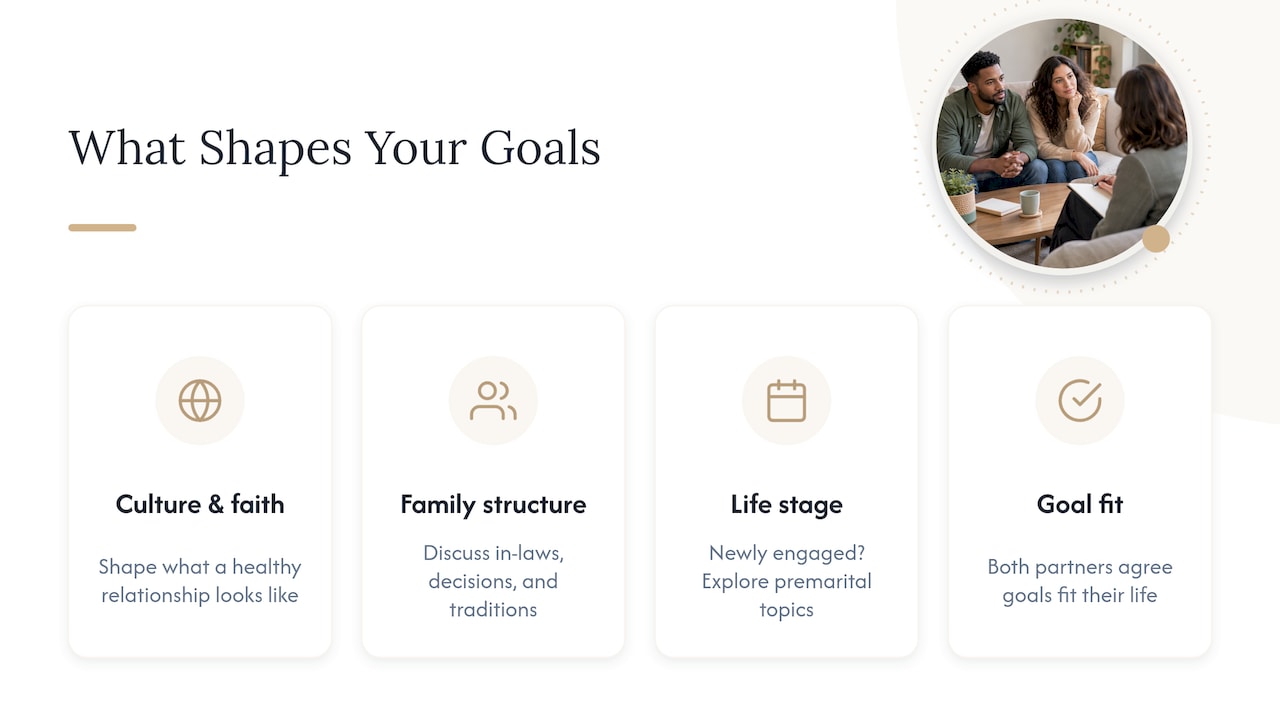
Good therapy respects this. If you are a blended family, raising children with extended family, or navigating different cultural expectations, say so early. Your goals might include how you handle in-laws, how decisions are made, or how each of you honors traditions that matter. Couples who are newly engaged may also want to explore premarital counseling topics before they set long-term goals.
The key is that both partners agree the goal fits their life. If a goal feels borrowed from someone else’s relationship, tell your therapist. Goals should be adapted to you, not the other way around, and we check for that fit at every review.
Your goals start taking shape before your first full session. A free connection call lets you meet your therapist, ask about their approach, and say in your own words why you are coming. It is a low-pressure way to find out whether the fit feels right.
Then comes the initial assessment, where we learn about your history, your strengths, and the patterns that cause pain. Here is how to prepare:
During assessment, your therapist helps you move from complaints toward goals. “You never listen” becomes “we want to feel heard in disagreements.” By the end of the initial sessions, you should have a short list of shared goals, a sense of how progress will be measured, and a plan for the weeks ahead. If something feels off, say so. You can always adjust.
Most of the change in couples therapy happens between sessions, in ordinary evenings and busy mornings. Motivation naturally rises and falls, so it helps to plan for the dips.
Remember that reductions in negative communication helped couples maintain their gains over 12 months in follow-up research. The habits you build now are worth protecting. If one of you is losing steam, say so early and bring it to your next session so the plan can change.
Here is my view, after reading the research and the practice guidance. Most advice about couples therapy goals makes them sound like a project plan, with dozens of metrics and a color-coded chart. That is not what helps. What helps is that two people sit down, name something they both want, and agree to try one small thing for a few weeks.
I think couples overrate the perfect goal and underrate the shared one. A modest goal that both partners truly own will outperform an ambitious one that only one of you believes in. I also think many couples start with what to stop doing, when it is more motivating to name what they want more of.
If you take one step first, make it this: each write down one thing you want more of, then compare your answers. The overlap is where your first goal lives.
— Deane

If you are ready to turn goals into progress, we are here to help. Our marriage and couples counselling is available in person and through online counselling, and we make the first step simple:
On your connection call, we listen to what you are hoping for and answer your questions. In your first session, we agree on goals together and plan your next steps. Browse our full list of services and book your free call today.
This article is general information, not a substitute for advice from a qualified doctor. Consult a qualified healthcare professional about your own circumstances before acting on anything here.
Come with one to three priorities and one recent example of a conflict. Be ready to listen as well as speak, and tell your therapist anything that affects your comfort or safety. You do not need to have everything figured out.
Yes, nerves are very common. Many people worry about being judged or blamed. A good therapist works to make both partners feel heard, and a free connection call can ease some of that uncertainty before you begin.
Each partner names what they want more of, and together you choose one to three goals. Make them specific, measurable, and time-bound, such as “a regular phone-free check-in.” Your therapist can help you refine them.
It varies by couple and by goal. Short-term goals such as a weekly check-in can show results in a few weeks, while rebuilding trust or intimacy usually takes longer. Reviewing your goals every two to four sessions helps you see change as it happens.
Related reading: Is it too late for couples counselling? and Is couples counselling covered by insurance?.