
Trust can be rebuilt after a lie, but it rarely happens through one apology or one good week. It happens through honest conversations, changed behaviour that your partner can actually see, and enough time for the hurt partner’s sense of safety to return. This guide walks through what each of you can do, what the research says about repair, and when it makes sense to bring in a therapist.
Whether you told the lie or you are the one who found out, you are probably carrying a lot right now. Shame, anger, fear and confusion are all common, and none of them mean the relationship is beyond repair.
Most people expect that a lie, especially a big one or a pattern of small ones, will sting. What surprises them is how deep it goes. Researchers describe betrayal as a situation where a trusted partner intentionally violates trust or a relationship rule, leaving the injured partner vulnerable. The reactions it can set off include shock, hurt, anger, shame and humiliation.
The damage often reaches beyond the specific lie. A Greater Good article on betrayal explains that it can make the hurt person question their own judgement, identity and assumptions about safety. It can also produce global hypervigilance: a constant scanning for threat that is not selective about what it flags.
That helps explain what you may see in the weeks afterward:
Neither side is being unreasonable. The hurt partner’s alarm system is stuck on, and the partner who lied is living with the consequences of setting it off. Naming this early takes some of the pressure off both of you.
A lie about a surprise party is not a lie about money, an affair or an addiction. Size matters, but so do pattern, intent and what the lie protected. Ask yourselves:
That last question matters more than many couples realize. Johnson, Makinen and Millikin call these moments attachment injuries, betrayals of trust at times of need. When an injury like this goes unresolved, it becomes a reference point for judging whether your partner is dependable.
Yes, often. Nothing guarantees it, and not every relationship survives, but the evidence is encouraging.
A 2013 laboratory study in PNAS looked at trust decisions after a breach. It found that breaches happening later in a relationship were followed by greater trust recovery than early ones, with a trust proportion of 0.77 after a late breach versus 0.58 after an early one. This was a lab experiment, not a study of married couples, so treat it as a hint: a history of good experiences gives trust something to return to.
A Journal of Management review defines trust repair as any increase above the level right after the violation, and complete repair as a return to the level before it. It also describes repair as a process that unfolds over time. That is a useful way to set expectations. You do not need to be fully back to normal to be making progress.
A 2025 systematic review in the Journal of Family Therapy looked across studies of couples and found five recurring themes in trust repair:
The rest of this guide follows those themes.
This part is hard, and it is also where most of the repair work begins. The hurt partner cannot rebuild trust alone. They need evidence, and you are the only one who can provide it.
A practitioner review on building trust recommends an apology without defensiveness or excuses, along with validating your partner’s pain. In practice, a meaningful apology usually has these parts:
Research on attachment injuries is blunt about the alternative. Dismissing, denying or minimizing the injury obstructs repair. “It was just a small thing” or “you’re overreacting” can undo an otherwise sincere apology.
Most people lie to avoid conflict, protect themselves from shame or hide something they feel unable to face. Understanding your own reason is not an excuse. It is information your partner may need later, and the Journal of Family Therapy review lists clear communication about the reasons for the betrayal as a repair theme. Think it through first, possibly with a therapist or someone you trust, so you can be clear rather than defensive when the conversation comes.
Some people find it helpful to have someone outside the relationship who can ask how they are keeping their word. If that appeals to you, finding an accountability partner is one way to keep your commitments steady between difficult conversations.
Proactive transparency means offering information rather than waiting to be caught again. You might share your schedule, tell your partner when plans change, or volunteer an uncomfortable detail before they find it. It can feel intrusive. It is also the clearest message that you are not hiding anything now.
Talk about how long this will last. Open-ended monitoring can feel like punishment to you and like an ongoing necessity to your partner. Agree on what transparency looks like and review it together every few weeks.
The hurt partner will probably ask the same questions repeatedly. That is not an attempt to torture you. They are trying to piece together a reality that has been rearranged. The practitioner review mentions openness to uncomfortable questions as part of sustained honesty. Answer calmly and consistently, and if you do not know, say so rather than guessing.
Reliability is built from small moments: showing up when you said you would, texting when you are late, doing the thing you promised. Each is minor. Together they become the evidence your partner needs.
You did not cause the lie, and you are not responsible for fixing it. You do, however, have a say in how repair happens, and you are allowed to decide whether you want to try.
The hypervigilance described earlier does not fade on a schedule. You may feel hopeful on Monday and shaken on Thursday. That does not mean repair has failed.
“Be more honest” is hard to act on. “Tell me when your plans change before I have to ask” is something your partner can do. Useful requests are concrete, reasonable, and tied to the specific breach. Examples include:
It can also help to name what you are willing to offer in return, such as listening without interrupting when they explain. The review of couples research includes shared activities as a repair theme, so make room for ordinary time together that is not about the betrayal.
There is a line between a partner being open and a partner being monitored. Agreed transparency, with an end in view, is part of repair. Demanding constant passwords, tracking someone’s location indefinitely, threatening or punishing them is something else. The Public Health Agency of Canada notes that intimate partner violence can include threats, control and technology monitoring, and advises reaching out to a trusted person or a health or social-service provider. If you feel afraid of your partner, or you are the one doing the controlling and cannot stop, speak with a counsellor or physician on your own before attempting couples work.
There is no standard timeline. What you can expect is a rough shape, which changes from couple to couple.
| Stage | What it usually involves | What helps |
|---|---|---|
| Disclosure and shock | The truth comes out, strong emotions, many questions | Honest answers, a real apology, no minimizing |
| Hypervigilance | Checking, doubting, difficulty sleeping or concentrating | Transparency, patience, outside support |
| Understanding | Talking about why it happened and what it meant | Calm conversations with clear time limits |
| Rebuilding | Reliable behaviour accumulates; some trust returns | Consistent follow-through, shared activities |
| Integration | The lie is part of the history, not the whole story | Ongoing communication, occasional check-ins |
The stages overlap, and couples often move back and forth. CAMH’s guide on anxiety disorders makes a similar point about relationship repair generally: it takes time, patience and effort.
The University of Ottawa work on the Attachment Injury Resolution Model describes repair as the hurt partner processing fear, sadness, anger and hurt while the partner who caused the injury becomes emotionally accessible and responsive. That responsiveness, it explains, works as a corrective experience. In plain terms: the moment your partner is hurting and you stay, listen and care rather than get defensive is often the moment trust begins to turn.
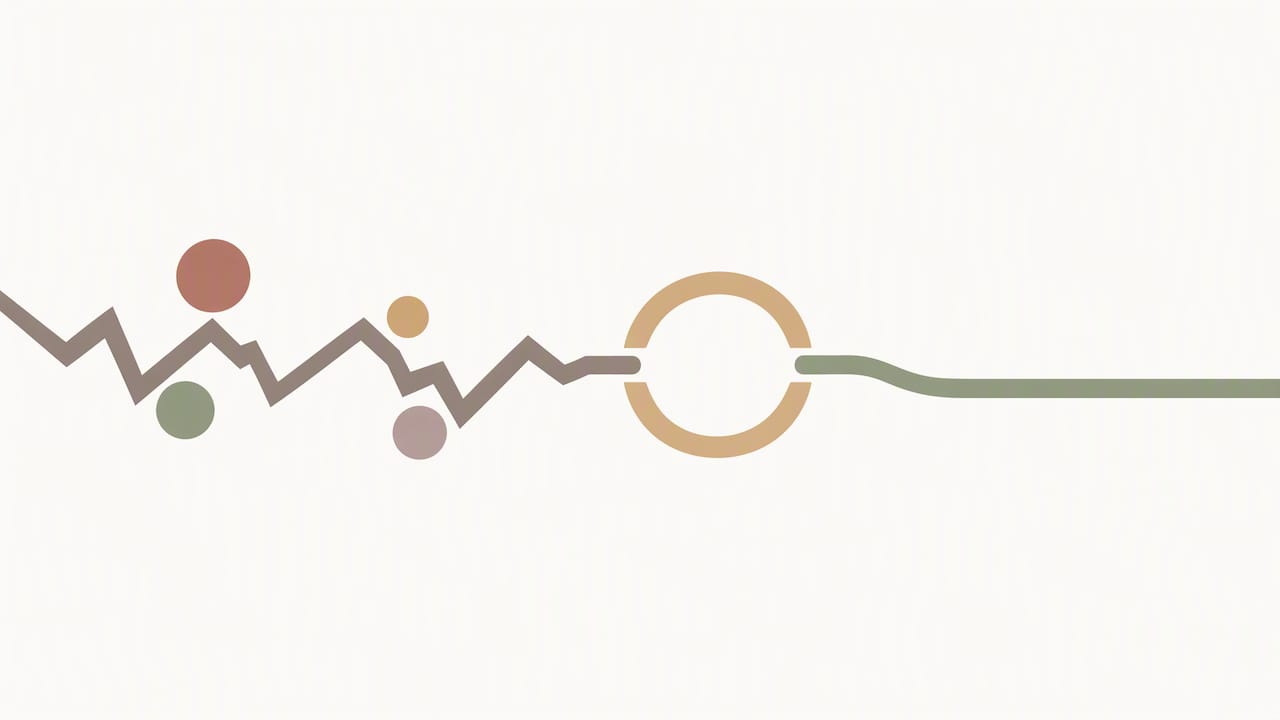
We see couples at many points in this process, from the first week after a discovery to years later when the lie still sits between them. A few things hold true for most of them.
First, the lie is rarely the only problem. It usually sits on top of a pattern: avoiding conflict, feeling judged, not knowing how to say a hard thing. Repairing trust means addressing the lie and the pattern. If you only deal with the lie, the pattern tends to produce another one.
Second, couples often try to rush. The person who lied wants to be forgiven so the shame can end. The hurt partner wants the pain to stop. Neither wish is wrong, but pushing for quick closure usually delays real repair.
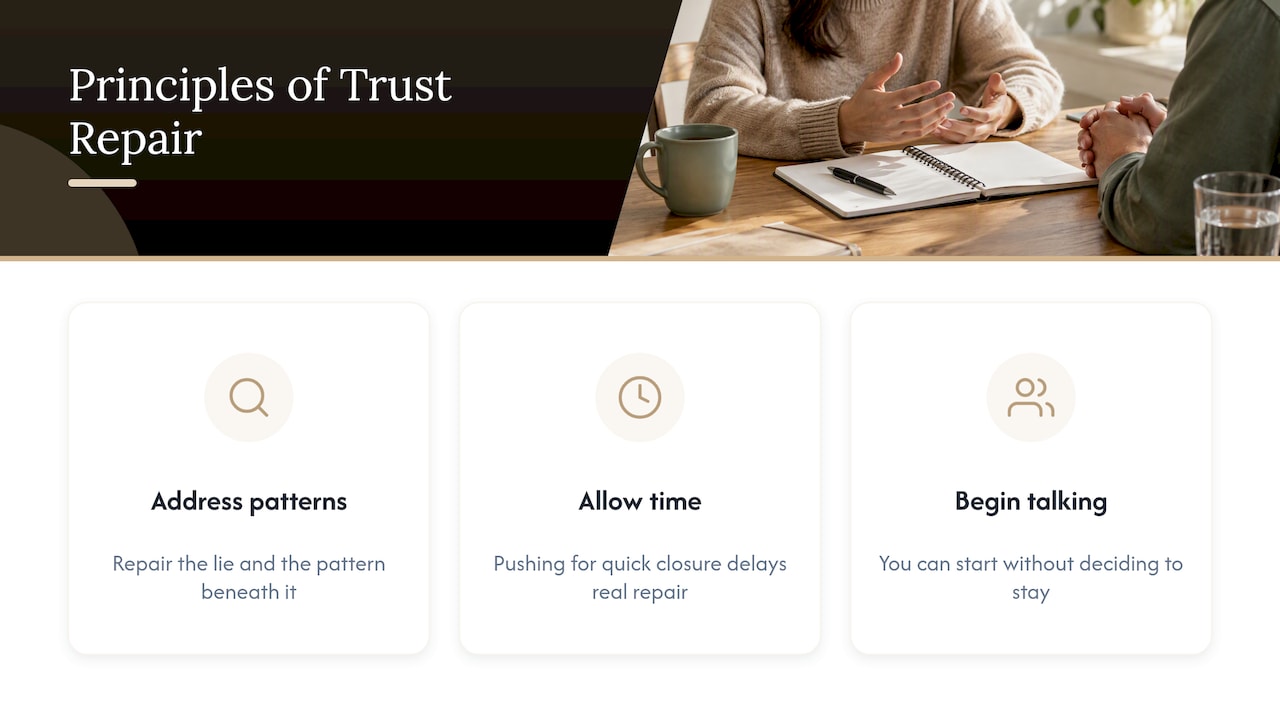
Third, you do not need to know whether you will stay together before you start. Many people come to therapy asking only whether they can talk about it without it exploding. That is enough of a reason to begin.
Our team works with couples using approaches such as the Gottman Method, and we encourage people to start with a free 15-minute connection call so they can see whether a therapist feels like a good fit. You do not need a physician referral. We are a collaborative, family-oriented practice, and we know that taking the first step is often the hardest part.
— Deane
You do not have to wait until things are at their worst. Consider reaching out if:
A therapist can set a structure that is hard to create at home: a place where the hurt partner can say everything and the other partner can listen without needing to defend. CAMH suggests that involving a partner and considering couples therapy with a therapist who understands the relevant condition can improve communication and teamwork. The same principle applies when the lie is linked to another issue. CAMH’s gambling resource, for example, notes that counselling with a partner or family can help restore trust and repair financial and emotional damage, and that families can work through concerns at their own pace.
Individual therapy matters too. If the lying relates to anxiety, trauma, or a pattern from earlier in your life, working one-on-one can make the couple work more effective. Our individual counselling and therapy is available for exactly that.
If you are in Calgary or Red Deer, our couples counselling in Calgary offers direct billing to a wide range of insurers, and evening and weekend availability. You can also see the full list of what we offer on our services page, including online counselling if distance or schedules make in-person sessions hard.
If cost is a concern, we offer affordable counselling at $100 one-off in Calgary through our affordable counselling program, and at $80 one-off in Red Deer through the Red Deer option. Some reduced-rate sessions are with interns, which can help if you do not have insurance.
If you are not ready for counselling, or you want to start working at home, a few of our resources may help:
A simple home routine many couples find manageable: set a fixed time once or twice a week to talk about the repair, keep it to 30 to 45 minutes, begin with one thing that has gone better, and end with something neutral or kind. This keeps the lie from taking over every conversation, while still giving it real space.
Trust returns quietly. You may notice:
A setback does not erase this progress. A new small lie, though, is a real step back, and it is worth saying so plainly and returning to the conversation about what is going on. Honesty about a slip often rebuilds more trust than hiding it would have.
There is no fixed answer. Research describes repair as a process that unfolds over time, and it depends on the size of the lie, how the person responds, and how safe the hurt partner feels. Many couples notice small improvements within weeks, but fuller repair can take much longer.
Repeated questions are a normal part of hypervigilance after betrayal. Answer consistently and calmly, and agree on a set time to talk so the conversation does not take over every day. If it feels endless, a couples counsellor can help you both build a structure.
Many do, but not all. Survival depends on accountability from the person who lied, the hurt partner’s willingness to try, and how you both deal with the underlying pattern. Choosing to leave can also be a healthy outcome.
No. You do not need a physician referral to book with Supporting Wellness. You can start with a free 15-minute connection call with a therapist to see whether it feels like a good fit.
If you feel unsafe, speak with a trusted person or a health or social-service provider before attempting a joint conversation. Control, threats and monitoring are safety concerns, and the Public Health Agency of Canada advises seeking support in those situations.