
If you swallow your frustration to keep the peace, or your spouse changes the subject whenever something hard comes up, you are dealing with conflict avoidance. It feels calm in the moment. Over months and years, though, the unspoken hurt tends to build into distance, resentment, or an argument that seems to come from nowhere. The good news is that this pattern is learned, and it can be unlearned, with small steps you can start this week and with support if you need it.
Conflict avoidance is rarely dramatic. It looks like a couple who says they never fight, yet each person keeps a private list of things they have stopped mentioning. According to the Gottman Institute, it can mean not telling your partner about hurt, frustration or disagreement, including everyday topics such as bills, anniversaries and parenting. Those feelings and problems stay unresolved.
Common signs include:
The Canadian Psychological Association describes a pattern it sees often in distressed couples: one partner does not say how they feel while the other blames and criticizes. Each reaction feeds the other. The more one person presses, the more the other pulls back, and the more the other pulls back, the harder the first person presses.
In many marriages both partners avoid, just about different things. One may avoid money talks while the other avoids anything about intimacy or in-laws. Noticing your own topics, rather than only your partner’s, is a useful first step.
Nobody avoids conflict because they are weak or uncaring. Most of the time, avoidance is an attempt to protect the relationship or to protect yourself. Here are the main reasons.
The Gottman Institute notes that people may avoid conflict because they feel uncomfortable, or believe past conflicts got them nowhere. If every earlier attempt ended in a fight or a shutdown, staying quiet starts to seem like the sensible option.
A peer-reviewed study in Communication Research found that expectations about outcomes and confidence in your ability to confront a partner help predict whether a confrontation happens. In plain terms: if you doubt that raising the issue will help, or doubt that you can do it well, you are less likely to try.
Researchers at the University of Chicago reported in 2024 that expecting a partner to respond negatively is a meaningful barrier to constructive confrontation. Their perspective is that people may misjudge how badly their partner will react. That is hopeful. Your spouse may be more open to a careful conversation than you assume, though you will only find out by trying.
Sometimes avoidance is physical. When a discussion becomes overwhelming, your body can go into fight, flight or freeze. The Gottman Institute explains that flight may mean shutting up or walking away, while freeze may involve dissociation, shutdown or stonewalling. If your heart is racing and you cannot think, going quiet is not a choice so much as a reflex. Telling the difference between flooding and a decision to avoid matters, because the fixes differ.
Many people learned early that anger was dangerous, that voicing needs caused trouble, or that the peacemaker keeps everyone safe. Those lessons follow us into marriage. A therapist can help you trace where your habit came from without blaming you for it.
Not every pause is avoidance, and this is where many couples get confused. Taking a break is a skill. Disappearing from a topic is a pattern.
Harvard Gazette reported in 2023 that silence can help partners pause, process emotions and avoid blurting out a first reaction. The Gottman Institute suggests a specific way to do it: if either of you becomes flooded, say that you need a break, self-soothe for 20 to 30 minutes, and agree on a time to return.
The words matter. Compare:
The second version tells your partner the issue still matters and you are not abandoning it. If one of you has hearing loss, pauses and clear, face-to-face talk matter even more, and these communication tips for hearing loss show practical ways to keep a conversation connected.
The same Harvard coverage draws a line: staying silent because you fear being judged or losing the relationship can damage it. The scholar it features, Sheila Heen, points out that pauses create room for reflection, but healthy relationships also need honest, two-way disclosure rather than permanent silence. A break is a bridge to the conversation. It is not a substitute for it.
Ask yourself after a tense moment:
If the answers are no, not sure, no, and yes, you are likely avoiding rather than pausing.
Avoided problems do not disappear. The Gottman Institute says unresolved issues and hurt feelings can produce resentment, reduced connection and feeling unheard, and may build up to an emotionally charged explosion. Many couples describe exactly this: months of calm, then one small comment sets off an argument about everything.
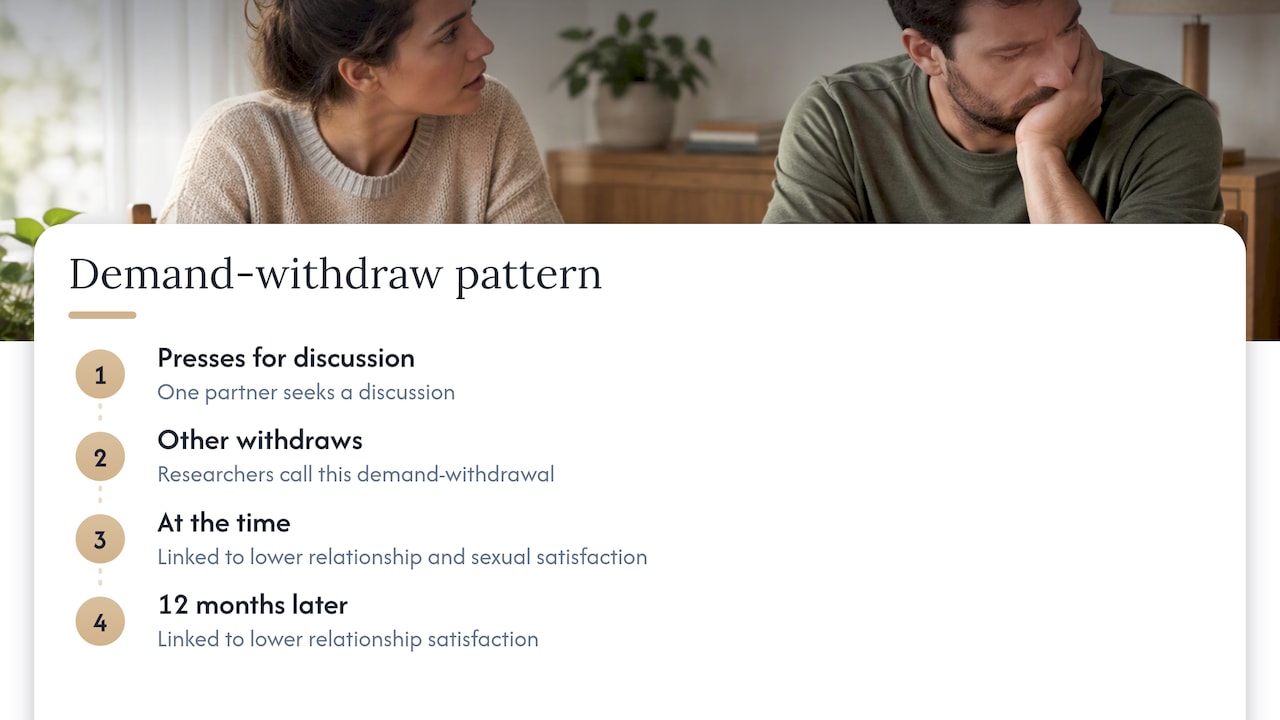
When one partner presses for a discussion and the other withdraws, researchers call it demand-withdrawal. The 2024 research cited above describes it as especially harmful to relationships. A report on research with 151 cohabiting couples in two Canadian cities found that higher demand-withdrawal during discussions of sexual conflict was linked to lower relationship and sexual satisfaction at the time, and lower relationship satisfaction 12 months later.
This is one reason it helps to be kind to the “pursuer” too. The partner who keeps pushing is usually not trying to start a fight. They are trying to feel connected, and silence feels like a closed door.
The quietest cost is emotional distance. You may share a home, a schedule and children, yet feel that your partner does not really know what is going on with you. That feeling is a common reason couples finally book a first session.
You do not need a perfect talk. You need a safer one. Try this sequence.
For a deeper toolkit, our guides on communication exercises for couples and scripts for the Gottman Four Horsemen give you words to use, and our article on setting couples therapy goals can help you decide what you want to change.
In our practice, we rarely meet couples who do not care. We meet couples who care so much about keeping the peace that they have stopped saying true things. Many tell us they came in because “we don’t even fight anymore,” and they say it with sadness, not pride.
We also think it matters not to treat avoidance as a character flaw. For some people it is a safety strategy learned in childhood or in a previous relationship. For veterans and first responders, shutting down can be a habit built to get through work that demands composure. We approach it with that context, not with a lecture.
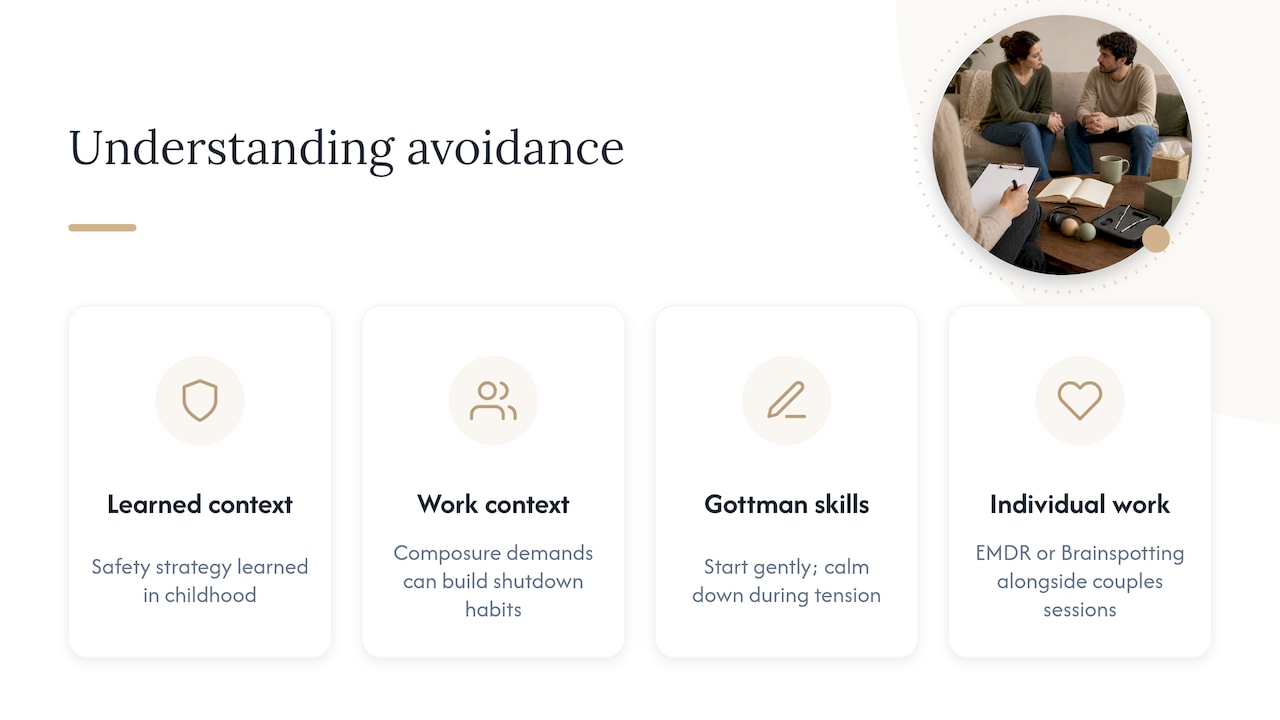
Our team works with approaches such as the Gottman Method, which gives couples concrete skills for starting conversations gently and calming down during tension. We pair these skills with a steady, collaborative pace. When past experiences keep one partner flooded, we may also recommend individual work, including trauma-focused therapies such as EMDR or Brainspotting, alongside couples sessions. Nothing here is rushed. The first goal is simply for each of you to feel safe enough to speak.
If you take one thing from this article, let it be this: a hard conversation handled imperfectly is usually better for a marriage than a perfect silence.
— Deane
Everything above assumes both of you are safe to speak. Avoidance is sometimes a sensible response to a partner who is controlling, threatening or violent. If you are afraid of how your partner will react, do not try to confront them using the steps in this article.
The Public Health Agency of Canada states that intimate partner violence can affect anyone, regardless of sex, gender identity, sexual orientation or relationship type, including married and common-law couples. It recommends safety planning: contacting trusted people or local services, identifying safe exits and places, gathering important items and protecting your digital privacy.
If you are unsure whether what you are experiencing counts as abuse, a counsellor can talk it through with you individually first. Couples sessions are not the right starting point when one partner is afraid of the other.
Consider reaching out if any of these sound familiar:
The Canadian Psychological Association says approaches such as Behavioural Marital Therapy and Cognitive Behavioural Couple Therapy help couples communicate more effectively and solve problems, while Emotion-Focused Couple Therapy addresses unmet emotional needs and promotes compassion. It also reports that in clinical trials most couples were more satisfied with their marriages by the end of treatment, with some studies finding gains still present two years later, or relationships continuing to improve. No therapist can promise an outcome, but the research gives good reason for hope.
Not sure whether it is too early or too late? Our pages on the signs you may need marriage counselling and on whether it is too late for couples counselling walk through those questions, and how couples counselling improves communication and connection explains what sessions are like.
We offer marriage and couples counselling in Calgary, with in-person and online options, and you do not need a physician referral. Every therapist offers a free 15-minute connection call, so you can ask questions and see whether the fit feels right before you commit. We direct bill a wide range of insurers, and we have evening and weekend availability, which helps when two work schedules have to line up.
If cost is a concern, our affordable counselling in Calgary is listed at $100 and affordable counselling in Red Deer at $80, as published on those pages. If one of you would like individual support alongside couples work, see our individual counselling in Calgary, or browse all our counselling services.
Big change comes from small, repeated attempts. Here is a gentle way to begin.
Week one: notice. Keep a private note of moments when you swallowed a comment or changed the subject. Do not act on them yet. Look for patterns: the topic, the time of day, how your body felt.
Week two: practice. Pick one low-stakes topic. Ask for a time, open with a feeling and a need, and agree on a break signal. Afterward, tell each other one thing that went well.
If the practice stirs up more than you expected, or if it stalls, that is useful information, not failure. It may be time to bring in a third person who can slow the conversation down.
No. A short, agreed break can calm a flooded nervous system and prevent hurtful words. It becomes a problem when it is permanent, when the issue never gets revisited, or when fear keeps you silent. The test is whether you return to the topic.
Soften how you start, choose a calm time and ask for a specific time to talk rather than demanding an answer now. Accept their request for a break as long as a return time is set. If pressing and withdrawing keep repeating, a couples therapist can help you both break the cycle.
Many can. Avoidance is a habit, not a verdict on the relationship. Couples who learn to raise issues gently and to take structured breaks often report feeling closer, and research on couple therapy reported by the Canadian Psychological Association shows most couples become more satisfied by the end of treatment.
At Supporting Wellness, you do not need a physician referral. You can start with a free 15-minute connection call to ask questions and meet a therapist before booking. We also direct bill many insurers, so check your coverage.
Treat that fear seriously. Do not push a confrontation. Make a safety plan, speak with a trusted person or service, and call 9-1-1 in an emergency. An individual counsellor can help you sort out your situation before any couples work.