
A speech delay means your child is following the usual path of speech development, just more slowly. A speech disorder means the development itself looks different from the typical pattern. That difference matters because a delay often closes with time and support, while a disorder usually needs targeted therapy. You can’t always tell which one you are seeing at home, and you don’t have to. A speech-language assessment is what answers the question.
If you are reading this because your toddler has fewer words than their cousin, or your five-year-old is hard for others to understand, you are in the right place. We will walk through the definitions, the signs that point one way or the other, what an assessment looks like, and how families in Calgary, Red Deer and Cold Lake can get help.
The clearest professional definition comes from the US Preventive Services Task Force. It describes a delay as a child developing skills in the typical sequence but at a slower rate than expected. A disorder is qualitatively different from typical development, often with atypical patterns such as skipping steps in the usual order of acquisition.
A simple way to picture it:
The same source notes that there is no universally accepted cut-off for calling something a delay. For research purposes, a score at least one standard deviation below the mean for a child’s age on a standardized test is often used. In real life, that means the line is a clinical judgment, not a number you can check with a milestone chart at home.
Parents often use “speech” for everything, and clinicians split it into parts. According to a children’s rehabilitation centre in Ontario, speech disorders involve the mechanics of producing sounds (articulation and phonology), fluency (stuttering) or voice and resonance. Language disorders affect understanding (receptive language) or using words and sentences to express thoughts (expressive language). The two can occur separately or together.
This is why “speech delay” and “language delay” are not the same thing:
| Speech | Language | |
|---|---|---|
| What it is | How sounds are produced and how smoothly words come out | Understanding what is said and using words to share ideas |
| Example of a delay | A four-year-old still says “wabbit” for “rabbit” | A two-year-old uses far fewer words than most peers |
| Example of a disorder | Sound errors that are unusual at any age, or persistent stuttering | Ongoing trouble understanding or building sentences despite good hearing |
| Who you may notice it | Strangers struggle to understand your child | Your child seems not to follow instructions, or can’t tell you what they want |
No list replaces an assessment, but these patterns help you describe what you see.
If several of these sound familiar, our article on signs your child might need a speech therapist goes through them in more detail. If you want to see what examples of language goals look like once a plan is made, this page of IEP-ready speech and language goal examples shows how clinicians and schools break communication skills into measurable steps.
A child who is learning two languages, or who speaks a different language at home, is not delayed because of that. A bilingual child may mix languages or have a smaller vocabulary in each one, and that is a language difference, not a disorder. A good assessment looks at all of the languages your child uses. Tell the therapist everything your child hears at home and daycare.
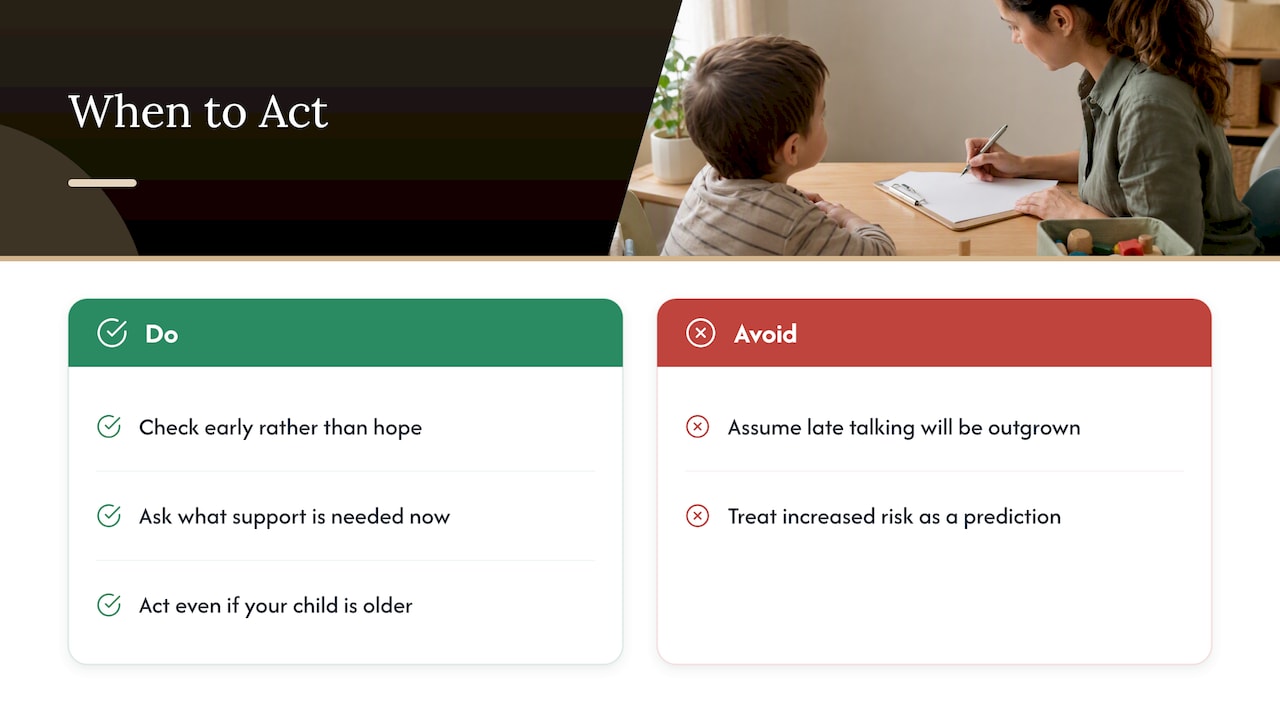
Many late talkers do catch up. That is true, and it is the reason so many families are told to wait. The problem is that nobody can know in advance which child is which. Speech-language experts writing for Expressable point out that late talking is not always outgrown, and that waiting for a persistent disorder to resolve can mean missed chances to improve academic, social and literacy outcomes.
The US Preventive Services Task Force also notes that school-aged children with speech or language delays may be at increased risk of learning and literacy difficulties. That is not a prediction for your child. It is a reason to check early rather than hope.
The Ontario children’s centre mentioned above adds that the first three years of life are the most significant window for language development. If your child is under three, an earlier look is usually better than a later one. If your child is older, it is still worth acting. Therapy works at every age, and it just has more ground to cover.
There is also a gentler way to think about it. An assessment does not automatically mean a permanent diagnosis. It is a way to find out what level of support your child needs right now, and that can change as they grow.
Before anyone decides between delay and disorder, your child’s hearing should be checked. Hearing loss is among the most common causes of language delay, according to Expressable. Passing a newborn screening does not rule it out forever, because hearing can change over time, for example after repeated ear infections.
A hearing test is quick and painless. If the result shows a hearing problem, the speech picture often looks very different. If the result is normal, you can move on knowing that one possible cause has been cleared.
A speech-language assessment looks at more than how your child says words. Clinicians assess speech, language and communication needs to decide whether therapy is needed and what kind. In practice, you can expect:
If learning, attention or other developmental questions are mixed in, a broader look may help. Our team also offers psychoeducational assessments for children whose communication concerns overlap with school or attention difficulties.
Therapy for young children is usually built around play. Parents are often surprised that it does not look like a classroom. Many therapists see their role partly as coaching you: showing you how to model words, expand on what your child says and build practice into daily routines like bath time and meals.
The approach depends on the problem:
Confidence is a real part of the picture. A child who is hard to understand may stop trying. We write about this in how speech therapy can boost your child’s confidence in school and social situations.
We see many parents who arrive worried and a little embarrassed, as though they waited too long or are overreacting. Neither is true. A parent’s sense that something is off is a good reason to ask a question, and the question is all it takes to begin.
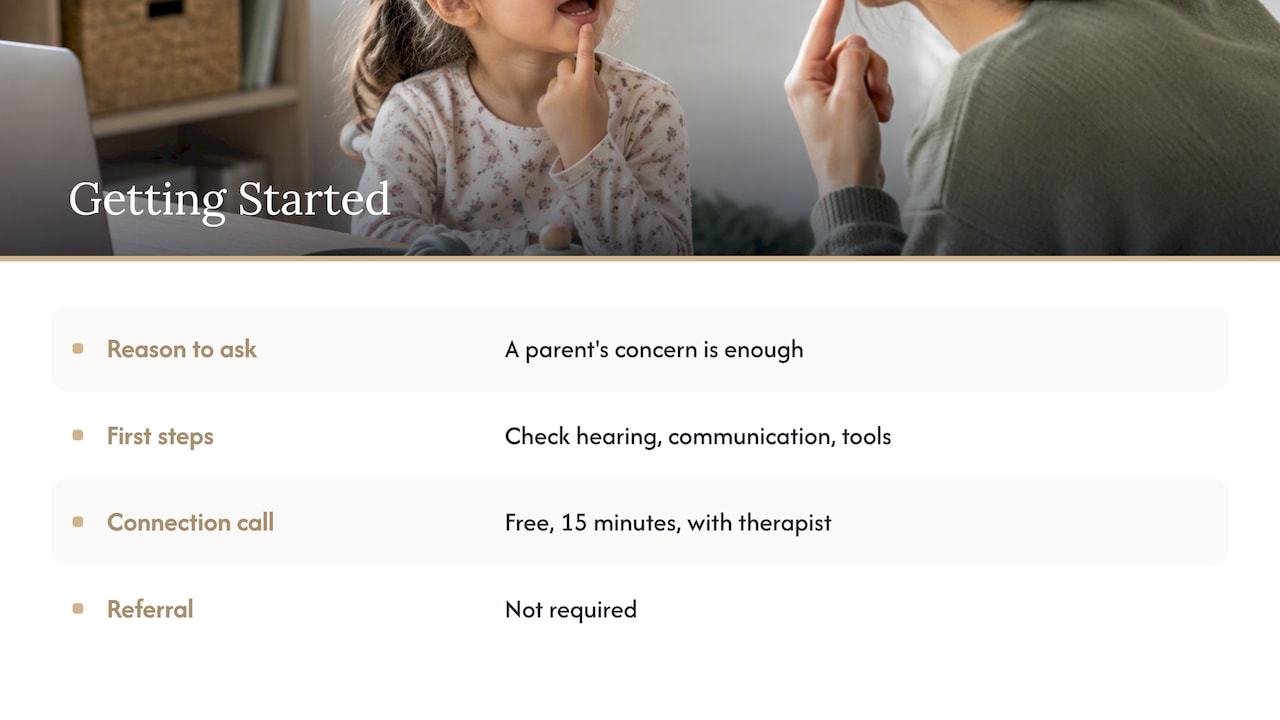
Our view is that the delay-or-disorder label matters less on day one than the plan that follows it. Whatever the label turns out to be, the first steps are similar: check hearing, understand how your child communicates, and give them and you some tools. That is why we offer a free 15-minute connection call with every therapist. It lets you describe what you see, ask how an assessment works and decide whether we feel like the right fit before you commit to anything. You don’t need a physician referral to start.
We also work with the whole family. Communication is not only a child’s job. Siblings, parents and grandparents all shape the language a child hears, and our practice is collaborative and family-oriented, with a multidisciplinary team. When a child’s speech concerns come with anxiety, attention difficulties or learning struggles, having those teams in one place makes it easier for you.
— Deane
Families in Alberta usually have several routes: school-based services, private speech-language pathologists, and government programs. Each fits a different situation.
If your child has a chronic diagnosis, apply early. Applications can take time to process, and private therapy can bridge the gap in the meantime, even though it is paid out of pocket or through insurance.
We offer speech therapy in person and online. You can read about the service at speech therapy in Calgary or, if you are farther north, speech therapy in Cold Lake. Our offices are in Calgary, Red Deer and Cold Lake, with evening and weekend availability, and we direct bill a wide range of insurers.
You don’t need to prepare much, but a few notes help:
For more on timing, our guide on when to see a speech therapist covers children and adults.
If you are still unsure whether you are looking at a delay or a disorder, start with a conversation. Our free 15-minute connection call is a low-pressure way to describe what you see and find out what an assessment would involve. You can explore our full list of services or head to our home page to get in touch.
Some children do catch up, particularly those with a simple delay and good understanding of language. Others have a disorder that persists without therapy, and it is hard to tell the two apart at home. An assessment tells you whether to watch and wait or to start support now.
Children vary a lot at this age, so a small vocabulary alone is not always a concern. It is still worth a hearing check and a conversation with a speech-language professional, especially if your child does not seem to understand simple requests, does not gesture, or has lost words they once used. At this age, early support does not cost much and may help a great deal.
Not with us. You can book a free 15-minute connection call and an assessment without a physician referral. Some government programs have their own requirements, so check those separately.
Speech and language difficulties can occur separately or together. A child can have a language problem along with speech sound errors, or a delay that turns out to be part of a larger pattern. An assessment looks at each area so that therapy targets the right ones.
No. An assessment is a way to work out what level of support your child needs, and that can be adjusted as they develop. Many children make significant progress with therapy and parent involvement.