
If your child is not talking as much as other children their age, you are probably wondering whether this is a speech delay, autism, or something else. The short answer: a speech delay means a child is learning to talk later than expected, while autism is broader and affects how a child connects, communicates and plays. A child can have a speech delay without being autistic, and some autistic children also have a speech delay. Only a qualified assessment can tell which applies, and you do not have to wait for a diagnosis to start helping your child talk. At Supporting Wellness, our speech therapy services and free 15-minute connection calls are a gentle first step.
A speech delay is when a child is developing speech later than most children of the same age. Speech is how sounds and words are produced. Language is the wider skill of understanding and using words to share ideas. Some children are late with speech, some with language, and some with both. If you want a closer look at how a delay differs from a speech disorder, our guide on speech delay versus disorder explains it.
According to Alberta Health Services, speech and language delays can be caused by hearing problems, Down syndrome or other genetic conditions, autism spectrum disorder, cerebral palsy or mental health conditions. They can also run in families, and sometimes the cause is not known. The same page notes that many children can overcome speech and language problems with treatment such as speech therapy.
So autism is one possible reason for a delay, not the default one. That matters, because many parents who type this question into a search bar are frightened by the idea that late talking equals autism. It does not.
Autism spectrum disorder is a difference in neurodevelopment. It shapes how a person communicates, relates to others and experiences the world. It is a spectrum, so it looks different from child to child. The Public Health Agency of Canada reports that, according to the 2019 Canadian Health Survey on Children and Youth, about 1 in 50 children and youth aged 1 to 17 had been diagnosed with autism.
Delayed babbling or talking is often the first thing parents notice. A European practice guidance summary states that although speech delay is not specific to autism, delays in babbling and talking are often the first signs that raise parents’ concerns. It lists other early signs: delays in pointing and gesturing, not responding to their name, and poor eye contact. It also notes that difficulties with peers and unusual repetitive behaviours may not be obvious in the first two to three years, so their absence in a very young child does not rule autism out.
That last point is why it is hard to sort this out at home. Two toddlers can both have ten words at age two, and one may be on a late-talker path while the other is showing early signs of autism. The difference is often in everything around the words.
This table is a general guide to what professionals look at. It is not a diagnostic tool, and many children do not fit neatly in one column.
| What you notice | More typical of a speech delay alone | More often seen alongside autism |
|---|---|---|
| Gestures and pointing | Uses gestures, points and waves to get needs across | Points, waves or gestures less, or not at all |
| Response to name | Usually turns when called, if hearing is normal | May not respond consistently to their name |
| Eye contact and shared attention | Looks to you and shares attention with toys and people | May look at you or share attention less |
| Play | Plays with toys in varied ways and enjoys back-and-forth games | May prefer repetitive play or lining things up |
| Interest in other children | Watches and wants to join in, even without words | May show less interest in peers |
| Understanding | May understand much more than they can say | Understanding can also be affected |
| Routines and senses | Adapts to changes with usual toddler protests | May be very distressed by small changes or particular sounds and textures |
The ESCAP guidance above supports the key idea behind this table: pointing, gesturing, response to name and eye contact are the early social signals clinicians watch for alongside speech. Hearing also needs checking in every child, because a child who cannot hear well may not respond to their name or develop speech on schedule.
Alberta Health Services lists these signs of a speech or language delay, and advises you to talk with your doctor if your child is not meeting them on schedule:
Alberta’s developmental testing page adds that no babbling, pointing or other gestures by 12 months, no single words by 16 months, and no spontaneous two-word phrases by 24 months should trigger an evaluation. Repeated phrases (echolalia) do not count as spontaneous phrases. Not walking by 18 months is on the list too, along with any loss of language or social skills at any age.
The Canadian best practice guidelines on autism add a reassuring note: a single missed milestone may not be a concern unless it involves a loss of language, but attention is needed when more than one is missed. If your child lost words or skills they once had, do not wait. Contact your doctor promptly.
We also have a plain-language list of signs your child might need a speech therapist and a guide to when to see a speech therapist if you want more examples.
It is not either/or. The American Speech-Language-Hearing Association explains that a spoken language disorder can occur on its own or alongside other conditions, and that clinicians use wording such as a language disorder associated with autism when the language difficulty sits alongside an autism diagnosis. The Public Health Agency of Canada’s autism framework also lists speech and language problems among the conditions that can occur with autism in Canadian youth, along with ADHD, learning disabilities and anxiety.
If ADHD is also on your mind, our article on whether ADHD is on the autism spectrum explains how the two overlap and differ.
The practical point: a child who has both needs support for both. Speech therapy helps with communication whether or not autism is part of the picture.
The usual starting point is your child’s doctor. Alberta Health Services explains that the doctor reviews milestones, does a physical exam and may refer your child to a speech-language pathologist if a problem is suspected. A speech-language pathologist is a clinician trained to assess and treat speech, language and communication. Testing may include a hearing test to rule out hearing loss, a check of speech sounds, and a review of speech, language and motor development.
For autism specifically, Alberta notes that the Canadian Paediatric Society recommends developmental testing at routine checkups, with autism-specific checks usually at 18 and 36 months using questionnaires. Children with a sibling who has autism are screened more often.
A diagnosis is a fuller process. The Canadian Paediatric Society’s clinical recommendations say that in most provinces and territories, physicians, including paediatricians, and psychologists are licensed to diagnose autism. Its eight components include a review of records, an interview with the family, direct assessment of core autism features, a physical exam, consideration of other explanations such as hearing or language disorders, and a plan for next steps. Our overview of autism assessments and what families need to know walks through what to expect.
Two realities are worth knowing. An Ontario evidence review notes that more than 80% of children with autism show clear behavioural signs by age 2 and diagnosis can be made reliably that early, yet the average age at diagnosis is about four. And the Public Health Agency of Canada reports that wait times for diagnosis and publicly funded services vary across provinces. Neither is a reason to hold back. Raising your concern early is how you get into the queue sooner.
You do not need a diagnosis to help a child communicate. A Canadian developmental surveillance paper states that interventions should begin while a child awaits a definitive diagnosis, with speech-language pathologists, audiologists and psychologists each assessing their own area.
Alberta’s autism patient pathway summary points families of children with developmental concerns to several routes:
The details are in Alberta’s autism pathway summary, and the current rules are on the official pages.
In practice, speech therapy often runs alongside these. A therapist works on the sounds, words and back-and-forth communication your child is ready for, and shows you how to build those skills into daily routines: mealtimes, bath time, play. Your day-to-day involvement is what makes sessions stick.
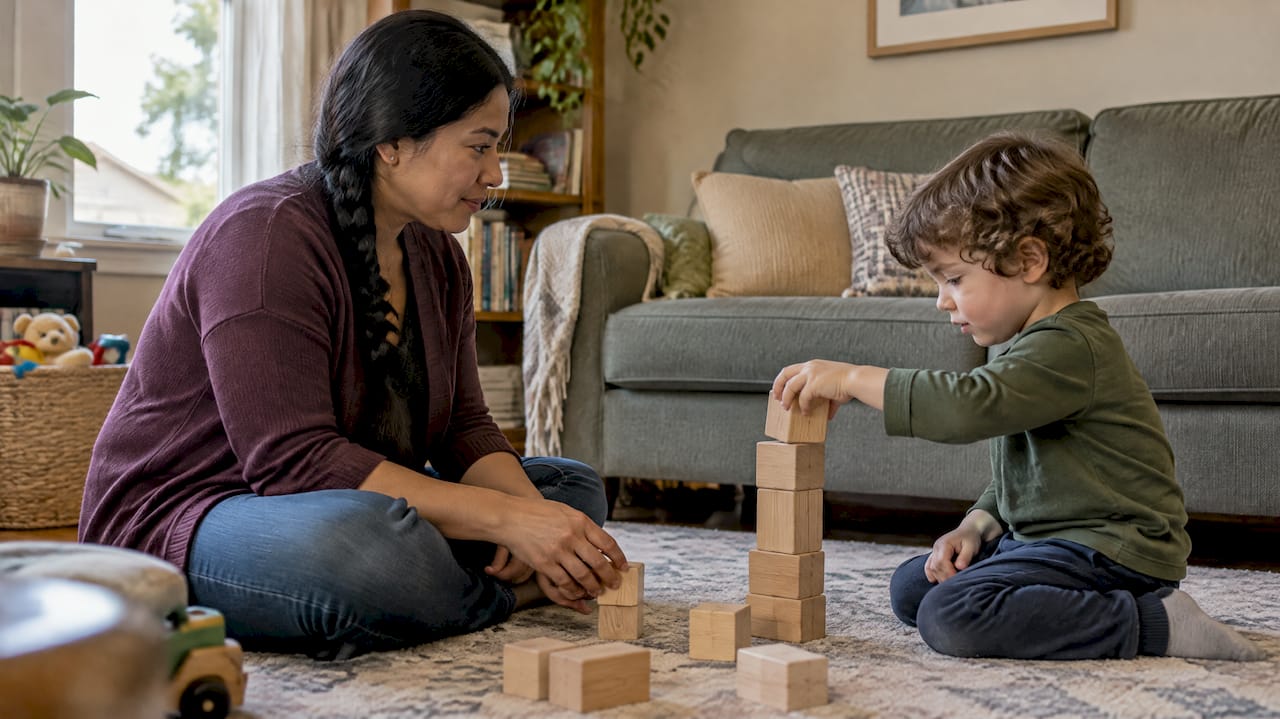
By five, a child who is still hard to understand or who uses short, incomplete sentences deserves a closer look, even if nobody has raised it before. At this age, parents also often describe frustration, meltdowns, difficulty making friends or trouble in a classroom. These can be a child’s response to not being understood, and they can also point to other needs such as attention, anxiety, hearing or learning differences.
The useful question is not which label fits. It is what is behind the behaviour. If frustration is frequent, if your child withdraws from other children, or if the school has noticed difficulties, talk to your doctor and the school team and ask about a speech-language assessment. A psycho-educational assessment looks at learning, attention and thinking skills, and can show where a child needs support. We offer both speech therapy and psycho-educational and ADHD assessments, so the pieces can be looked at together.
Supporting Wellness offers speech therapy for children, as well as child and adolescent counselling, family counselling, psycho-educational assessments and ADHD assessments, in person in Calgary, Red Deer and Cold Lake, and online. If you are not sure where to begin, every therapist offers a free 15-minute connection call, so you can describe what you are seeing and see whether we are a good fit. No physician referral is needed, we offer evening and weekend availability, and we direct bill a wide range of insurers.

You can see everything we offer on our services page, or reach us through Supporting Wellness to book a call. If your child is in Red Deer, our child psychologist page is a good place to start.
When parents come to us worried about late talking, the question under the question is usually: did I miss something? You did not. Speech and language development has many paths, and noticing a difference is exactly what a caring parent does.
We believe the best first step is a conversation, which is why we offer a free 15-minute connection call with every therapist. You can say what you are seeing, ask how therapy works and decide whether it feels right, before anything else is asked of you.
Our practice is collaborative and family-oriented, and our multidisciplinary team brings speech therapy, counselling and assessment services under one roof. A child’s communication is tied to how they feel, learn and connect with the people around them, so we look at the whole child and the whole family, not only the words.
Whatever the eventual answer is, speech delay, autism, or both, communication support helps, and it can start now.
Deane
Yes. Speech delays have many causes, including hearing problems, genetic conditions and family patterns, and sometimes no cause is found. Many children improve with speech therapy. A child who communicates through gestures, responds to their name and enjoys sharing attention with you is showing strengths that professionals look for.
No. Delayed talking is one of the first things parents notice in autism, but it is not specific to it. Clinicians look at the whole picture, including gestures, response to name, eye contact and play, along with hearing and language testing, before reaching any conclusion.
It varies from child to child and depends on the cause and the support your child receives. Some children catch up with therapy, while others need ongoing help with language. A speech-language assessment can give you a clearer picture for your child, and starting early gives them more time to build skills.
Raise it with your doctor whenever you are concerned. Alberta’s guidance points to no babbling by 9 months, no first words by 15 months and no word combinations by age 2 as reasons to talk with your doctor. Any loss of words or social skills at any age should be raised right away.
No physician referral is needed to book with us. You can start with a free 15-minute connection call, and we direct bill a wide range of insurers.