
Most children coo by about 2 months, babble by about 6 months, say a first word around their first birthday, and put two words together by about 2 years. Those are the main speech and language milestones to watch for, and children reach them at different speeds. This guide walks through each age, shows you the signs that deserve a closer look, and explains what you can do at home and when to ask a speech-language professional.
If you are reading this because something about your child’s talking has been on your mind, that instinct is worth listening to. Checking in early is a calm, practical step, and it usually brings reassurance or a clear plan.
People often use “speech” and “language” as if they were the same thing. Clinicians separate them. HealthLink BC describes speech as making the sounds that become words, and language as using words and gestures to communicate and to understand others.
Language has two sides, according to AboutKidsHealth:
This matters because a child can understand a great deal and still say little, or the other way around. A milestone check looks at all three: the sounds, the understanding and the sharing.
Different health organizations word their milestones a little differently, and the numbers below come from several Canadian and international sources. Treat them as a map of the typical path, not a test your child must pass on a given day.
Your baby is already tuned in to voices. HealthLink BC notes that learning starts in the womb, where babies hear and respond to familiar voices. By 3 months, Alberta’s Talk Box resource says a baby responds to sound by startling, blinking, crying or quieting. ASHA’s examples for this stage include quieting or smiling when you talk. Cooing usually begins at about 2 months.
Sounds become more varied. ASHA lists vocalizing different vowel sounds in this window. By 6 months, AboutKidsHealth says a child turns toward where a sound is coming from and coos or babbles with simple sounds. Alberta’s Talk Box adds interest in voices and music and babbling like “mama” and “gaga”.
This is the stretch where babbling becomes conversation-like. ASHA’s milestone for 7 to 9 months is babbling long strings of sounds. By 9 months, AboutKidsHealth says a child responds to their name and repeats sounds. From 10 to 12 months, ASHA lists pointing, waving, and showing or giving you objects.
By 12 months, AboutKidsHealth reports consistent use of three to five words and following simple one-step directions. Alberta’s Talk Box says first words like “mama” or “dada” may appear by this age.
Understanding runs ahead of talking. HealthLink BC says a typical toddler at 15 to 18 months understands much more than they can say. ASHA lists following directions at 13 to 18 months and putting two or more words together at 19 to 24 months.
AboutKidsHealth gives these vocabulary markers:
HealthLink BC uses a more cautious floor, saying that by 24 months children tend to use at least 50 words and are starting two-word phrases. Both can describe a typical child, which shows how wide the normal range is.
Vocabulary grows quickly. AboutKidsHealth reports more than 350 words by 2.5 years. By 3 years, sentences run five to eight words, and people outside the family understand your child most of the time. ASHA’s milestone for 2 to 3 years includes saying their own name when asked.
HealthLink BC points out that the fastest learning of speech and language happens between ages 2 and 5.
Speech turns into storytelling. ASHA lists telling a story from a book or video at 3 to 4 years, and recognizing and naming 10 or more letters, plus usually writing their own name, at 4 to 5 years. By 5, Alberta’s Talk Box says a child understands words for colours, shapes, locations, textures, time and numbers, uses past, present and future tenses, and retells a story by naming the characters.
| Age | What you may hear or see |
|---|---|
| 2 months | Cooing |
| 6 months | Babbling, turning toward sounds |
| 9 months | Responds to name, repeats sounds |
| 12 months | First words, 3 to 5 used consistently, follows simple directions |
| 18 months | Around 20 words, follows directions |
| 24 months | At least 50 words, two-word phrases |
| 3 years | Sentences of 5 to 8 words, mostly understood by others |
| 4 to 5 years | Tells stories, names letters, uses past and future tenses |
A lot. HealthLink BC says some children are advanced, others develop more slowly, and mild, temporary delays can happen. ASHA explains that its checklists show the age ranges when 75% of children demonstrate a skill, and that skills develop over time rather than on an exact birthday. That is why a milestone reads “7 to 9 months” and not “7 months”. ASHA also reminds families that each child develops differently, even within the same family.
The Association québécoise des neuropsychologues adds that even among children whose language is developing typically, the pace varies quite a bit.
So a late talker is not automatically a child with a problem. But the same variation is the reason a professional check is useful: it separates a child who is taking the scenic route from a child who needs extra support. Our article on speech delay versus disorder explains the difference in more detail.
HealthLink BC’s list of red flags is a useful reference. Consider an assessment if you notice:
For kindergarten-age children, AboutKidsHealth adds trouble learning songs and nursery rhymes, difficulty expressing thoughts after age 3, immature grammar, trouble answering “why” questions, and trouble retelling a familiar story.
If your child is not saying words by 18 months, or says fewer than 50 words by 24 months, HealthLink BC advises talking with your doctor. It also says every child with a speech delay should have their hearing tested, so it is worth asking for that early. A sudden loss of skills is a reason to contact your doctor promptly rather than wait.
Some factors raise the chance that a child will need support. Prince Edward Island’s Help Me Grow brochure lists parental concern, premature birth (before 37 weeks), low birth weight, a family history of speech, language or learning problems, a family history of hearing loss, and a history of ear infections. Parental concern is on that list for a reason. You know your child best.
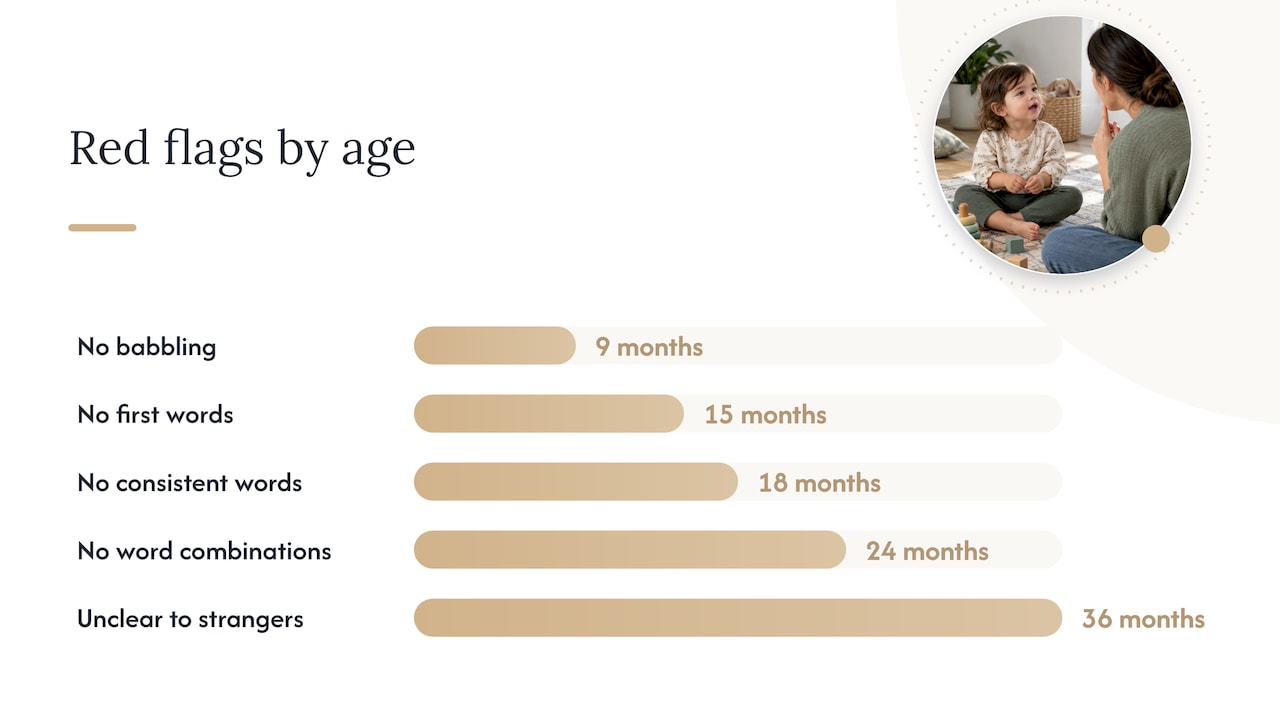
A 2012 paper in a Canadian physicians’ journal states that failing to recognize and act on delays early can have serious consequences for early development and later literacy, and that long waits for consultation are valuable lost time. Speech-Language & Audiology Canada notes that about 11 to 12% of children have a speech sound disorder at school entry, and about 10% a language disorder. You are far from alone.
The Thames Valley Children’s Centre also notes that even speech-language pathologists cannot predict whether a child will improve without therapy, so an assessment is the dependable way to find out. Our guide to the signs your child might need a speech therapist and our page on when to see a speech therapist go through the questions parents ask most.
You do not need special equipment. HealthLink BC’s advice is simple, and it works from the first weeks:
HealthLink BC also says the size of a 2-year-old’s vocabulary is directly related to how much caregivers have talked to the child since birth, and that Canadian experts advise avoiding screen time for children under 2.
Alberta’s Everyday ideas for supporting speech suggests several habits that fit into any routine:
Say your toddler points at a “cah” on the road. You answer, “Yes, a car! A red car. The car is going fast.” You have modelled the word three times without any pressure.
Talking with other children matters too. Once your child is ready for playdates and group activities, these tips on helping kids make friends show how conversation practice can carry into friendships.
Speech-language pathologists (SLPs) are the professionals who assess and treat communication difficulties. Ontario’s regulator, CASLPO, explains that SLPs work with children who are slow to start talking, cannot pronounce certain sounds, stutter or have trouble understanding. Speech-Language & Audiology Canada says SLPs have primary responsibility for identifying, assessing and supporting children with communication disorders.
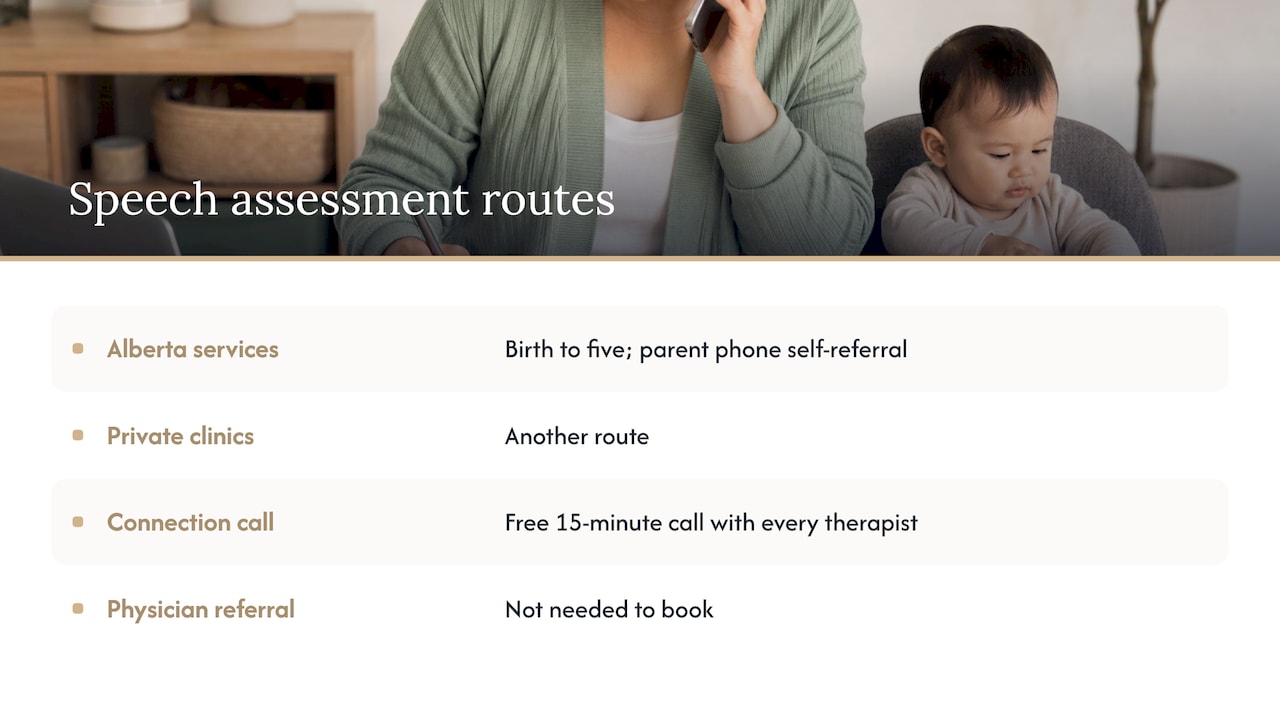
In Alberta, Alberta Health Services lists preschool speech and language services for children from birth to five, with parent self-referral by phone. Services vary by zone, so confirm the details for your area. Private clinics are another route, and the one we can speak to.
Our perspective
We meet many parents who have waited months because they were told, kindly, that their child would catch up. Sometimes that turns out to be true. But we believe a parent should not have to carry that question alone. A child’s speech does not develop in isolation: it connects with hearing, attention, confidence, play and how safe they feel with other people.
That is why our practice is collaborative and family-oriented. Our multidisciplinary team includes speech therapy alongside child and adolescent counselling and psycho-educational and ADHD assessments, so if your child’s needs reach beyond speech, you do not need to start again somewhere new.
We also offer a free 15-minute connection call with every therapist. It is a low-pressure way to describe what you are noticing, ask questions and find out whether we are the right fit. You do not need a physician referral to book.
Deane
If your child’s speech is on your mind, we are glad to talk it through. We offer speech therapy for children, along with child and adolescent counselling and psycho-educational assessments, and we have evening and weekend availability and direct billing with a wide range of insurers. Our clinics are in Calgary, Red Deer and Cold Lake, and we also offer online sessions.
Start with a free 15-minute connection call. You can see everything we offer on our services page. In the north, read about our speech therapy in Cold Lake. If you are wondering how therapy can help your child at school and with friends, see how speech therapy builds confidence. If your concerns go beyond speech, such as attention or learning, our psychoeducational assessments in Calgary are another option.
By 24 months, HealthLink BC says children tend to use at least 50 words and are starting two-word phrases. AboutKidsHealth gives a range of 100 to 150 words with two- to four-word combinations. Children understand more than they say, so also watch whether yours follows simple directions.
Some variation is normal, and mild, temporary delays happen. Milestones are given as ranges because skills build over time. If you are past a red flag, such as no words by 18 months, or you are simply worried, an assessment gives you a clear answer.
It depends on the service. At Supporting Wellness, you do not need a physician referral to book. Public programs have their own rules, so confirm them for your area. Your doctor is also the right person to ask about a hearing test.
Yes. HealthLink BC advises that all children with a speech delay should have their hearing tested, because hearing affects how children learn sounds and words. Ask your doctor about it as early as you can.
Talk through daily routines, read and sing together, turn off screens during play, and wait for your child to take a turn. Repeat target words several times in conversation, and say any mispronounced word back correctly without pressure.