
Therapy for oppositional defiant disorder (ODD) works best when parents are part of it. The core treatment is parent training. It is often combined with individual therapy for the child or teen, family therapy and, when another condition is present, treatment for that condition. If you are worn out by daily power struggles, this is a treatable pattern. You do not have to wait for things to get worse before asking for help.
Below, we explain what each type of therapy involves, how treatment changes by age, when medication comes into the picture, and how to take a first step.
ODD is a persistent pattern of angry, defiant and argumentative behaviour, especially toward authority figures. Therapy does not aim to make a child obedient through pressure. It aims to change the patterns between a child and the adults around them, and to build the child’s skills for handling frustration.
According to the Mayo Clinic, treatment usually includes parenting skills training, parent-child interaction therapy (PCIT), individual and family therapy, problem-solving training and social skills training. Which of these are used, and in what order, depends on the child.
The Canadian eMentalHealth.ca primary care guide describes a starting point many families find reassuring. The clinician builds a working relationship with both parent and child. Then everyone agrees on goals they all share, such as getting along better at home. Programs it names include the Incredible Years Program, Triple P parenting and Collaborative Problem-Solving. These can be delivered in groups or by individual therapists.
The Merck Manual (Canadian professional edition) says the initial treatment of choice is a rewards-based behaviour-modification program. It also notes that many children benefit from group therapy that builds social skills, and that family-based approaches are effective too.
If you read only one section, make it this one. A Canadian position statement on disruptive behaviour in preschool children recommends evidence-based parent behaviour training as the usual first-line intervention for significant disruptive behaviour. It also says children whose problems are complicated by other conditions, or who do not respond to first-line help, should be referred to more intensive specialized services.
The evidence behind it is strong. A review summarized by MDedge looked at 16 randomized controlled trials of training programs for children aged 3 to 10 with externalizing problems. Parents reported that their children’s problems decreased by between 0.6 and 2.9 standard deviations from before to after treatment. That article is from 2005, but it shows the size of the effect researchers have measured.
The eMentalHealth.ca guide lists what parent management programs commonly teach. On the positive side:
On the side of reducing negative parenting:
The American Academy of Child and Adolescent Psychiatry (AACAP) practice parameter explains the logic in its parent management training recommendation. Parents reduce the reinforcement of disruptive behaviour and increase reinforcement of cooperative, prosocial behaviour. They apply consequences for disruptive behaviour. Their response becomes predictable, contingent and immediate.
In plain terms, a child with ODD often gets the most reaction from the adults when things go badly. Parent training shifts attention and energy toward what is going well. That is not a judgment of your parenting. Many capable, loving parents have never been taught these specific skills, because they are not what typical children need.
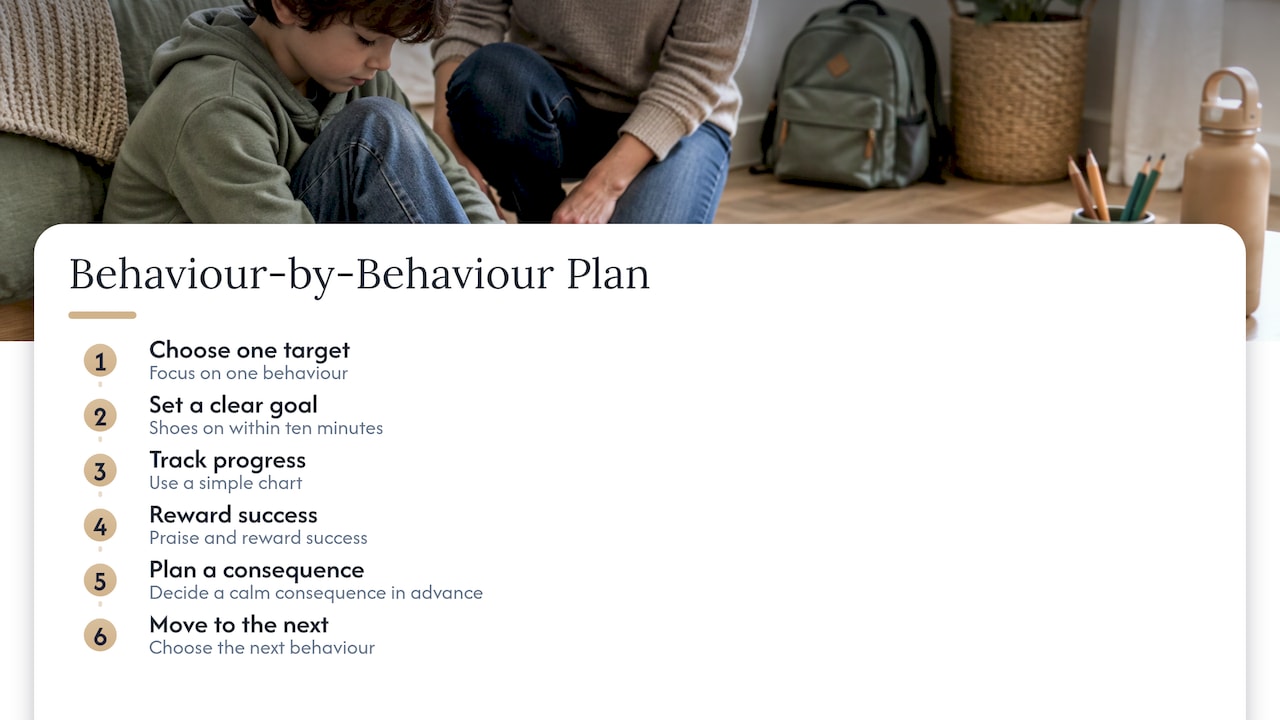
Imagine a 7-year-old who refuses to put shoes on every school morning, and the routine ends in shouting. A therapist would not start with all the problems at once. Together you might choose one target: getting shoes on within ten minutes. You define it clearly, track it on a simple chart, praise and reward success, and decide ahead of time what calm consequence follows if it does not happen. Once that works, you move to the next behaviour. This is the “one behaviour at a time” principle at work.
Our parenting counselling page describes how we support caregivers who want to strengthen the bond with their children.
Parent training changes the environment. Individual therapy builds the child’s own skills. According to the Mayo Clinic, individual therapy may help a child learn to manage anger and express feelings in healthier ways.
The 811 Nova Scotia health guide says treatment focuses on helping the child manage anger and handle social situations. It names cognitive behaviour therapy (CBT) as one approach in which children and families learn problem-solving skills and how to feel more positive.
In practice, individual sessions might cover:
Children practise between sessions. Short CBT tools and homework ideas can help keep those skills fresh, and a therapist can match them to your child’s age and interests.
An honest note on the evidence: the AACAP practice parameter says parent training is the best-supported option, along with problem-solving skills training for the child. For some other individual approaches, recommendations rest more on clinical experience and consensus than on large trials. This is one reason a good plan combines individual work with parent involvement rather than relying on either alone.
The Mayo Clinic says family therapy may improve communication and relationships and help family members work together. The eMentalHealth.ca guide adds that counselling is especially valuable when there is conflict or relationship difficulty between the child and a parent.
Family sessions are useful when:
The 811 Nova Scotia guide lists several risk factors that families sometimes face: inconsistent discipline, little supervision, instability such as divorce, multiple moves or changing schools, financial problems, exposure to violence, and a caregiver with a mood disorder or substance use difficulties. These are not blame. They are signs of where support may be needed, and a family approach can address the whole picture.
If a separated household is part of your situation, our page on co-parenting counselling covers skills for parents who live apart. If one family member is struggling and everyone feels it, this family counselling page explains how we involve the whole household.
The AACAP ODD guide and its FAQ describe how the emphasis shifts as children grow.
| Age group | Main emphasis | Often added |
|---|---|---|
| Preschool | Parent education and training | Parent-child interaction work |
| School age | Parent management training | School-based interventions, individual therapy, family-based treatment |
| Adolescents | Individual therapy | Family intervention and parent-management training |
The principle underneath is that there is no single treatment for every child. The most effective plan is individualized to the child’s age, the severity of the difficulties, and the goals, resources and circumstances of the family.
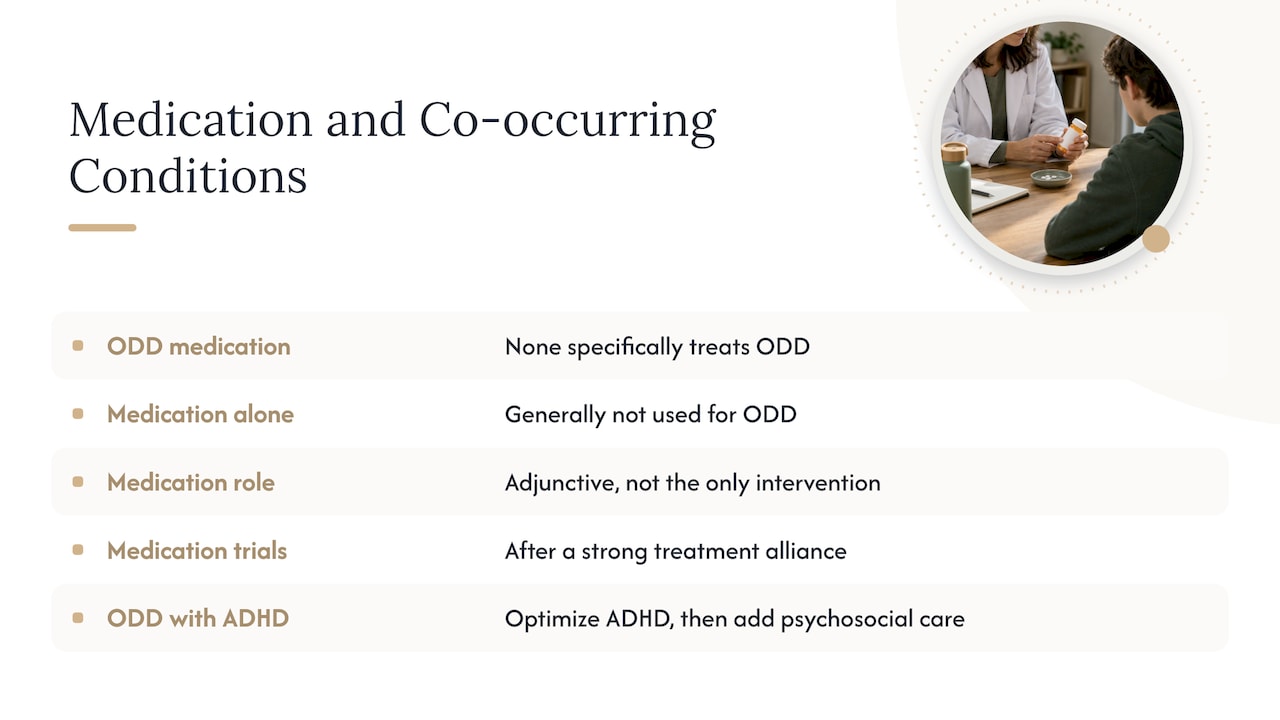
No medication specifically treats ODD. The Mayo Clinic notes that medicines alone are generally not used for ODD unless the child also has another condition such as ADHD, an anxiety disorder or depression. AACAP’s practice parameter says medication is mostly adjunctive and should not be the only intervention, and that medication trials work best after a strong treatment alliance is in place.
This matters because ODD rarely travels alone. The Mayo Clinic stresses treating any other problem, including a mental health condition or a learning disorder, since untreated conditions can cause or worsen ODD symptoms.
ADHD is the most common pairing. The Canadian ADHD Practice Guidelines from CADDRA say treatment of ODD with ADHD should be multimodal. The first step is optimizing ADHD treatment to stabilize reactive, irritable symptoms, followed by adding psychosocial treatment such as parent management training, CBT or Collaborative Problem-Solving. Medication decisions belong to your child’s physician or psychiatrist. If ADHD may be part of the picture, our guide to family therapy for ADHD in Canada explains practical steps.
The same guidelines note that ODD was a precursor to conduct disorder in about half of cases in one study, and that effective treatment may reduce later risks, including conduct disorder, substance use disorder and depression. They also stress telling ODD apart from conduct disorder, where a child repeatedly violates the rights of others or age-appropriate social norms. That is a reason to seek an assessment early rather than wait.
Expect months, not weeks. The AACAP FAQ says treatment must run an adequate length of time, usually several months or longer, and may need repeat episodes or periodic booster sessions. The Mayo Clinic gives a similar timeline.
Progress should be visible, not guesswork. According to the information AACAP summarizes, parents learn to observe and record behaviour, often on a progress chart. With that data the therapist and parents set goals and measure change. If you are tracking one behaviour at a time, you will see progress in specific terms: fewer morning battles, shorter outbursts, more days of cooperation.
The Mayo Clinic advises seeking help from a child psychologist or child psychiatrist with expertise in behaviour problems if you think your child may have ODD, or if you are concerned about your ability to parent a challenging child. It also suggests asking your child’s health care provider for a referral. You do not have to wait for a diagnosis to talk to a therapist about what is happening at home.
If anyone in your family has serious thoughts of suicide or of harming others, go to emergency care right away. For questions about ODD in the meantime, the 811 Nova Scotia guide notes that registered nurses are available by phone at 811 around the clock. Check your own province’s health line for local access.
Parents often arrive at our clinic exhausted, and a little ashamed. They have tried everything they know. The first thing we want them to hear is that a child’s defiance is a pattern we can work on together, and that asking for help is a strength.
Our approach is collaborative and family-oriented. We believe lasting change comes when a child gets support, and the adults around them get skills and understanding too. That is why our multidisciplinary team offers child and adolescent counselling, family counselling and parenting counselling under one roof, and why we are glad to look at the wider picture, including ADHD, anxiety or trauma, when it shapes a child’s behaviour.
We also know the first call is the hardest. That is why every therapist offers a free 15-minute connection call, so you can ask questions and see whether we feel like the right fit before you commit to anything.
Deane
Supporting Wellness Psychological & Family Services offers child and adolescent counselling, family counselling, parenting counselling and ADHD assessments, in person in Calgary, Red Deer and Cold Lake, and online. You can see everything we offer on our services page.
A few practical points that remove common barriers:

If you live in Calgary, start with individual counselling and therapy or family counselling in Calgary. Details for Red Deer are on our affordable counselling page, and families in Cold Lake can see family counselling in Cold Lake. Book a free connection call to talk through what you are seeing at home.
For many younger children, parent training is the main treatment. Canadian guidance describes it as the usual first-line approach for significant disruptive behaviour. Older children and teens often add individual therapy, and a clinician decides the mix after assessing your child and family.
Many children improve with consistent treatment, and the earlier it starts, the better the outlook. Treatment usually takes several months or longer, and some families return for booster sessions. A clinician can tell you what to expect for your child’s specific situation.
No medication treats ODD itself. Medication may be considered when your child also has a condition such as ADHD, anxiety or depression. That decision is made with your child’s physician or psychiatrist, alongside therapy.
Starting with the parents is a workable option, since parent training is the foundation of treatment and does not depend on the child’s cooperation at first. Therapists also work to build trust with the child and to agree on goals that matter to them, such as less arguing at home.