
If your teenager seems persistently low, irritable or withdrawn, therapy is a reasonable and well-supported first step. The treatments with the strongest evidence for adolescent depression are talk therapies, mainly cognitive behavioural therapy (CBT) and interpersonal therapy for adolescents (IPT-A). Medication is sometimes added for moderate to severe cases, and only after a proper assessment. This guide explains how to tell depression from ordinary moodiness, what therapy involves, what to do at home, and where to get urgent help in Alberta.
You may be reading this with a knot in your stomach. That is understandable. Depression in teens is common and treatable, and reaching out early gives your teen the best chance of feeling better.
Every teenager has bad days. Hormones, school pressure and friendships all make moods swing. The question is how long it lasts and how much it interferes with life.
HealthLink BC describes major depressive disorder in a child or teen as a grouchy, down or sad mood, or loss of interest in most activities, lasting at least two weeks. Other possible signs include changes in appetite or sleep, low energy, pulling away from people, trouble at school, feelings of guilt or worthlessness, and thoughts of suicide.
In teens, depression often looks like irritability rather than sadness. MyHealth Alberta lists feeling sad, empty or hopeless, being irritable much of the time, low energy, and slowed-down or restless movement among the signs in children and teens.
Parents often notice a pattern before their teen says anything. Look for:
Nemours KidsHealth notes that a depressed mood lasting weeks or longer, together with these changes, is a reason to act. It also says suicidal talk or thoughts call for immediate help.
The Government of Ontario’s guidance gives a useful rule of thumb that applies anywhere in Canada: behaviours may point to an underlying concern if they are intense, last a long time, don’t fit the child’s age, or interfere with their life. If you are worried, it encourages parents to trust their instincts and meet with a trusted professional.
You do not need to be certain it is depression before you ask for help. A therapist can assess what is going on, and a family doctor can check for medical causes such as thyroid problems or other health issues.
Therapy for teens is not just a teen sitting in a room being asked how they feel. Good adolescent therapy is structured, practical and usually involves parents in some way, while still giving the teen private space to talk.
A typical course looks like this:
An evidence-base update published in 2024 classified CBT and IPT-A, CBT combined with antidepressant medication, and collaborative-care programmes as well-established treatments for adolescent depression.
An earlier network meta-analysis of 52 psychotherapy studies found CBT and interpersonal therapy were significantly more effective than most control conditions for children and adolescents. Evidence for psychodynamic and play therapy was more limited.
Here is what those approaches mean in plain terms.
| Approach | What it focuses on | What your teen might do |
|---|---|---|
| CBT (cognitive behavioural therapy) | The link between thoughts, feelings and actions | Spot harsh or hopeless thinking, test it against reality, and gradually return to activities they have been avoiding |
| IPT-A (interpersonal therapy for adolescents) | Relationships and how they affect mood | Work on conflict with parents or friends, grief, big life changes and feeling isolated |
| Family involvement | How the household supports recovery | Parents learn how to respond to symptoms and support the plan |
| Collaborative care | Coordination between therapist, doctor and family | Shared monitoring so that therapy and any medication work together |
You will also hear about other approaches, such as dialectical behaviour therapy (DBT) and mindfulness-based work, in teen depression care. These are often used when emotions feel overwhelming or when self-harm is a concern. A good therapist will tell you why they are suggesting a particular approach and what the first few weeks will look like. If they cannot, ask again.
Fit matters as much as method. A teen who does not feel comfortable with their therapist will not do the work, whatever the model. This is one reason we offer a free 15-minute connection call, covered below.
Many parents worry about medication, and that is a fair concern. Here is what the evidence and Canadian guidance say.
The Canadian Association of Child and Adolescent Psychiatry’s rapid review of guidelines reports that Canadian guidance recommends CBT or IPT first for youth depression, followed by fluoxetine if medication is needed. It also summarizes guidance that antidepressants should not be used without psychological therapy. They should be prescribed after an assessment and monitored for adverse reactions and suicidal behaviour.
A 2020 Lancet Psychiatry network meta-analysis of 71 trials with 9,510 participants found fluoxetine plus CBT more effective than CBT alone for mostly moderate-to-severe depressive disorders. The authors also cautioned that confidence in most comparisons was low to very low. They said the choice should weigh benefits, acceptability and suicide risk case by case.
What this means for you:
This is general information, not a recommendation for your teen. Your family doctor, paediatrician or a child and adolescent psychiatrist can tell you what fits your teen’s situation.
Therapy is typically an hour a week. The other 167 hours matter too. You cannot fix depression by yourself, and it is not your fault, but your everyday response makes a real difference.
MyHealth Alberta’s care instructions for teen depression suggest that parents and caregivers listen when the teen wants to talk, help them keep a balanced diet, encourage exercise and consistent sleep, and make sure they attend counselling appointments. It also advises keeping the relationship as normal as possible while recognizing that depression is a real problem.
If your family is under strain, family counselling can help everyone work out how to talk to each other during a hard stretch. If it is one person who is struggling and the rest of the household is unsure how to help, our article on when one family member is struggling covers how that process works.
This section is the one to keep handy.
MyHealth Alberta says to get help right away if a teen talks about suicide, self-harm, a mental health crisis, or emotional distress. You can call or text 988 or contact Kids Help Phone at 1-800-668-6868, or text CONNECT to 686868. In Alberta, both are available 24/7.
Call 911 if your teen cannot stop themselves from hurting themselves or someone else.
Asking your teen directly whether they are thinking about suicide does not plant the idea. It opens a door. Stay calm, listen, and get professional help the same day.
Once the immediate situation is safe, a therapist can help your teen build a suicide safety plan. MyHealth Alberta explains that a safety plan should be developed together with a therapist. It maps out warning signs, personal coping strategies, and trusted professional and personal supports. Keep a copy somewhere your teen can find it, and make sure you know what is on it.
The hardest part is often the first call. Here is what we do to make it easier.
Supporting Wellness Psychological & Family Services has clinics in Calgary, Red Deer and Cold Lake. Our child and adolescent counselling is part of a multidisciplinary team that works with teens and families on anxiety, depression and relationship challenges. If you would like to read more about what teen sessions involve, see our guide to adolescent counselling or our page on depression counselling in Calgary.
What families tell us matters most:
If you are not sure where to begin, book a connection call through our main site. You can tell us what you are seeing at home, and we will suggest a sensible next step. You do not have to have the right words.
Some teens find it easier to talk from their own room than in an office. Online sessions can work well for those who are anxious about leaving the house, for families outside the big cities, or for busy schedules. Research on teletherapy for depression looks at what video-based care can and cannot do. Whichever format you choose, your teen needs a private space and a device with a reliable connection. In-person sessions may be a better fit if your teen is in crisis or struggles to engage on screen. Your therapist can help you decide.
We have sat across from many worried parents, and the same few things come up again and again.
First, waiting rarely helps. Families often hold off because they hope it is a phase, or because they fear a diagnosis will label their child. We would rather see a family come in early, learn that it is a rough patch, and leave with some tools, than wait until school has fallen apart.
Second, the relationship with the therapist comes first. That is why we offer a free 15-minute connection call with every therapist. A teen who has had a chance to say “I don’t want to do this” and be heard is much more likely to engage.
Third, families are part of the treatment, not bystanders. We work with parents so that what happens in session carries into home life, while respecting a teen’s need for privacy.
Fourth, care should fit the person. Our team provides evidence-based and culturally safe care. Research on Black youth mental health in Canada points to gaps in service quality and a lack of culturally safe practices as factors linked to disparities in outcomes. We take that seriously, and you can read more in our explanation of what culturally safe counselling means. We also provide Indigenous (NIHB) counselling and care for veterans’ and first responders’ families, so a teen’s background and family context are understood from the first session.
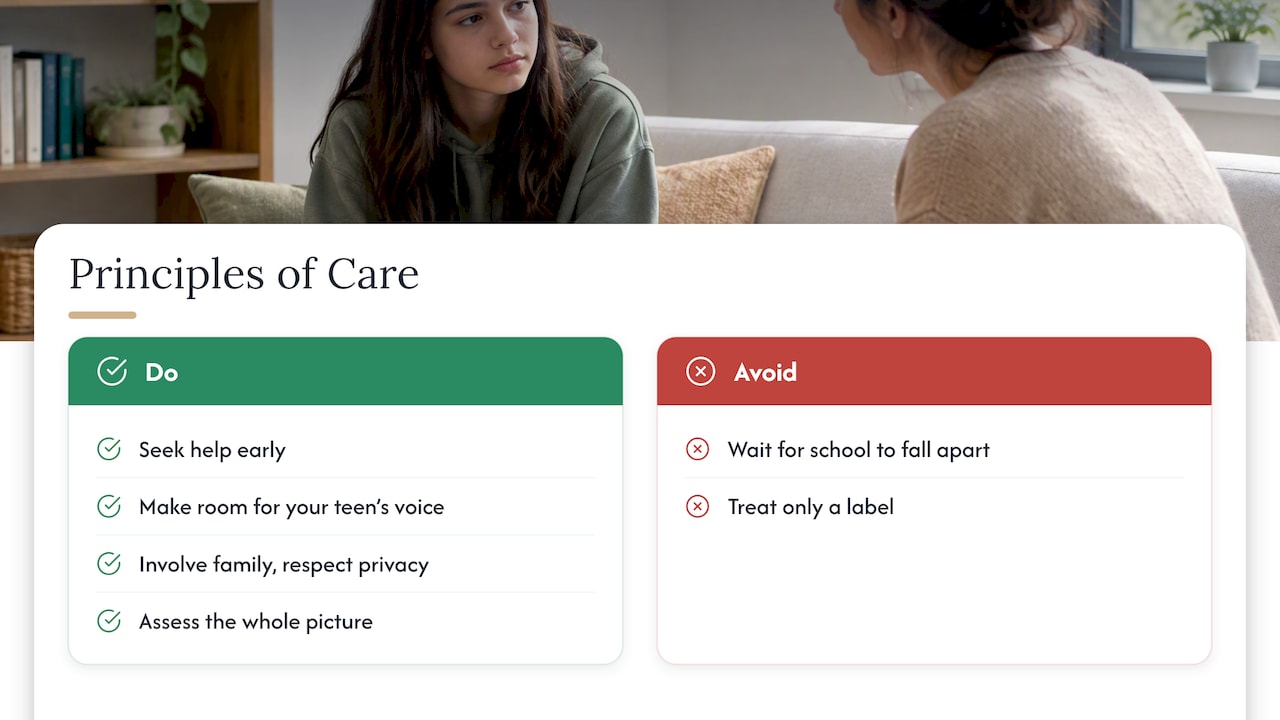
Finally, depression sometimes sits alongside other things: anxiety, trauma, ADHD or sleep problems. We assess the whole picture rather than treating a label. When a teen needs something outside our scope, such as medication, we work alongside their doctor.
If you take one thing from this article, let it be this: asking for help is not a sign you have failed as a parent. It is one of the most protective things you can do.
— Deane
Whether you choose us or another provider, these questions help you decide:
A good therapist welcomes these questions.
There is no single answer. Some teens notice small changes within a few weeks, such as sleeping a little better or arguing less. Others need months. Progress is rarely a straight line, and a bad week does not mean therapy is failing.
What helps most is consistency: regular attendance, practice of skills between sessions, and support at home. If you see no change after a reasonable period, say so to the therapist. A plan can be changed, and a second opinion is always acceptable.
For most teens, the best starting point is a structured talk therapy such as CBT or IPT-A. Both are classed as well-established treatments for adolescent depression. For moderate to severe depression, a physician may suggest adding medication, always alongside therapy and with close monitoring. The right mix depends on your teen, so start with an assessment.
Listen without rushing to fix things, keep routines for sleep, meals and movement, and make sure they get to their appointments. Keep your relationship as normal as you can, with time that is not about the depression. If they mention suicide or self-harm, call or text 988 straight away.
It can be. Moodiness comes and goes with events. Depression tends to last two weeks or more, shows up in several areas of life such as sleep, school and friendships, and often includes loss of interest in things your teen used to enjoy. If you are unsure, an assessment with a therapist or family doctor will clarify it.
No. You can contact us directly and book a free 15-minute connection call first. If medication or a medical check seems worthwhile, we will suggest you see your family doctor or paediatrician.
Yes. We offer both in-person and online counselling. Online sessions suit many teens, as long as they have a private space and a stable connection. If your teen is in crisis or is not engaging on screen, in-person care may be better.