
The best questions for a therapy consultation are the ones that tell you whether this person can help with your concern, how they work, what it will cost and whether you feel at ease talking to them. A short call is enough to find out. At Supporting Wellness, every therapist offers a free 15-minute connection call, so you can ask these questions before you commit to a first session.
You do not need to ask all of them. Pick the five or six that matter most to you, write them down and keep the call to its 15 minutes.
A consultation call is a brief conversation, usually by phone or video, before any therapy begins. It is not a session. Nobody expects you to explain your whole story or make a decision on the spot. The Ontario Psychological Association suggests booking calls of about 15 minutes to ask a therapist about their training, focus, approaches and fees.
The call does two jobs. It gives you facts: whether the therapist works with your concern, what it costs, when they are available. It also gives you a feel for the person. Research and professional bodies agree that you should leave the call asking yourself whether you felt seen, safe and heard, and whether you could imagine talking openly with them.
If you want to know more about how our calls run, we explain it in what to ask and expect on a 15-minute consultation call. If you are wondering what happens after, the therapy intake process walks through it.
The Ontario Psychological Association recommends a little self-reflection first. Ask yourself:
Your answers shape which questions you ask. A veteran may want to know about experience with service-related stress. A couple may want to know how the therapist works with two people at once. A parent may care most about experience with children and teens.
You do not have to know exactly what to say about your problem. A sentence is enough, such as “I have felt anxious for a year and it is affecting my sleep.” If you are not sure what to bring up, what to talk about in therapy can help.
This is the most important group. A kind therapist who rarely sees your type of concern may be a weaker match than one who sees it every week.
“Have you worked with concerns like mine?” Mention your situation in plain words: anxiety, a hard stretch in your relationship, trauma, a child who is struggling, work-related stress as a first responder. The British Columbia Psychological Association lists experience with your specific challenges and the therapist’s areas of expertise among its core questions. It also notes that a therapist who says they work with every age and every condition may not be specialized in any area.
A good answer is specific. You hear what kinds of people they usually see and what that work looks like, not just “yes, I can help with that.”
“What is your approach to therapy?” Therapists use different methods, and a good one can explain theirs without jargon. Some examples you might hear:
At Supporting Wellness we offer all three, along with talk therapy for anxiety, depression and relationship concerns. If a method sounds unfamiliar, ask the therapist to explain it in everyday words. That is a fair request, and a clear explanation is a good sign.
“What would treatment look like for me?” The Ontario Psychological Association suggests asking which approaches or treatments the psychologist offers for needs like yours. The Nova Scotia College of Counselling Therapists adds a useful pair of questions: do you focus on immediate problems or on deeper issues and past events, and do you see clients short term or long term? Your own preference matters here. Some people want practical tools for this month. Others want to understand where a pattern began.
“What does a typical session look like?” This helps you picture the first hour. It also shows how structured the therapist is.
Titles in this field are not interchangeable, so it is reasonable to ask about them. The Canadian Counselling and Psychotherapy Association (CCPA) advises asking about a therapist’s qualifications and whether they belong to a credible professional body. In provinces where counselling or psychotherapy is regulated, which includes Alberta, it says you should make sure the therapist is a member of the provincial regulatory college and holds a permit where one is required.
To put that into practice, ask:
The BCPA suggests asking the degree (Master’s or PhD) and the years of practice. In Alberta, to become a psychologist you register with the College of Alberta Psychologists, so a registered psychologist can tell you their registration status directly. Other regulated professionals have their own colleges, and a clear answer about which one is what you are listening for.
If a therapist is still in training, such as a provisional psychologist, they should say so and tell you who supervises their work. Many people find this perfectly comfortable. What matters is that you know.
Practical questions are not awkward. Professional bodies list them first. The Nova Scotia College of Counselling Therapists suggests asking how long the appointment is, how much it costs, how to pay and whether the therapist accepts health insurance. The Ordre des psychologues du Québec points to office location, access, availability and fees as things to settle by phone before you schedule.
Bring these to the call:
| Question | Why it matters |
|---|---|
| What is the fee per session, and how long is a session? | So there are no surprises on your first invoice. |
| Do you direct bill my insurer? | Direct billing means the clinic sends the claim to your insurer, so you do not pay the full amount first and wait for reimbursement. |
| Do I need a physician referral? | Some plans or services ask for one, and it can delay your start. |
| When are you available? | Mornings, afternoons, evenings and weekends all matter if you work or have children at home. |
| What happens if I miss or cancel a session? | Knowing the policy ahead of time avoids a charge you did not expect. |
| Is there a lower-cost option? | The BCPA lists sliding-scale fees among its suggested questions. |
Fees are one area where regulators are firm that you should be told in advance. Ontario’s professional misconduct rules for psychologists, for example, treat failing to tell a client the fee and any late-payment penalties before providing a service as misconduct. Alberta rules differ, but the principle is a good one to apply anywhere: a therapist should be able to tell you what you will pay before you start.
We offer free 15-minute connection calls with every therapist. We direct bill a wide range of insurers, and you do not need a physician referral. We also offer evening and weekend availability. If cost is a concern, our Affordable Counselling Calgary page lists $100, and Affordable Counselling Red Deer lists $80. Our direct billing guide explains how claims work, and if you wonder about tax receipts, we cover claiming therapy on your taxes in Canada.
You are about to share personal things, so it is fair to ask how they are protected. The Nova Scotia College of Counselling Therapists and the College of Registered Psychotherapists of Ontario both list the same first-call questions: is everything I tell you confidential, and will you take notes during sessions and what happens to them?
Ask the second half too: are there situations where you would have to share what I say? The Psychological Association of Manitoba’s Code of Conduct says therapists should explain the limits of confidentiality at the start of the relationship, with a written explanation recommended, and that information is shared with others only with your written consent except where the rules allow otherwise. It also treats consent as ongoing, so you can change your mind as your circumstances change.
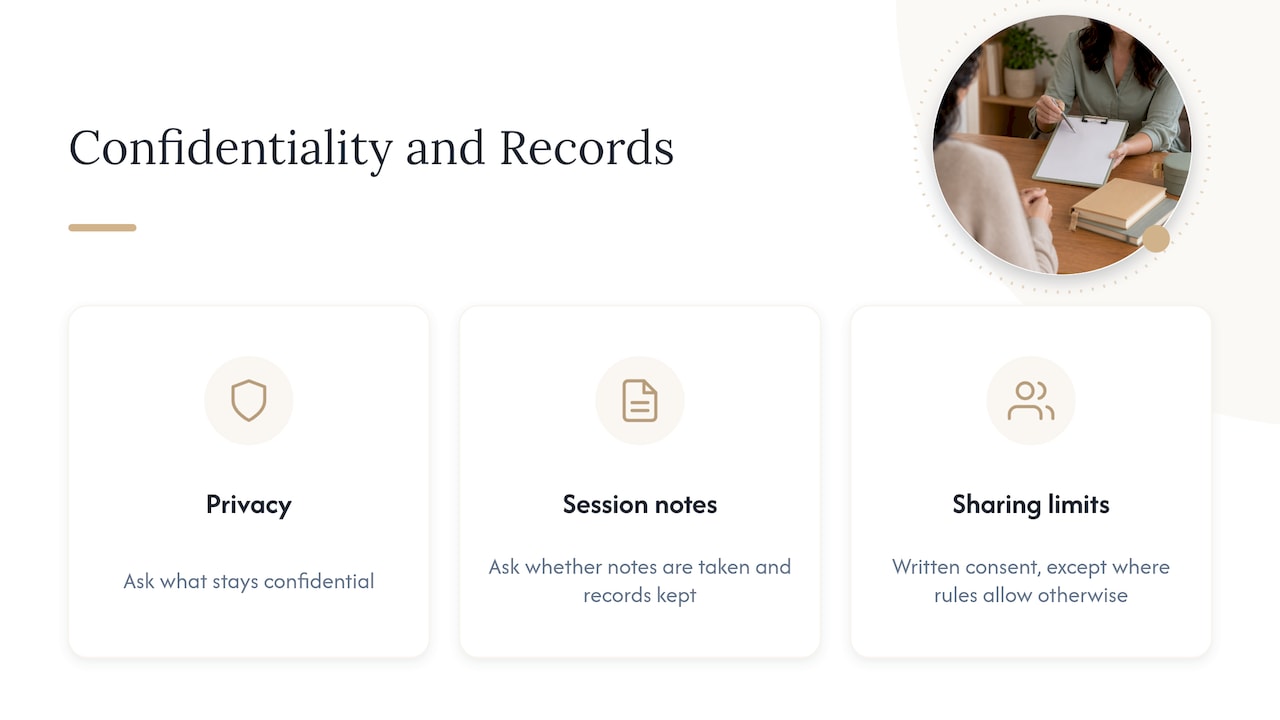
A good answer is calm, clear and specific. You should come away knowing what stays private, where the exceptions are and where your records are kept.
This matters especially for veterans, first responders and anyone worried about work consequences. If that is you, say so on the call and ask how your records are handled.
Therapy should have a direction. The College of Registered Psychotherapists of Ontario describes a registered psychotherapist’s practice as including a clearly communicated, mutually agreed goal or plan for the work. You can ask for that on the call:
The BCPA says therapy often starts with weekly sessions, with the frequency adjusted as you make progress, and that some people find resolution in a few sessions while others need longer. Nobody can promise an exact number on a first call. A thoughtful therapist will explain what shapes the answer for you, such as how long the concern has been present and what you want to change. We go deeper in how many therapy sessions you will need.
The CCPA also suggests asking whether you can contact the therapist between sessions, and the Nova Scotia College adds email, text and after-hours contact to the list. Clarify this early so your expectations match.
If you are coming as a couple or a family, a few extra questions help:
If you are unsure whether to start together or with individual sessions, family therapy vs. individual therapy explains how to choose. Couples who are planning a wedding may find premarital counseling topics useful to bring to a first session.
Our couples counselling includes the Gottman Method, and we also see families, children and adolescents, and seniors.
If you carry service-related stress or trauma, or you want care that respects your culture, ask directly:
Supporting Wellness offers veterans and first responder counselling, PTSD and trauma counselling, EMDR and Indigenous (NIHB) counselling. You can find them on our services page, and our EMDR therapy in Calgary page explains how that approach works.
Answers are only half the call. The rest is how it felt. After you hang up, ask yourself:
The BCPA lists red flags that can show up later in therapy, including conversations that centre on the therapist, a one-size-fits-all approach, being overly directive and persistent discomfort. The first call is where you start noticing these things. Your comfort is a valid reason to choose one therapist over another.
If you try someone and still do not feel confident after a few meetings, the Ordre des psychologues du Québec notes you have the right to continue with another professional. That is a normal part of finding a fit, not a failure.
If you want a single page to carry with you, these ten cover most of what matters:
We think the consultation call is where good therapy begins. People often arrive nervous, unsure whether they are “bad enough” to ask for help or whether they will be judged. The call is a chance to find out that the answer to both is no.
That is why we offer a free 15-minute connection call with every therapist, and why we do not ask for a physician referral. You should be able to ask your questions, hear how a therapist works and decide whether it feels right before you spend anything.
We are a collaborative, family-oriented practice with a multidisciplinary team. Our approach is evidence-based and culturally safe, and we use methods such as EMDR, Brainspotting and the Gottman Method. We direct bill a wide range of insurers and offer evening and weekend availability, because getting care should fit around your life.
Bring your questions, all of them. A good fit starts with a good conversation.
Deane
We offer in-person sessions in Calgary, Red Deer and Cold Lake, and online counselling for people who prefer to meet from home. A free 15-minute connection call with the therapist you are considering is the quickest way to ask your questions.

Start with our individual counselling and therapy page, or see all of our services. If you prefer to meet from home, our online counselling page explains how that works. Not sure where to begin? How to find a therapist in Calgary can help.
Usually around 15 minutes. That is enough time to ask about experience, approach, fees and availability, and to see how the conversation feels. At Supporting Wellness, the connection call is free and offered with every therapist.
Start with whether they have worked with concerns like yours, what approach they use and how you will know it is helping. Then cover registration, fees, insurance, cancellations and confidentiality. If you are short on time, those are the questions to prioritize.
It depends on the provider and on your insurance plan, so ask on the call. At Supporting Wellness, you do not need a physician referral to book.
That is useful information, and you are free to speak with someone else. Fit is a legitimate reason to choose a different therapist, and a few sessions in you can still change your mind.