
Direct billing means your therapist’s office sends the claim to your insurer for you, so at the appointment you pay only the part your plan does not cover. It is not available from every provider or with every plan. Whether your policy pays, and how much, is set by your plan, not by the clinic. This guide explains how direct billing works, what coverage looks like in Canada, and what to do if you have to claim on your own.
Without direct billing, you pay your therapist in full, receive a receipt and send it to your insurer. You wait for reimbursement. With direct billing, the clinic submits the claim electronically after your session. Your insurer decides what is covered and how much it will pay, and you cover any balance.
Two details matter here:
Think of direct billing as a convenience on the payment side. The coverage question is separate, and it is answered by your benefits booklet.
Often yes, but rarely through public health insurance.
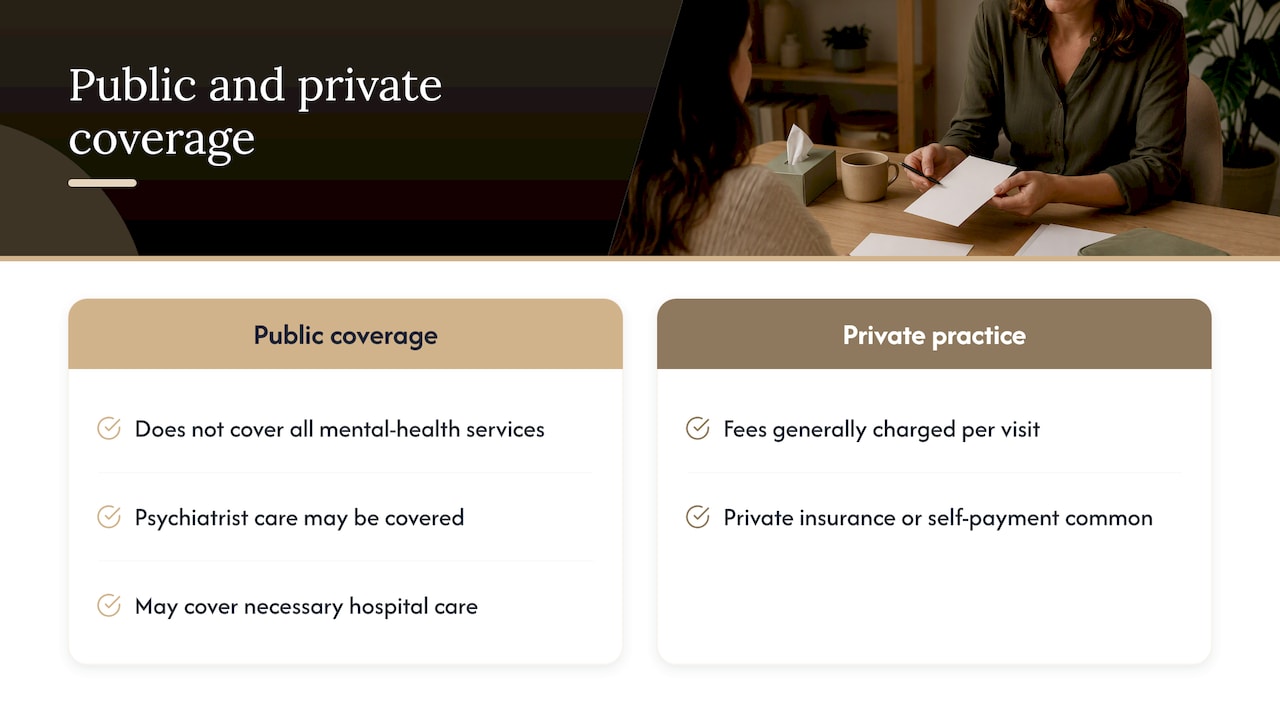
The Canadian Medical Association says provincial public insurance does not cover all mental-health services. Psychiatrist care and medically necessary services delivered through publicly funded hospitals, clinics or agencies may be covered. For private-practice psychologists, psychotherapists and social workers, the CMA says fees are generally charged per visit, and private insurance or self-payment is commonly needed when public coverage does not apply.
If you want a closer look at how this plays out in our province, see our guide to paying for therapy in Alberta and our answer to whether therapy is free in Alberta.
The Mental Health Commission of Canada explains that extended health benefits are available through employers or by direct purchase. Members generally choose a provider and submit receipts, subject to plan limits. Employer EAPs may also provide a set number of free counselling sessions.
In practice, that gives you three common routes:
Student plans are another source. One Canadian student plan, for example, covers eligible mental-health practitioners up to $100 per visit and 15 visits per policy year, combined across practitioners. It names psychologists, psychotherapists, clinical counsellors and Master’s-level social workers.
This is where many people are surprised. Plans name the provider types they cover, and the titles vary. The ACTA says insurers may describe eligible providers as counselling therapists, psychotherapists, clinical counsellors or professional counsellors, and that you should confirm whether your plan covers both the provider and the service.
Sun Life, for instance, announced that its standard extended-health proposals effective May 12, 2024 include psychologists, social workers, psychotherapists and clinical counsellors, subject to each plan’s rules. Its list of clinical-counsellor designations is long, which shows how many titles exist in this field. An employer can still design a plan differently, so your own booklet is what counts.
Coverage questions also come up for other services. If you are weighing what private plans typically include for children’s services, this overview of insurance coverage for ABA therapy shows how the same plan-by-plan logic applies to a different type of care.
We also have pages on specific plans and services, such as whether Blue Cross covers therapy and whether couples counselling is covered by insurance.
Limits are the other big variable. PolicyMe’s Canadian examples show annual maximums of $400 to $800, or limits of 10 or 12 visits, with per-session limits from $25 to $100. It also notes that group plans may carry low limits, deductibles and other out-of-pocket costs. PolicyMe adds that private plans may use annual maximums, fixed per-visit limits or percentage reimbursement, and may include waiting periods or pre-existing-condition clauses.
Here is a simple way to think about it, using made-up numbers for illustration only:
| Plan feature | What it means for you |
|---|---|
| Per-visit limit | The insurer pays up to a set amount per session. You pay the difference if the fee is higher. |
| Annual maximum | Once you reach the yearly dollar cap, further sessions are yours to pay. |
| Visit cap | The plan pays for a set number of sessions per year. |
| Percentage reimbursement | The plan pays a share, such as a portion of each fee. You pay the rest. |
| Waiting period | Coverage may not start until you have been on the plan for a set time. |
If your plan pays up to a set amount per visit and your therapist’s fee is higher, direct billing means you pay the gap at the appointment instead of fronting the full fee and waiting for a refund.
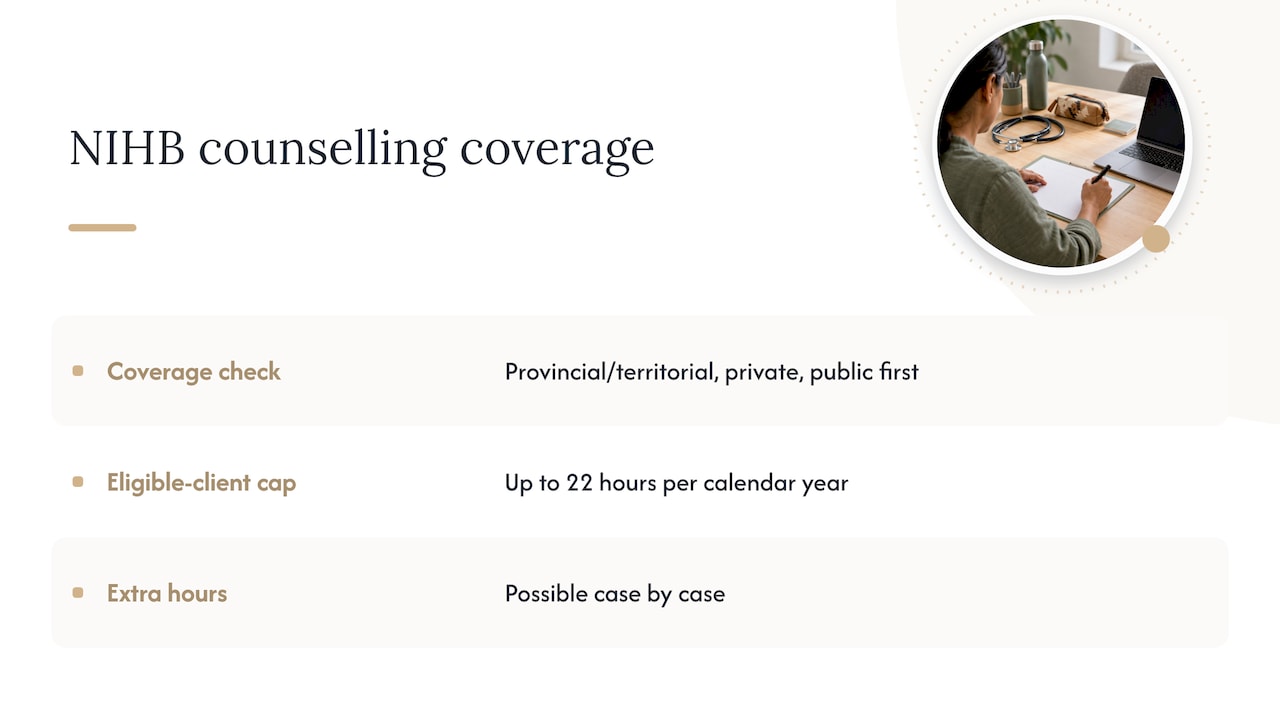
The Government of Canada says eligible First Nations and Inuit clients receive mental-health counselling coverage when the benefit is not available through provincial or territorial insurance, private insurance or another publicly funded program. NIHB provides up to 22 hours of professional counselling per eligible client per calendar year on a fee-for-service basis, and additional hours may be possible case by case. We are set up for culturally safe counselling and offer Indigenous (NIHB) counselling. Read more in our guide on whether NIHB covers counselling.
Veterans Affairs Canada says its Mental Health Benefits initiative covers eligible treatment for anxiety disorders, depressive disorders and trauma-and-stressor-related disorders while a disability application is being processed, generally for two years from receipt of the application or until a favourable decision. Eligible former Canadian Armed Forces members, including qualifying Class A or Class B Reservists, may qualify after applying for disability benefits for an eligible condition. Current and former RCMP members are generally not eligible under this initiative unless CAF service is relevant. Confirm your own eligibility with Veterans Affairs Canada.
A few minutes of preparation saves surprises later. Try this order:
You can also contact us before booking. Our team can tell you how direct billing works with your insurer, and our direct billing and insurance page explains what to expect.
Sometimes your insurer does not work with direct billing, or your clinician is not enrolled. You can still claim, as the Mental Health Commission of Canada describes: you choose a provider, pay, and submit your receipt. A typical process looks like this:
The receipt format your insurer needs can differ, so check its claim instructions first. If you pay out of pocket, you may also wonder about taxes. Our article on claiming therapy on your taxes in Canada covers that question.
We hear the same worry from many people before they book: “Will my insurance actually cover this?” It is a fair question, and no one should have to guess the answer while they are already feeling overwhelmed.
That is why we built our practice to make the first steps easier. Every therapist offers a free 15-minute connection call, so you can talk through whether we are a good fit before you commit to anything. We direct bill a wide range of insurers, you do not need a physician referral, and we offer evening and weekend appointments for people balancing work and family.
We also believe the right support depends on the person. Our multidisciplinary team works with individuals, couples, families, veterans and first responders, and Indigenous clients, using evidence-based approaches such as EMDR, Brainspotting and the Gottman Method. Coverage should help you reach that care, not stand in the way of it.
Call your insurer, bring us your questions, and we will help you work out the next step together.
Deane
If you are in Calgary, Red Deer or Cold Lake, or prefer to meet online, we can help you sort out billing as part of getting started. Our services page lists individual, couples, family, child and adolescent, senior, veterans and first responder counselling, plus EMDR, Brainspotting and assessments.
If you have no insurance, or your coverage has run out, we offer reduced-rate sessions with interns. Our pages for affordable counselling in Calgary list $100 and for affordable counselling in Red Deer list $80. To book a free connection call, start from our individual counselling page.
It can. Provincial health insurance generally does not cover private-practice therapy, but many employer and individual extended health plans do, up to the limits they set. EAPs, NIHB and Veterans Affairs Canada programs may also help if you qualify. Check your plan or call your insurer.
No. Direct billing is a payment method: the clinic submits your claim for you. Your policy still decides what it pays, so confirm your coverage with your insurer before the first session.
At Supporting Wellness, you do not need a physician referral to book. Some plans have their own rules, so ask your insurer whether they require one before they will reimburse you.
You can pay at the appointment, keep an itemized receipt and submit it to your insurer for reimbursement. The process is usually done online through your insurer’s member portal.
Yes. Every therapist at Supporting Wellness offers a free 15-minute connection call, so you can ask about fit and billing before you book a session.