
Individual therapy gives you private time with a therapist to work on your own thoughts, feelings and history. Family therapy brings several family members into the room to change how they communicate and support each other. The right choice depends on where the difficulty sits: mainly inside one person, or in the patterns between people. Many people end up using both, and you do not have to decide alone.
If you are reading this because someone you love is struggling, or because you are, that is already a good first step. Below we explain how each format works, what each is suited to, and how to pick a starting point you feel comfortable with.
In individual therapy, you and a therapist work one-on-one. The therapist’s attention is on you: what you feel, what you think, what you have been through and what you want to change.
In family therapy, the unit being helped is the family. CAMH describes family therapy as focused on changing the way families interact, with the aim of increasing understanding and improving communication among members without placing blame on any one person. It is generally used when the family system is seen as contributing to one person’s difficulties, for example a child’s or teenager’s.
The difference also shows up in theory. A comparison published in the American Journal of Psychiatry describes family therapy as viewing personality development and symptoms as shaped by the family working as an interdependent unit, while individual therapies look mainly at the inner psychological life of the person alone. You do not need to hold a view on that theory to benefit from either. It simply explains why a family therapist asks about relationships and routines, and an individual therapist asks more about your inner experience.
| Individual therapy | Family therapy | |
|---|---|---|
| Who attends | You alone | Two or more family members, sometimes everyone in the household |
| Main focus | Your thoughts, emotions, history and coping skills | Communication, roles and patterns between family members |
| Privacy | Fully your own space, within the usual limits of confidentiality | Shared space, with information handled for the benefit of the whole group |
| Typical goal | Relief from symptoms, healing, personal growth | Better understanding, less conflict, mutual support |
| Good fit when | The difficulty is mainly personal, or you need space to speak freely | The difficulty affects, or is affected by, how the family functions |
An individual session is a conversation with structure. Early on, your therapist asks about what brought you in, your history and your goals. Over time, the work depends on the approach. It might involve building skills for anxious thoughts, processing difficult memories or understanding long-standing patterns in your relationships.
CAMH notes that individual sessions generally last between 20 and 50 minutes, while family or group appointments can run longer. Session length at any clinic depends on the service, so ask when you book.
Individual therapy is also where specialized trauma methods often sit. Our therapists offer approaches such as EMDR therapy in Calgary and Brainspotting, which are usually done one-on-one because they involve a person’s own memories and body responses. If you are curious how these two compare, we explain it in Brainspotting vs EMDR.
A family therapist usually works with one family at a time, as CAMH’s concurrent disorders guide explains. The therapist is not there to decide who is right. The job is to help everyone be heard.
CAMH lists the kinds of things that happen in family therapy:
In practice, that can look like a parent and teen learning to have a conversation that does not end in a shouting match. It can also be a blended family working out new roles, or siblings who finally explain how a parent’s illness affected them. Our blended family therapy and family counselling in Calgary pages describe how we work with different family shapes.
Family therapy is not always a group of five people in a room either. CAMH says a family therapist may meet with family members individually as well as together, and that some programs offer family therapy in a group with other families facing similar situations.
Both formats address real, common difficulties. The question is who needs to be part of the solution.
For children and teens, individual therapy has a strong evidence base too. CAMH’s childhood trauma toolkit lists individual therapies such as CBT, DBT for teens, TF-CBT, mindfulness-based therapies and play therapy alongside family-based options.
CAMH says family therapy can help when families feel overwhelmed, sad or angry, are unsure how to move forward, or keep repeating the same harmful behaviours. It can also help during big changes such as illness, mental health or substance use problems, unemployment, moving, ageing, divorce, trauma, and death and grieving.
The same toolkit lists family treatments for childhood trauma, including Parent-Child Interaction Therapy and Child-Parent Psychotherapy. In other words, for a young child the parent is often a central part of the treatment.
Family therapy can also support households living with ADHD, where routines, expectations and frustration affect everyone. We cover this in family therapy for ADHD.
This is the question behind many searches, and the answer is gentler than it sounds. When one family member is struggling, the family often feels it too. CAMH states that both the “identified client” and the other family members can benefit from family therapy, and that it can help relatives cope and adjust when one person’s difficulties affect the rest.
Here are some starting points:
We go deeper on that last situation in when one family member is struggling.
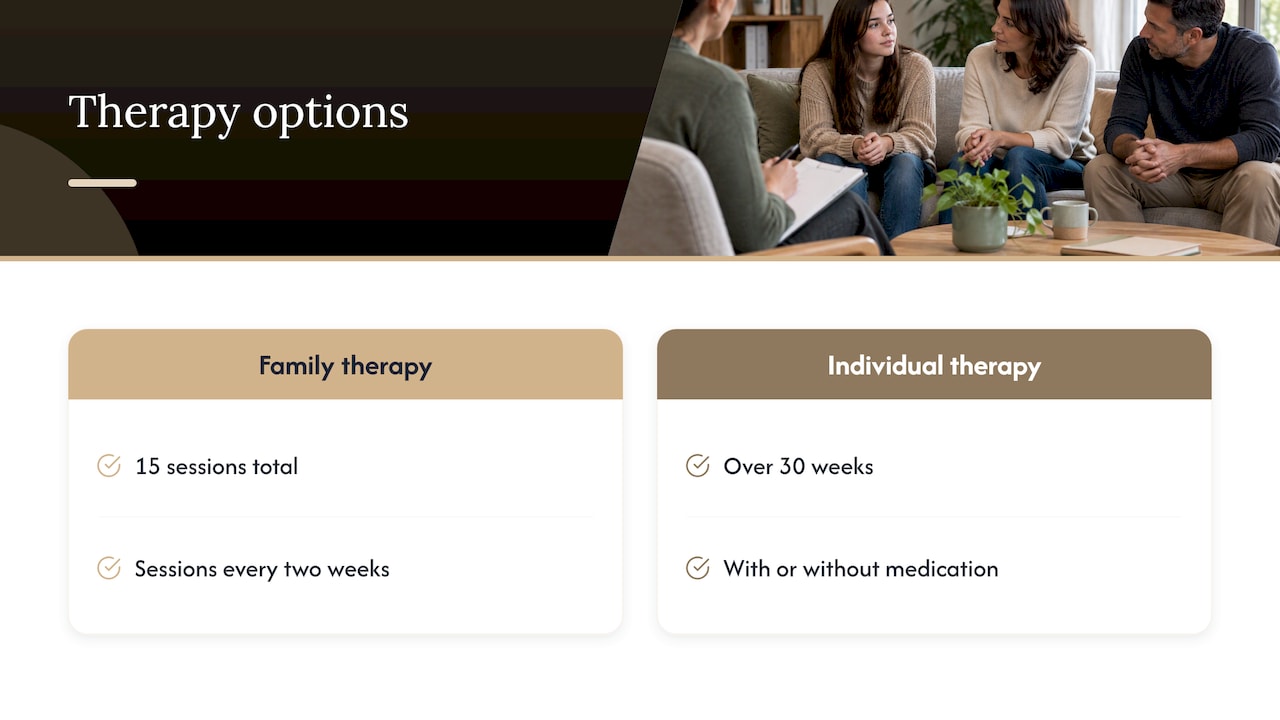
CAMH’s Cundill Centre decision aid for child and youth depression shows that these are not rival choices. It lists systemic family therapy (15 sessions, every two weeks) and individual psychotherapy over 30 weeks, with or without medication, as options to consider. Both are treated as legitimate paths, and the decision is made with the clinician based on the young person’s situation.
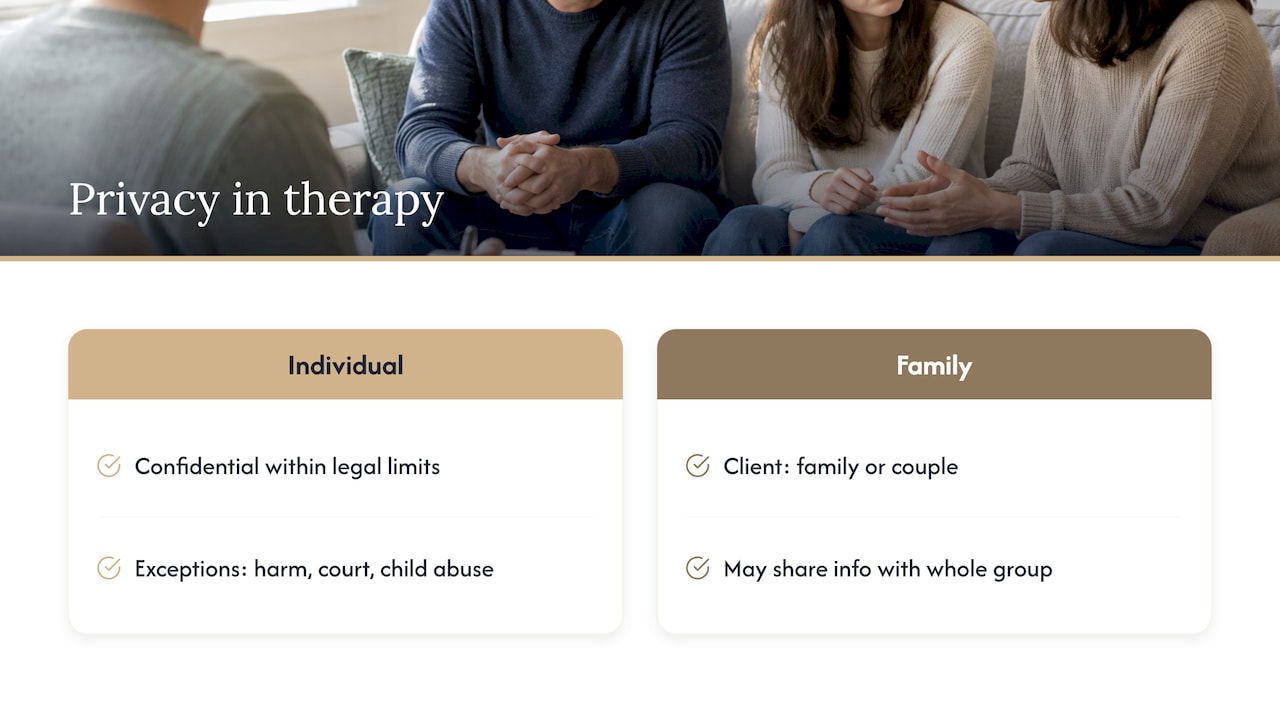
Privacy is where the two formats feel most different, so it is worth understanding before you start.
In individual therapy, what you say stays between you and your therapist, with legal limits. CAMH explains that therapists must keep information confidential, with exceptions such as suspected serious harm to self or others, some court proceedings, and suspected child abuse. CAMH is based in Ontario, so the specific reporting bodies differ by province. Your therapist will go over the rules that apply in Alberta at the start.
In family therapy, the family or couple is treated as the client. A professional association’s sample “no secrets” policy for couples and families describes the idea: a therapist may meet with part of the group and may need to share what was learned in an individual session with the whole group to serve it well. The purpose is to avoid a conflict of interest between one person’s interests and the group’s.
What this means for you: ask your therapist how they handle information shared in separate sessions before you begin. A good therapist will explain their approach plainly and answer questions without pressure.
Yes, and many people do. CAMH says there is no single path for family therapy. It may last only a few sessions or take longer, and other treatments, such as medication, may be used alongside it.
Common combinations include:
How long will it take? There is no universal number, and it depends on your goals. Our article on how many therapy sessions you will need walks through what affects it.
CAMH suggests the choice depends on the kind of problem, and that a family doctor, nurse, community mental health worker, employee assistance program or social service agency can help you find recommendations. These questions can make that conversation easier.
If you are still unsure, that is normal. Therapists often make the format recommendation themselves after the first conversation.
At Supporting Wellness, we rarely think of this as a contest between formats. When someone calls us, we listen for who is hurting and who could help.
Our practice is collaborative and family-oriented, with a multidisciplinary team that includes evidence-based and culturally safe care. That means a parent can see one of our therapists for anxiety while a teen works with another, and the two can come together when it makes sense. It also means veterans, first responders and Indigenous clients can find a therapist who understands their context.
We offer a free 15-minute connection call with every therapist, because we believe the fit between you and your therapist matters as much as the method. Use that call to ask which format we would suggest, how confidentiality works in family sessions, and what a first appointment looks like. We would rather you start in the format you feel safe in than the one that sounds ideal on paper.
You do not need a physician referral, and you can change direction as you go.
Deane
We offer individual counselling, family counselling, couples counselling, child and adolescent therapy, and specialized treatments in Calgary, Red Deer and Cold Lake, in person and online. We direct bill a wide range of insurers, and we offer evening and weekend availability.
If you are ready to talk it through, start with a free 15-minute call. You can read about our individual counselling in Calgary, explore our family counselling in Calgary, or see the full list on our services page.
Cost can be a worry too. Our affordable counselling pages list a rate of $100 in Calgary and $80 in Red Deer. Check the page for the details of how those sessions work. Families in Red Deer can also look at our family counselling in Red Deer.
Neither is better in general. CAMH says the right choice depends on the kind of problem you want help with. Family therapy suits difficulties that involve how family members interact, while individual therapy suits concerns that are mainly personal. Many people use both over time.
No. CAMH describes family therapy as improving understanding and communication without placing blame on any one person. The family is treated as a team working toward shared goals, and the person who is struggling is not singled out.
Yes. There is no fixed order, and CAMH notes that family therapy can be combined with other treatments and may involve meeting members individually as well as together. Many families begin with one person’s sessions, then bring others in when it becomes helpful.
You can begin with that person. Individual therapy can build skills and clarity, and relatives can also seek therapy to learn how to support someone they love. Others can often join later once they see the process is respectful and not about blame.
Start with a conversation. On our free 15-minute connection call, you can describe what is going on and ask which format we would suggest. You can also ask a family doctor or another local health professional for recommendations.