
A stress-reducing conversation is a short, regular talk where you and your partner take turns sharing stress that comes from outside your relationship, such as work, money, family or a bad commute, while the listener offers understanding instead of advice. The Gottman Institute describes it as a structured practice of about 15 to 30 minutes in which one partner speaks, the other listens with empathy and validation, and then you swap. It sounds simple. Most couples find the hard part is not fixing anything.
This guide explains the rules, walks you through a full conversation step by step, shows what to say and what to avoid, and covers what to do if it keeps going wrong. It also answers a question people often ask next: how a daily check-in differs from this conversation.
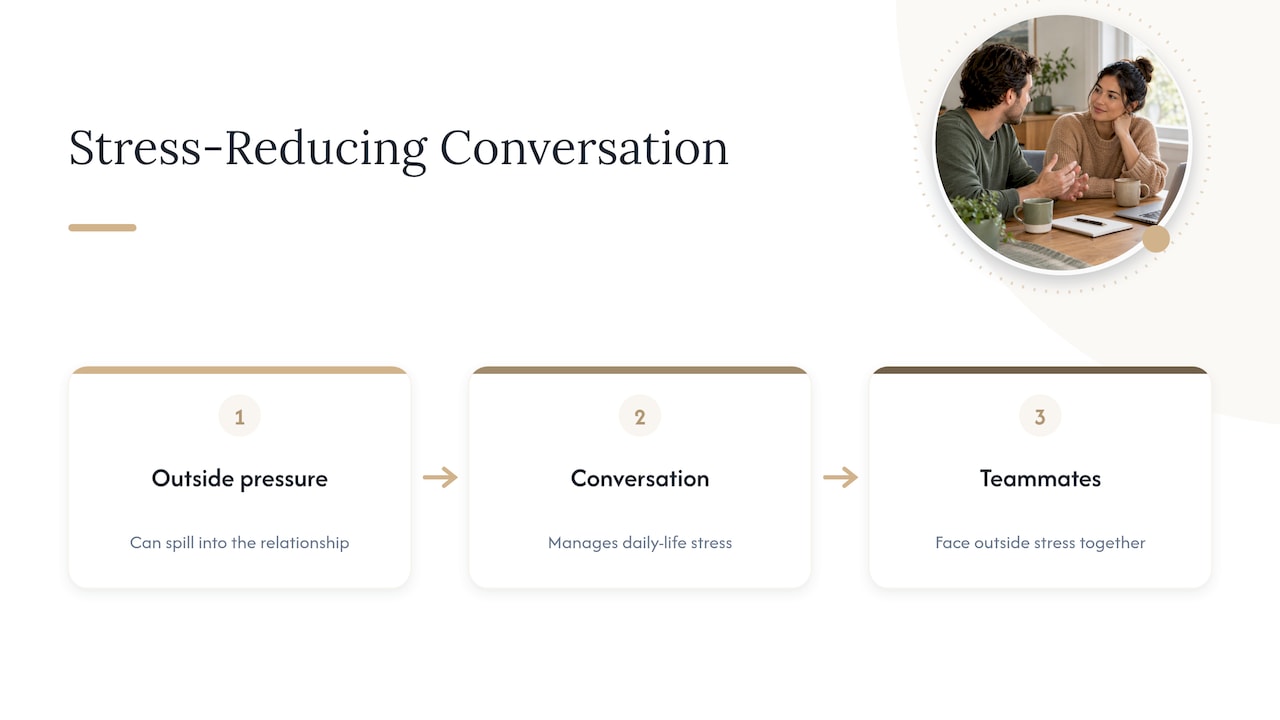
Dr. John Gottman’s research on couples led to a set of daily habits that keep partners feeling like a team. This conversation is one of them. The aim is to manage the stress of daily life so that outside pressure does not spill into your relationship. The Gottman Institute explains that outside stressors need somewhere to go or they tend to show up as irritability at home.
The conversation does not solve your boss problem or your credit card balance. What it does is change who you are to each other while you carry that problem. According to the Gottman Institute, it builds a ‘we-ness’ attitude and moves the two of you from opponents to teammates facing outside stress together.
That shift is the real product. A partner who feels seen at the end of a hard day is less likely to pick a fight at 9 p.m. about the dishes.
The Gottman Institute’s research on new parents reports that 67% of couples experience a sharp decline in relationship satisfaction in the first three years after a baby arrives. It recommends a daily stress-reducing conversation as a protective habit, because outside pressure turns into conflict when partners stop talking openly about their own frustrations. You do not need a new baby for this to apply. Any heavy season counts: a job loss, a move, caring for an aging parent, a long winter.
The topic must be stress that starts outside the relationship. That is the rule couples break most often.
Good topics:
Topics to save for another time:
If the stress is about each other, this format will not hold it. Introducing relationship grievances turns a safe, neutral space into a courtroom, and the point of the exercise is lost. For those topics, try a different tool. Our guide to communication exercises for couples has options that fit them better.
These steps follow the Gottman Institute’s published instructions, adapted into plain language.
Gottman sources give a range. The institute’s own instructions suggest 15 to 30 minutes, and a recent article on life transitions describes a daily 20 to 30 minute talk. If your days are full, a shorter version is better than none. Start with 10 minutes each if 30 feels like too much, and build from there.
The most common way this goes wrong is that the listener tries to help.
Say your partner tells you their manager changed a deadline again. You immediately think of three fixes. Offering them feels loving. To your partner, it can feel like you are rushing past the feeling to get to the task. Their emotional experience gets treated as a problem to remove, and they end up feeling alone with it.
The Gottman approach is the opposite: understand first. Advice is allowed, but only after your partner says yes to “Do you feel understood?” and agrees they want ideas.
You do not have to agree with every choice your partner made. Validation means you understand why they feel the way they do, not that you think they were right about everything. If your partner complains about a friend and you see the friend’s side, keep that thought for another day.
Amir comes home after a week of layoffs rumours at work.
Amir: “I keep waiting for the email. I can’t focus, and I’m worried about the mortgage.”
Priya (listener): “That’s a lot to carry. What’s the scariest part right now?”
Amir: “Honestly, starting over at 45.”
Priya: “That makes sense. I can see why that’s heavy. Do you feel like I understand?”
Amir: “Yes. Thanks.”
Priya: “Would it help to talk through a plan, or do you want to just sit with this tonight?”
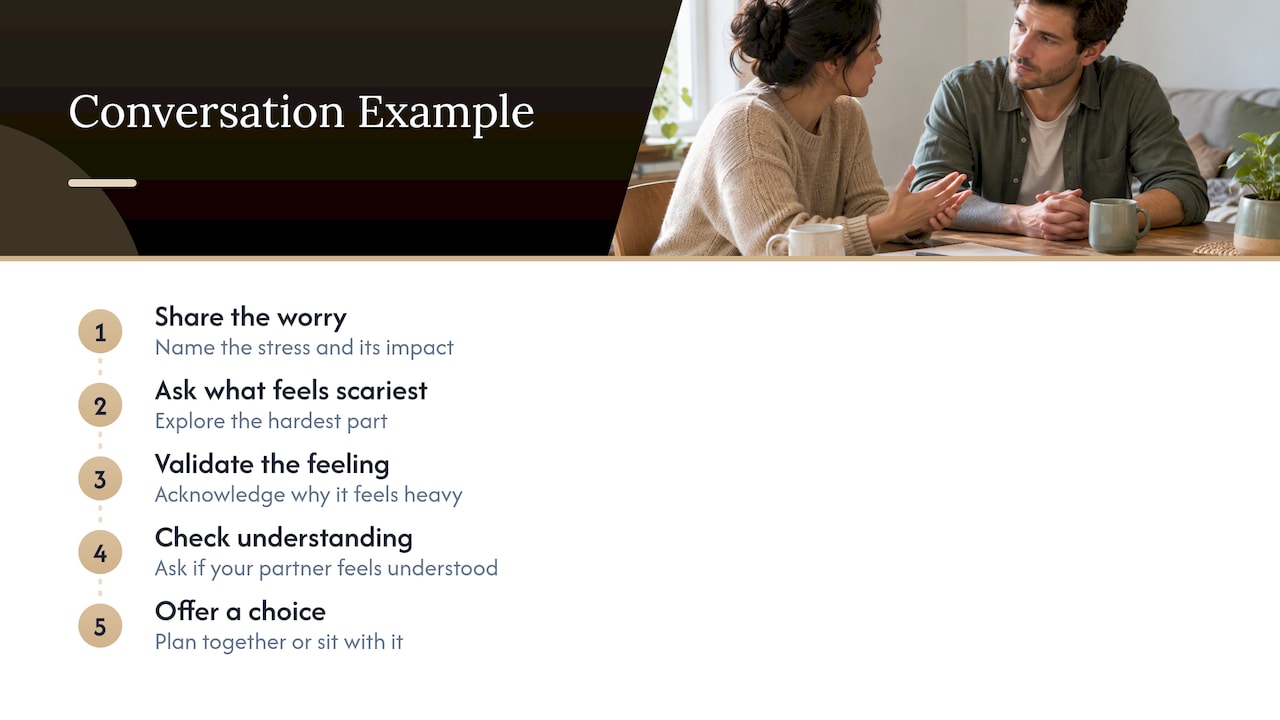
Priya never fixes a thing, and that is why Amir relaxes. This example is illustrative, not a real client case.
Talking about stress can bring up more than you expected. Two habits help.
Keep it contained. Pick a regular time and place so the conversation has edges. It begins, it ends, and it does not follow you to bed.
Pause when you are flooded. Flooding means feeling physically overwhelmed: a racing heart, tight chest, wanting to leave or lash out. Gottman practitioners suggest stopping for at least 20 minutes before you return, which helps avoid saying something you will regret. Spend the break on something calming, not on rehearsing your argument. If you cope by reaching for a cigarette, there are ideas for stress relief without smoking that can fill that gap. Then come back and finish the turn.
Not quite. People searching for a Gottman daily check-in often mean this conversation, but the two are different tools.
| Stress-reducing conversation | Relationship check-in | |
|---|---|---|
| Topic | Stress from outside the relationship | How the relationship itself is going |
| Frequency | Daily or several times a week | Daily, weekly, monthly or quarterly |
| Listener’s job | Support, no fixing | Hear needs, plan changes together |
| Goal | Feel like teammates | Adjust how you relate to each other |
The Gottman Institute describes a regular check-in as a dedicated space for what your relationship needs, whether daily, weekly, monthly or quarterly. Use both, but not in the same sitting. Keep the stress conversation as the neutral one, so it stays safe. Schedule the check-in for another day.
A third habit helps in the gaps. The institute notes that two minutes of undistracted communication each day matters more than a week of distracted time together. On evenings with no energy, two minutes can be your minimum.
The stress-reducing conversation is one tool within the wider Gottman Method. A 2026 quasi-experimental study of 60 distressed married couples in Canada found that Gottman Method Couple Therapy reduced physiological arousal during conflict discussions and cut destructive communication patterns, with improvements maintained at a three-month follow-up. Couples had 12 weekly 90-minute sessions. The study was small and not a randomized trial, so read it as encouraging, not as a guarantee. Results vary by couple.
If you want a closer look at how the method is structured and what to expect over a course of sessions, see our overview of the Gottman Method, from 8 to 12 sessions.
At Supporting Wellness, we often see couples arrive having tried to talk more and ending up in the same argument. What is usually missing is not effort. It is a safe format. The stress-reducing conversation gives you one, because it removes the two things that make talking risky: blame and pressure to fix.
We offer Gottman Method work as part of couples and family counselling, and our team is trained in evidence-based approaches. We also see that people are often anxious before a first session. That is why every therapist at our clinic offers a free 15-minute connection call, so you can ask questions and see whether the fit feels right before you commit to anything.
We suggest couples treat this practice as a skill, like any other. The first few tries feel stiff. Listening without advice is unnatural when you love someone and want their pain to stop. Give yourselves a month of regular tries before judging it. If you hit the same wall each time, that is useful information, not a failure, and a therapist can help you read it.
— Deane
Self-guided practice has limits. Consider professional support if:
If a partner has been affected by trauma, such as veterans and first responders, individual work like EMDR can run alongside couples sessions. If you are worried about safety at home, contact a crisis line or emergency services rather than trying a communication exercise.
If you are unsure what to ask a therapist, our guide to couples therapy goals turns shared examples into session plans, and our overview of how couples counselling improves communication and connection shows what the process looks like.
We offer marriage and couples counselling in Calgary, with in-person and online sessions across our Calgary, Red Deer and Cold Lake locations. You do not need a physician referral, we offer evening and weekend availability, and we direct bill to a wide range of insurers. Begin with a free 15-minute connection call, and you can see our full range of counselling services, including family, veterans and first responder support.
Aim for daily if you can, and several times a week if not. Gottman sources describe it as a daily or weekly practice, so the right rhythm is the one you will keep. Consistency matters more than length.
Do not push. Offer a shorter, lower-stakes version, such as 10 minutes on a walk, and be the first to speak so they can see it is safe. If your partner keeps declining, raise it at a calmer time using your own feelings: “I miss feeling close to you.” A counsellor can help if this is a long pattern.
No. The conversation only works for stress from outside the relationship. Relationship issues need their own time and structure, such as a check-in or couples therapy session, so that this one stays neutral and supportive.
No, most couples can try it at home with the steps above. A therapist helps when it keeps ending in conflict, or when heavy stress or past trauma makes listening hard. In Alberta, you can book with us without a physician referral.
Stop and take at least 20 minutes apart, doing something calming. Then return and finish the turn. Pausing is not avoiding. It protects the conversation.