
Child articulation therapy teaches a child to make specific speech sounds correctly, so other people can understand them more easily. A speech-language pathologist (SLP) starts by finding which sounds are giving your child trouble, then builds those sounds step by step, from single sounds to everyday conversation. If your child is hard to understand, you do not need to wait and wonder. At Supporting Wellness you can book speech therapy directly, with no physician referral, and start with a free 15-minute connection call to ask your questions.
An articulation disorder is a difficulty producing particular speech sounds. Children’s Hospital of Philadelphia describes the errors as dropping, adding, distorting or substituting sounds. A child might say “wabbit” for “rabbit”, “thoap” for “soap”, or leave the last sound off a word so that “cat” becomes “ca”.
The wider label is speech sound disorder. MyHealth Alberta explains that it can involve trouble moving the mouth, lips and tongue the right way to make sounds, which makes speech hard to understand. Parents may notice sounds left out or replaced, or a child who becomes frustrated when others do not understand them.
The same page lists possible contributors: hearing problems, a cleft palate or other mouth differences, and brain-related issues. In many children the cause is simply unknown. That is worth saying plainly, because many parents quietly ask what they did wrong. A speech sound difficulty is not a sign of poor parenting.
Children’s Hospital of Philadelphia also cautions that some sound differences reflect a child’s accent or family dialect rather than a speech disorder. Canada is home to many languages and accents, and a child who speaks English with a home-language influence is not automatically a child who needs therapy. A therapist who takes a full history can tell the difference. This matters most for families who speak more than one language at home, and it is one reason a proper assessment is better than guessing from a checklist.
If several of these sound familiar, our guide to seven signs your child might need a speech therapist goes through them in more detail.
MyHealth Alberta advises that if a child is having trouble with speech, you can talk with a doctor, who may refer the child to an SLP. The SLP is the professional who diagnoses and treats speech and language problems. In our clinics you can also book directly, since no physician referral is needed to see us.
Age guides help you judge how urgent your concern is. They are general indicators, not a diagnosis, and every child develops at their own pace.
| Age | What the guides suggest |
|---|---|
| By 2 years | Cleveland Clinic says parents should generally understand about half of a child’s speech. |
| By 3 years | Children’s Minnesota lists failing to use several early consonants as a referral indicator. |
| By 4 years | Cleveland Clinic says most speech should be understood by a parent. Children’s Minnesota lists speech understood less than 90% of the time as an indicator. |
| By 5 to 6 years | Children’s Minnesota lists not yet using more complex sounds such as s, z, f, v, sh, ch, th, l or r correctly as an indicator. |
The practical message is that earlier is easier. A four-year-old who is understood only by family, or a six-year-old who still cannot say r or s, is a good candidate for an assessment. If you are unsure whether your child is simply a little late or has a true difficulty, our article on speech delay versus speech disorder explains the difference, and our guide to speech milestones from birth to age 5 shows what is typical at each stage.
For a wider look at adults and children, see when to see a speech therapist.
Therapy begins with an assessment, because the right treatment depends on which sounds are affected and why. The Royal College of Speech and Language Therapists states that treatment should be selected from assessment findings and the evidence base.
A typical assessment looks at several things:
If you want to talk through what an assessment would involve for your child before booking, the free 15-minute connection call is a low-pressure way to do that.
MyHealth Alberta describes the SLP’s work as helping a child learn to make the right sounds and sound combinations by correcting mouth and tongue movements. The SLP also helps the child recognize when a sound is right or wrong, so the child can self-correct and speech becomes clearer.
In practice, most programs follow a progression. Children’s Minnesota describes moving from sounds in simple syllables to increasingly complex words, phrases, sentences and conversational speech.
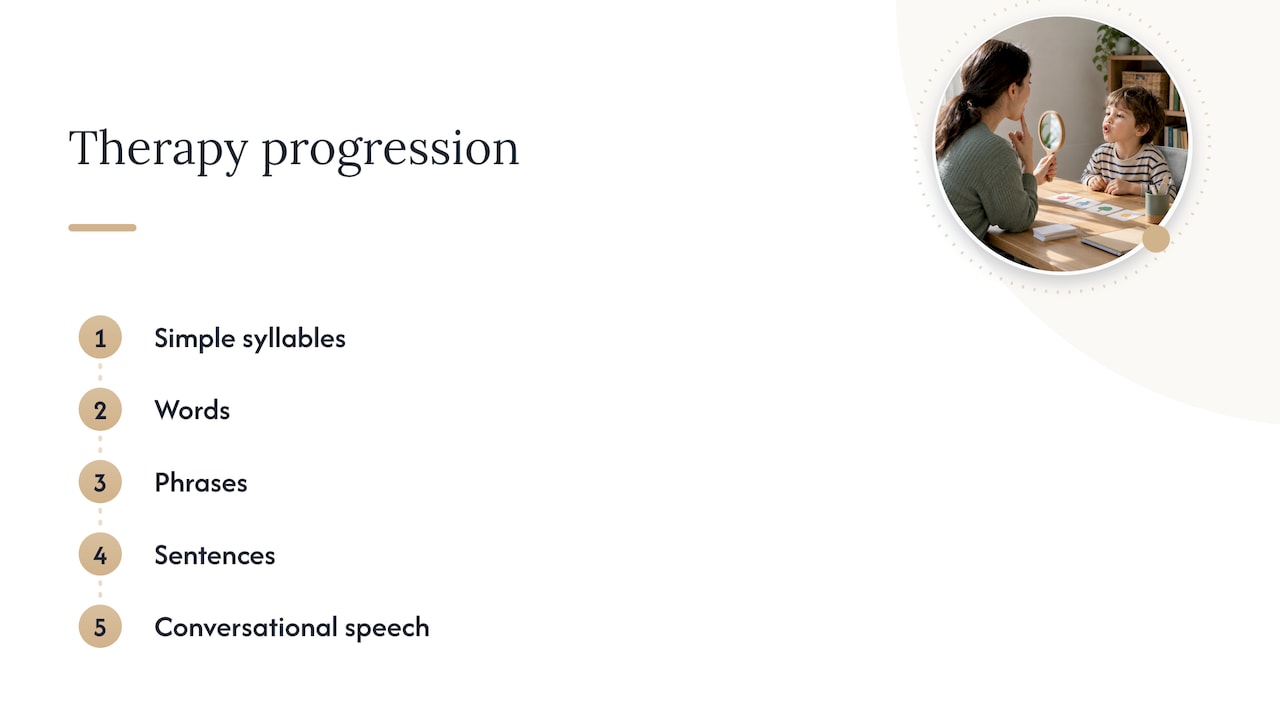
The therapist picks one or two sounds to start with. These are often sounds your child should already be producing for their age, and sounds that most affect how well others understand them. Starting small keeps the work achievable and gives your child early wins.
The RCSLT notes that effective therapy may involve both practising production and listening to sounds and words. It is not only repeated speaking practice. A child who cannot tell their “th” from their “s” will struggle to fix it, so the therapist often begins with listening games: which word sounds right, which sounds wrong, and what the tongue is doing.
The therapist shows your child where the tongue, lips and teeth go. They use mirrors, simple descriptions and sometimes touch cues. The goal is a correct sound in isolation, even if it takes many tries.
Once your child can make the sound alone, it goes into simple syllables (“sa, so, see”), then short words, first at the start, then the middle and end of words.
The sound moves into longer phrases and sentences, and finally into natural talking. This last step is where many children slip back into old habits, so the therapist keeps checking for the sound in everyday speech, not just during exercises.
The real finish line is correct sounds at home, at school and with friends. This is why practice between sessions matters so much, which we cover below.
Children’s Minnesota explains that activities may be play-based or more structured, such as seated table activities, depending on the child’s age and abilities. A toddler may practise sounds through bubbles, toy cars and animal noises. A school-age child may work with cards, short stories, reading aloud or word games with a set number of repetitions.
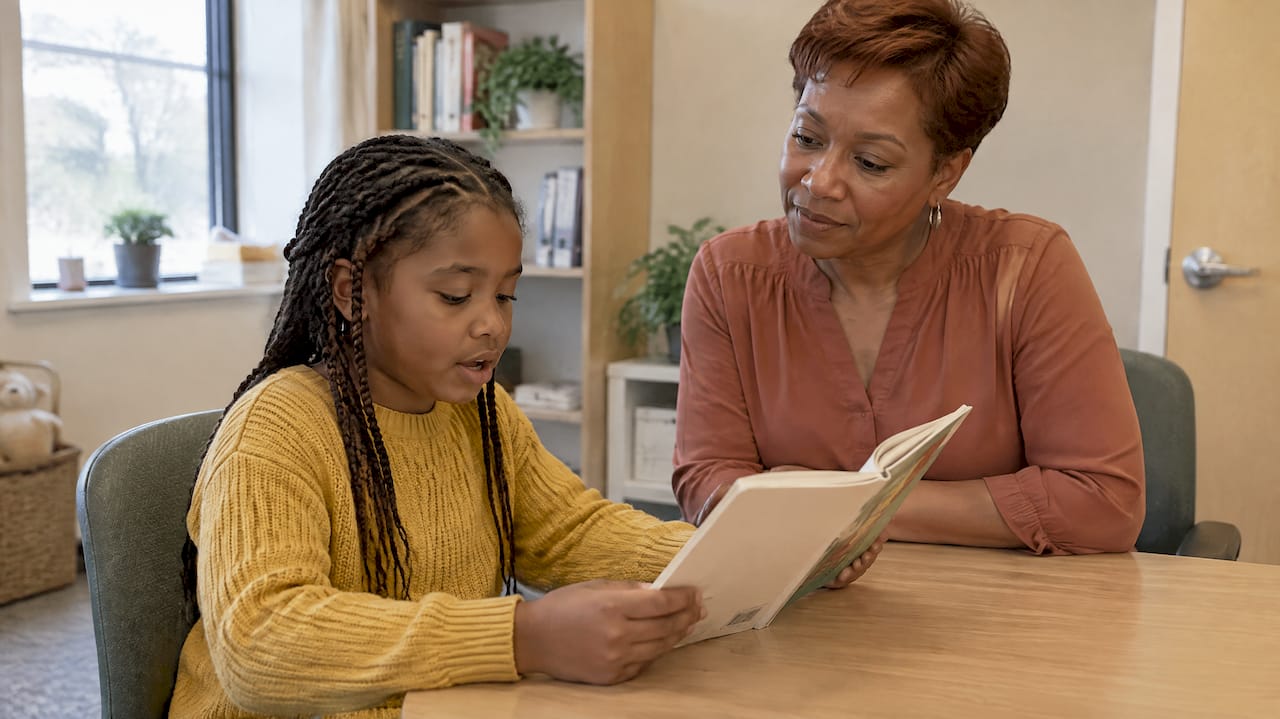
What stays the same is that every activity has a clear purpose: lots of correct attempts at the target sound, with feedback your child can understand. Children cooperate when the work is fun, so a good therapist adapts the session to your child’s personality.
Some children also have difficulty planning the movements for speech, which is a different condition. If your child’s speech is inconsistent and effortful, read our article on why once-a-week therapy often falls short for apraxia of speech.
Therapy sessions are short. The sounds are learned through repetition across the week. MyHealth Alberta says the SLP may suggest daily practice between sessions and teach caregivers how to help the child practise at home. Its guidance on working together adds that caregivers, including guardians and extended family, may be part of the therapy team, and that teachers, daycare staff, audiologists and physicians may also contribute.
A school-based speech-language services page from Ontario suggests several everyday habits that also work well in Alberta homes:
These tips come from the Thames Valley school speech-language services page.
Short and frequent beats long and tiring. Five focused minutes after breakfast, plus a game at bedtime, is easier for a young child than one 30-minute session. Praise the effort and the attempts, not only the perfect sound. If practice turns into a battle, tell your therapist. The plan can be changed.
Speech therapy can also support how children feel about school and friends. Our article on how speech therapy can boost your child’s confidence looks at that side.
Our perspective
At Supporting Wellness we see speech and emotional wellbeing as connected. A child who is not understood often feels it, and a parent who watches that happen feels it too. That is why we work as a collaborative, family-oriented practice with a multidisciplinary team, and why we want parents in the room, learning what to do at home.
We also think access should be simple. You do not need a physician referral to book with us. Every therapist offers a free 15-minute connection call, so you can describe your child, ask how sessions work and decide whether it feels right before you begin. We offer evening and weekend availability, because many families cannot get to appointments during the school day.
Speech therapy sits alongside our counselling, assessment and family services. If your child’s speech difficulty comes with anxiety, attention concerns or school stress, our team can look at the whole child rather than one sound at a time.
Deane
We offer speech therapy for children in Calgary, Red Deer and Cold Lake, with direct billing to a wide range of insurers. You can book without a physician referral, and evening and weekend times are available. Start with a free 15-minute connection call with the therapist, then decide what comes next.

See our services to find speech therapy, or read about speech therapy in Cold Lake. If you also have questions about attention or learning, we offer psychoeducational assessments in Calgary.
Alberta Health Services lists the services an SLP provides: screening, clinical assessment, diagnosis, individual or group treatment, partner training, education, counselling, consultation, referral and environmental modifications. That range is useful to know, because good speech care is more than drills. It includes teaching the people around the child how to help.
Insurance matters too. Many extended health plans cover speech therapy, and we direct bill a wide range of insurers, so you may not need to pay the full fee up front. Check your plan’s coverage for speech-language pathology, including any annual limit, before your first session.
It varies with the child, the number of sounds affected and how often they practise. A child with one or two errors may need less time than a child with many. Your therapist will review progress regularly and adjust the plan. Daily short practice at home generally helps progress.
Some sound errors do resolve as children mature, which is why age guides matter. If your child is past the ages in the table above for a sound and still cannot make it, or if you cannot understand most of their speech, an assessment gives you a clear answer. Acting early is easier than waiting.
MyHealth Alberta says a doctor may refer a child to an SLP, and you are welcome to talk to your doctor about your concerns. To book with us, though, no physician referral is needed. You can start with a free 15-minute connection call.
Your therapist will give you specific tasks, often a few minutes each day. Model the correct sound, emphasize it gently in everyday speech, and praise your child’s effort. Keep practice short, playful and regular.
No. Children’s Hospital of Philadelphia notes that some differences reflect a child’s accent or family dialect. A therapist can tell whether a sound pattern is a difference or a disorder during the assessment.