
Apraxia of speech and dysarthria both make speech hard to understand, but they break down in different places. In apraxia, the brain has trouble planning the mouth movements for speech. In dysarthria, the plan is intact but the muscles are weak, slow or poorly coordinated, so the movements come out imprecise. A speech-language pathologist is the professional who sorts out which one you or your child has, and sometimes it is both.
If you are comparing the two because of a diagnosis, a school report or something you have noticed at home, this guide explains the differences in plain words. It also covers what causes each, how they are assessed and what treatment aims to do.
Think of speech as a two-step process. First the brain works out which movements to make, in what order and at what speed. Then the nerves and muscles carry those movements out.
Apraxia of speech sits at step one. A 2022 ASHA tutorial describes childhood apraxia of speech (CAS) as a disorder of speech motor planning and programming in the absence of neuromuscular deficits. The NIDCD says the same thing from the other side: apraxia of speech is not caused by weakness or paralysis of the speech muscles, and weakness or paralysis results in dysarthria.
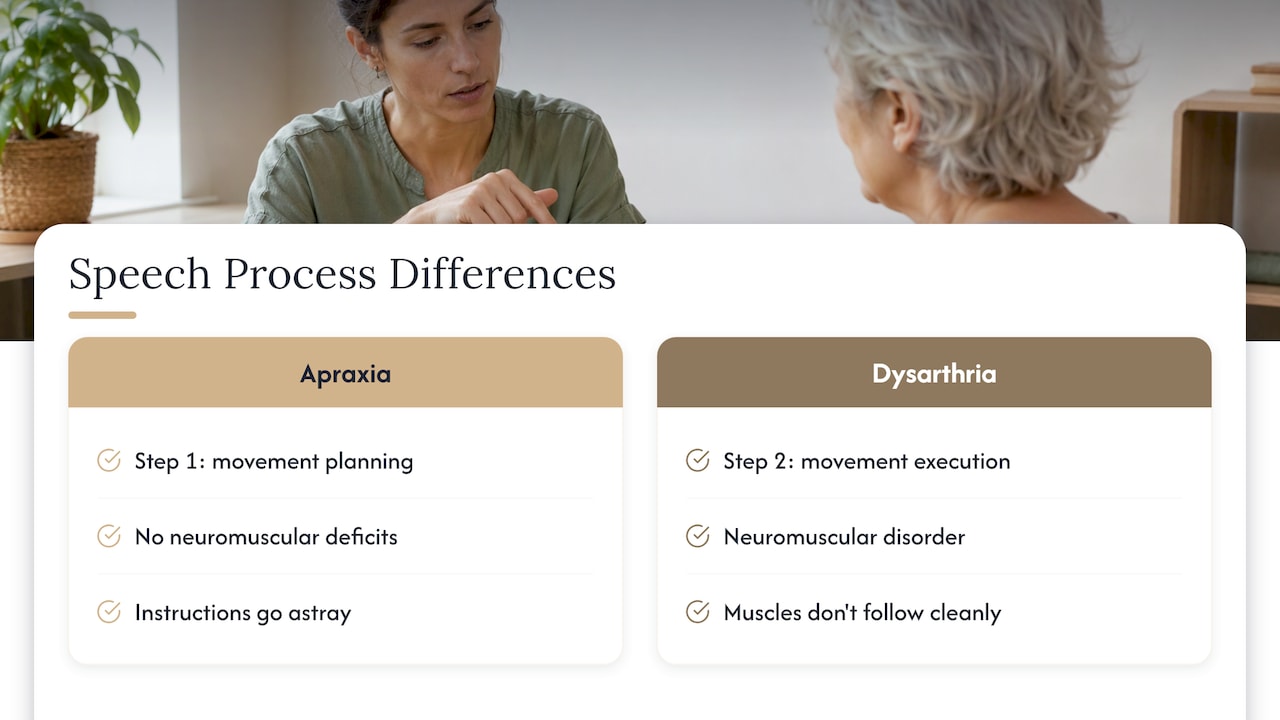
Dysarthria sits at step two. The same ASHA tutorial describes it as a neuromuscular disorder of motor execution, resulting from changes in the strength, range of motion, tone or precision of the movements needed to control the parts of the speech system.
So the person with apraxia knows what they want to say, but the instructions to the mouth go astray. The person with dysarthria sends the right instructions, but the equipment does not follow them cleanly.
| Feature | Apraxia of speech | Dysarthria |
|---|---|---|
| Where the problem lies | Planning and programming of movements | Strength, tone, range and coordination of muscles |
| Muscle weakness | Not the cause | Central to the problem |
| Error pattern | Often inconsistent: the same word may come out differently each time | Usually consistent: the same distortion repeats |
| Automatic speech (counting, greetings) | Often smoother than new sentences | Generally not influenced by how automatic the speech is |
| Parts of speech affected | Mainly articulation and prosody (rhythm, stress) | Often breathing, voice and resonance too, as well as articulation |
| Typical sound | Groping for mouth positions, halting, uneven stress | Slurred, slow, quiet or nasal speech |
Treat this table as a guide, not a test you can run at home. The features overlap, as the next sections explain.
The NIDCD lists four main speech signs of apraxia of speech:
The ASHA Practice Portal adds that key features used in diagnosis include distorted sounds, a reduced overall speech rate and prosodic differences such as equal stress across neighbouring syllables.
One pattern families often notice is the gap between automatic and planned speech. Counting, saying hello or singing a familiar song may come out smoothly, while a new sentence falls apart. That gap points toward a planning problem rather than a muscle problem.
In dysarthria the speech muscles are weak or hard to control. The NHS describes it as difficulty speaking because the muscles used for speech are weak. In practice, this may sound like slurred, slow or quiet speech, a nasal quality, or a voice that is strained or breathy.
Because dysarthria can affect breathing, voice production and resonance as well as articulation, the whole speech signal tends to be affected. A scoping review in PMC notes these global distortions of the acoustic signal are not typically present in apraxia.
The ASHA Practice Portal also notes that, unlike apraxia, dysarthria is generally not influenced by how automatic the speech is, the way a word is presented or linguistic variables. A person with dysarthria will sound similarly affected whether they are reciting the days of the week or composing a new sentence.
The tidy contrast above is the textbook version. Real speech is messier, and the research is open about it.
The PMC review notes that slow speech rate, unusual prosody and sound distortions, including vowel errors, are common in both apraxia and dysarthria, in children and adults alike. It also suggests that diagnostic features are likely to be sensitive but not specific, meaning a feature may show up often in apraxia without being unique to it.
Inconsistency is a good example. It has long been used to tell CAS from other speech sound disorders. But researchers writing in the 2022 ASHA tutorial report that it is less helpful for telling CAS from dysarthria, because people with dysarthria can also produce variable speech when control of vowel length and the precision of tongue and lip contact fluctuates.
The ASHA Practice Portal names the dysarthria types most easily confused with apraxia of speech: ataxic dysarthria, linked to damage in the cerebellum, and unilateral upper motor neuron dysarthria, which often occurs alongside apraxia when the lesion is in the left hemisphere.
This is the main reason not to self-diagnose from a checklist. The same sound can have different roots, and the right therapy depends on which root it is.
There are two broad groups. Acquired apraxia of speech appears after damage to the parts of the brain involved in speaking. The NIDCD lists stroke, head injury, tumor and other illnesses affecting the brain. ASHA also lists surgical trauma and progressive neurodegenerative disease.
Childhood apraxia of speech is present from birth. The NIDCD says its causes are not well understood, though genetic factors may play a role.
Dysarthria comes from damage to the nervous system that weakens or paralyzes the muscles used for speech, as the Cleveland Clinic and NHS both describe. The NHS lists stroke, severe head injury, brain tumours, Parkinson’s disease, multiple sclerosis, motor neurone disease, cerebral palsy and Down’s syndrome among the common causes. The Mayo Clinic adds conditions such as ALS, Huntington’s disease, muscular dystrophy and myasthenia gravis, and notes that some medicines, including sedatives and seizure medicines, can also cause it.
Yes. The NIDCD states that some people have both dysarthria and apraxia of speech, which makes each harder to diagnose. ASHA notes that apraxia of speech commonly occurs together with dysarthria and with aphasia.
In children, the usual comparison is between childhood apraxia of speech and dysarthria linked to conditions such as cerebral palsy. The slpa.ca overview describes CAS as a struggle to plan precise speech movements, leading to inconsistent errors, and dysarthria as slurred or unclear speech from weakness or poor coordination.
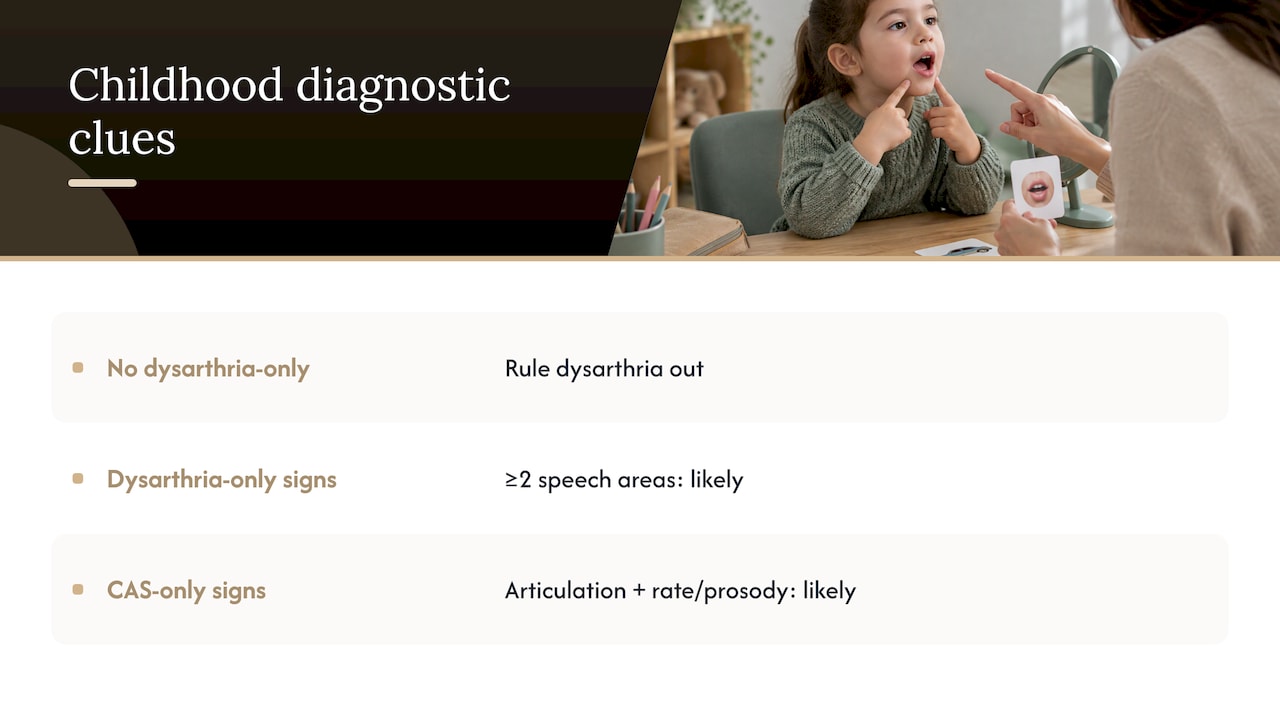
Dysarthria is a harder call in children. In the ASHA tutorial’s survey of 359 pediatric speech-language pathologists, 60% reported low or no confidence diagnosing dysarthria in children, while most had moderate to high confidence diagnosing CAS. The tutorial offers a decision-making flowchart to help: if no dysarthria-only features are present, dysarthria can be ruled out. If dysarthria-only features appear across two or more speech areas, dysarthria is likely. If CAS-only features appear in both articulation and rate or prosody, CAS is likely.
If your child is slow to talk but you are not sure it is a motor speech issue at all, two of our guides may help you sort out where to start: how a speech delay differs from a speech disorder and what to expect in child speech milestones. Language-based difficulties are a separate question again. Resources on expressive language delay therapy explain how clinicians approach a child who understands more than they can say.
The NIDCD is clear that children with apraxia of speech do not outgrow it without help, and they do not pick up the foundations of speech just by being around other children. That makes early assessment worth it. Our article on when to see a speech therapist lists the signs for children and adults.
In adults, both conditions most often follow a stroke, brain injury or a progressive neurological condition. Apraxia of speech may appear alongside aphasia, which is a different problem. The BMJ Best Practice summary separates the three:
The three can coexist but often occur separately. A quick way to hold them apart: aphasia affects the words, apraxia affects the plan for the sounds, and dysarthria affects the muscles that make the sounds. Dysphonia, another term readers search for, refers to a voice problem rather than an articulation problem.
Yes, a speech-language pathologist can assess and diagnose these conditions. According to the International Association of Logopedists and Phoniatrists, diagnosis rests on examining speech production and speech motor control, combined with brain imaging, neurophysiological or neurological information when available. The same source notes that there is no clear international consensus yet on the core criteria for diagnosing apraxia of speech, which is why an experienced clinician’s judgment matters.
An assessment typically looks at:
The clinician then weighs the whole picture rather than one sign.
Treatment depends on the diagnosis, which is why getting it right matters. For apraxia of speech, the ASHA Practice Portal describes the goal as greater independence in communication and social participation. Therapy builds on a person’s strengths, works to improve speech production, intelligibility, naturalness and efficiency, teaches compensations and, where it helps, brings in augmentative and alternative communication (AAC), such as picture boards or speech-generating devices.
The IALP notes that treatment for motor speech disorders in general helps people speak more intelligibly or communicate more effectively. It also says the speech therapist should take personal goals, lifestyle, health, age and living environment into account in consultation with the person. It mentions ongoing debate about oral motor exercises as a way to improve intelligibility, so ask your clinician how any proposed exercises connect to real speech goals.
The NIDCD adds that frequent, intensive, individual sessions are needed for both children and adults with apraxia. We explain what that means for scheduling in why once-a-week therapy often falls short for apraxia of speech.
Our perspective
When families and adults come to us with questions about unclear speech, the first thing they usually need is clarity, not a label. The apraxia and dysarthria question is a good example. The two look alike from the outside, but they ask for different therapy, so we think the careful, unhurried assessment is worth the time.
We believe speech concerns are best handled as a team effort. Our multidisciplinary practice offers speech therapy alongside counselling, psycho-educational assessments and ADHD assessments, because communication difficulties rarely stand alone. A child who struggles to be understood may also feel anxious at school. An adult who has lost clear speech after a stroke or injury may be dealing with grief and frustration. Addressing both the speech and the feelings around it is part of how we work.
We also want the first step to be easy. Every one of our therapists offers a free 15-minute connection call, so you can describe what you are noticing and ask how we would approach it before you book anything. You do not need a physician referral, and we offer evening and weekend availability and direct billing to a wide range of insurers.
Deane
Any sudden change in speech needs urgent attention. The NHS lists difficulty speaking, a drooping face and being unable to lift both arms as possible signs of a stroke and a medical emergency. The Mayo Clinic likewise advises seeing a healthcare professional right away for sudden or unexplained speech changes, since dysarthria can signal a serious condition. In Canada, call 911.
For gradual changes in your own speech, or in a loved one’s, book an appointment with your family doctor, who can look for causes such as medicines or neurological conditions and refer you onward. For a child whose speech is not developing as expected, a speech-language pathologist is a good first stop.
If you are trying to work out whether your child’s or your own speech difficulty is apraxia, dysarthria or something else, we can help you take the first step. Supporting Wellness Psychological & Family Services offers speech therapy and psycho-educational assessments, plus counselling for the stress and worry that so often come with communication difficulties. We see people in person in Calgary, Red Deer and Cold Lake, and online.

Start with a free 15-minute connection call with one of our therapists. You can see our full range of services and how to book, or, if the weight of it all is affecting your family, explore family counselling in Calgary.
No. Dysarthria is a problem of muscle strength and control, while apraxia of speech is a problem of planning the movements. The muscles in apraxia are not weak, and the errors tend to vary from attempt to attempt. People can have both at once.
Yes. A speech-language pathologist examines how you produce speech and control the speech muscles, sometimes alongside neurological or imaging information from your doctor. Dysarthria in children is a less common diagnosis and can be harder to confirm, so a clinician experienced with motor speech is valuable.
Aphasia affects language: finding words, understanding or forming sentences. Apraxia of speech affects the motor plan for the sounds of those words. The two can occur together after a stroke but often occur separately.
The NIDCD says children with apraxia of speech will not outgrow it without help. Speech therapy that is frequent, intensive and individual is needed, so an assessment is worthwhile if you suspect it.
No physician referral is needed to book with us. You can begin with a free 15-minute connection call to talk through your concerns.