
ADHD coaching and therapy are not two names for the same thing. Coaching is practical and forward-looking: it helps you build systems, routines and accountability. Therapy treats ADHD as a health condition and works on the emotional, relational and mental health side, including anxiety, depression and long-standing shame. Many adults benefit from both, and the right starting point depends on what is getting in your way right now.
If you are in Calgary, Red Deer or Cold Lake and wondering where to begin, this guide walks through the differences, what Canadian clinical guidance says, and how to decide without feeling pressured to get it “right” the first time.
The simplest way to separate them is by the question each one asks.
A coach asks: What do you want to get done, and what will you do this week to move toward it? A therapist asks: What is going on for you, where does it come from, and how can we help you feel and function better?
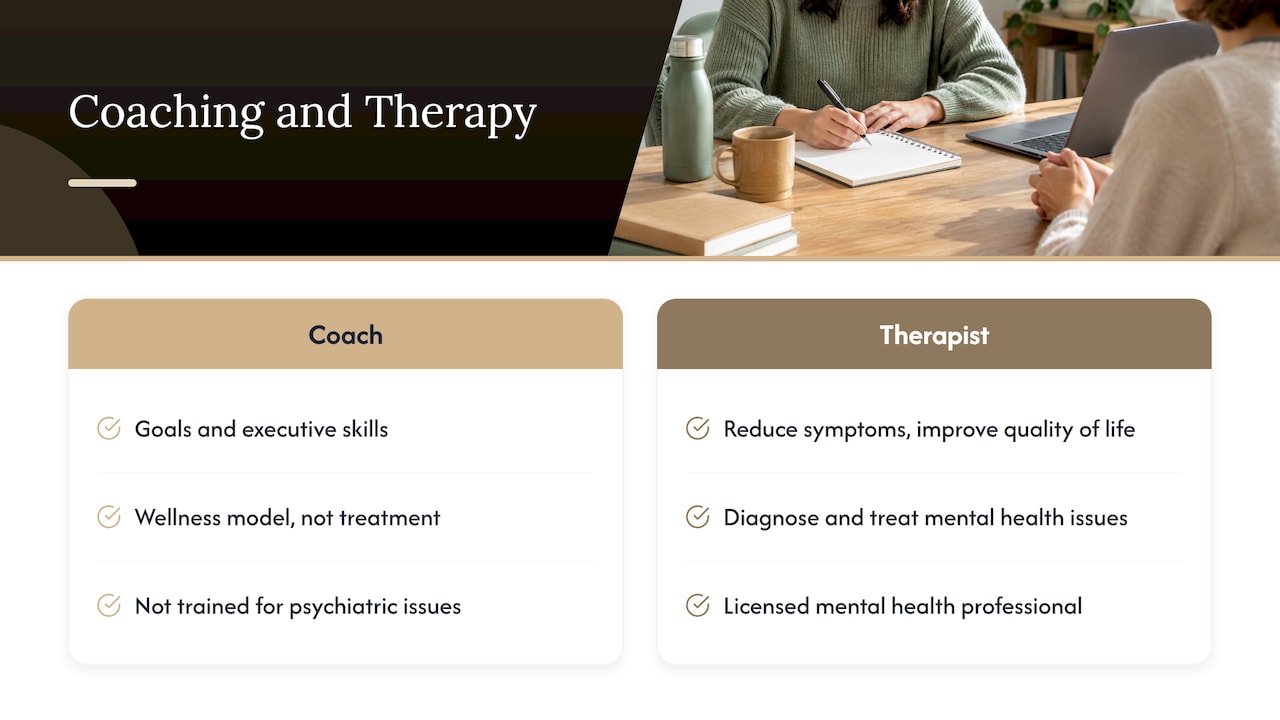
According to ADDA’s overview of ADHD professionals, psychotherapy generally treats ADHD as a mental health disorder, aiming to reduce symptoms and improve quality of life, while coaches help clients use their strengths to reach goals and develop executive skills such as planning, prioritizing and starting tasks.
CHADD describes the same split. Coaches focus on what, when and how. They are not trained to address psychiatric, emotional or interpersonal problems unless they are also licensed mental health professionals. CHADD calls coaching a wellness model, not designed to help clients heal or work through psychological barriers to growth, whereas licensed mental health professionals are trained to diagnose and treat mental health issues.
None of this makes coaching lesser. It means the two tools fit different problems.
| ADHD coaching | Therapy for ADHD | |
|---|---|---|
| Main focus | Goals, routines, accountability | Emotional health, thinking patterns, relationships |
| Time orientation | Present and future | Present, with attention to how the past shapes it |
| Typical work | Planning systems, weekly check-ins, breaking tasks down | CBT, supportive counselling, family or couples work, trauma-focused care when needed |
| Treats anxiety, depression, trauma | No, unless the coach is also a licensed clinician | Yes, within a licensed professional’s scope |
| Regulation in Alberta | No coach-specific regulator | Psychologists are regulated by a professional college |
| Best for | “I know what I need to do, but I can’t make it happen” | “I feel overwhelmed, ashamed or stuck, and it affects everything” |
Coaching works best when the problem is mainly about execution. You may understand your ADHD well and have no major mood concerns, but you still miss deadlines, lose track of appointments or start projects you never finish.
The Canadian ADHD Resource Alliance (CADDRA) guidelines note that coaching helps people stay accountable for specific behavioural agendas, through weekly follow-up meetings and reminders. In practice, that often looks like:
What coaching does not provide is diagnosis, treatment of mood or anxiety disorders, trauma care, or work on relationship patterns. A good coach will tell you this and refer you on when something goes beyond coaching.
Honest answer: it is still developing. The Australian clinical practice guideline says the evidence supporting ADHD coaching is relatively weak at present, and it notes that this may reflect how little research exists rather than a lack of effectiveness. That is a fair reading. Coaching is promising for many people, but it has a thinner research base than psychotherapy and medication.
Therapy is the better fit when ADHD comes with emotional weight. Adults who were diagnosed late often carry years of criticism, missed opportunities and a sense of “trying harder” without results. That can show up as low self-esteem, anxiety or depression.
CADDRA’s guidance says psychotherapy for adolescents and adults with ADHD, with or without conditions such as poor self-esteem, depression and anxiety, includes CBT, interpersonal therapy, family therapy and supportive counselling. In a therapy room, that can mean:
The Centre for Addiction and Mental Health also notes that because ADHD is often accompanied by mood disorders, one-on-one cognitive-behavioural therapy can help people reframe negative situations. Therapists can also coordinate with your physician, which leads to the next point.
Neither coaching nor therapy is a stand-in for medical care. CADDRA’s guidance states that combining medication with psychosocial interventions is the most effective way to address core ADHD symptoms and the impairments that follow. The same chapter lists psychoeducation, behavioural interventions, social interventions, psychotherapy and educational or vocational accommodations as parts of the toolkit.
A therapist does not prescribe medication, but can support you through decisions about it, help you track what is changing, and work on the skills and emotions that medication alone does not touch. If you are still at the diagnosis stage, our guide on how to get diagnosed with ADHD in Alberta lays out the steps, and we also offer ADHD assessments.
Yes, and for many people that is the strongest setup. CADDRA says that if ADHD coaching is used, it should be part of a team that includes a physician who manages medication and a psychologist or social worker who provides individual therapy. CHADD also describes a three-pronged approach of psychiatrist, therapist and coach that is gaining recognition in adult ADHD consensus statements.
A common pattern looks like this:
Some people reverse the order. If your mood is steady and your challenge is clearly organizational, you might begin with skills-focused support and add therapy later if feelings of overwhelm keep surfacing.
This is where the two options differ most sharply. A therapist practising as a psychologist in Alberta is part of a regulated profession: the College of Alberta Psychologists regulates the practice of psychology under the Health Professions Act and the Psychologists Profession Regulation.
Coaching has no equivalent. CADDRA says there is no coach accreditation body in Canada. Coaches are typically occupational therapists, social workers or other health care providers, and the guidance urges caution when anyone goes beyond their competence and training.
A U.S. focus-group study found that 15 of 16 surveyed ADHD coaches held credentials from organizations such as ICF or PAAC. The same study reported that over half of participants did not recall training in working with other health providers. That gap matters if you want your coach, therapist and doctor to work from the same page.
Questions worth asking any provider:
Insurance is a practical factor too. Many extended health plans cover registered psychologists and other regulated clinicians, but coaching often is not covered. Check your own plan wording, and for tax purposes, the Canada Revenue Agency keeps a list of authorized medical practitioners for the medical expense tax credit that includes psychologists in various provinces.
There is no single correct answer, but a few honest questions usually point the way.
A useful test: if you could be handed a perfect schedule tomorrow and still feel stuck inside, therapy is probably part of the answer. If you feel fine emotionally but the day keeps slipping away, coaching-style skill building may be the missing piece.
At Supporting Wellness, we see ADHD as something that rarely shows up alone. The adults who come to us often arrive for anxiety, relationship strain or burnout, and ADHD turns out to be part of the story. That is why we start with the whole person, not just the to-do list.
We believe skills matter. Practical strategies for focus, planning and follow-through belong in good ADHD care, and our therapists work on them with you. But we also believe those strategies stick better when the emotional load is being looked after at the same time. Shame and exhaustion make any system harder to keep.

Our team is multidisciplinary, and we offer ADHD assessments, individual counselling, family counselling and couples counselling, so support can grow as your needs change. If ADHD affects the whole household, family therapy for ADHD can help everyone work from the same understanding. We also keep evening and weekend availability, because we know a standard workday does not suit everyone, and you do not need a physician referral to start.
Whatever you choose, you deserve someone who is clear about what they can and cannot help with.
— Deane
If you are not sure whether you need therapy, coaching-style skill support or an assessment first, a short conversation can settle it. Every one of our therapists offers a free 15-minute connection call, so you can ask questions and see whether the fit feels right before committing to anything.
We provide in-person sessions in Calgary, Red Deer and Cold Lake, as well as online counselling, with direct billing to a wide range of insurers. You can read about individual counselling and therapy in Calgary or see all of our services, including ADHD assessments.

If cost is a concern, we also offer affordable counselling in Calgary and in Red Deer, with sessions delivered by interns.
No. A coach helps with goals, routines and accountability. A therapist is a licensed mental health professional who can diagnose and treat conditions such as anxiety and depression. Some people hold both roles, so ask any provider about their licence and scope.
It usually should not if you have emotional or mental health concerns alongside ADHD. Canadian guidance says coaching, when used, belongs within a team that includes a physician and a psychologist or social worker. Coaching can work well as an addition to that care.
No. You can begin counselling to talk through what you are experiencing, and a therapist can help you decide whether an assessment makes sense. If you want a formal answer, we offer ADHD assessments, and you do not need a physician referral to book with us.
Often not, though plans differ. Therapy with a regulated professional such as a psychologist is more commonly covered. Check your extended health benefits, and ask us about direct billing to your insurer before you book.
Yes, and many people do. Therapy can address the emotional side while coaching builds daily habits. It helps when the providers know about each other, so share your goals with both.