
If you suspect you have ADHD, start with a brief screening tool like the ASRS, then book a formal clinical assessment that documents your childhood history, gathers collateral reports, and screens for related conditions. Women often present with inattentive and emotional symptoms that get missed for years, and hormonal shifts across your cycle can change how severe those symptoms feel, so mention them to whoever assesses you.
TL;DR:
- The ASRS Part A uses six questions about symptoms over the past six months; a positive result signals evaluation, not a diagnosis.
- A thorough assessment typically takes one to three hours and combines mental health screening, developmental interviews, rating scales, collateral information, and a written report.
- A 2024 cohort found severe psychological perimenopause symptoms in 58.6% of women with ADHD, compared with 36.0% of women without ADHD.
- Track symptoms daily for about eight weeks alongside your cycle, noting whether difficulties rise and fall with hormonal changes or persist across months.
- Bring school records, a symptom timeline, medication history, and three concrete examples of impairment; ask about results, next steps, and insurance billing.
ADHD in women tends to look different from the hyperactive stereotype most people picture. Many of us grow up praised for being quiet or “a little scattered” while the underlying pattern goes unnamed for decades.
Comprehensive reviews describe female adult ADHD as frequently presenting with high inattention and emotional dysregulation, which contributes to diagnostic challenges tied to gender bias in how the criteria were originally studied. Anxiety, depression, and sleep problems often ride alongside undiagnosed ADHD, and clinicians need to untangle which symptoms belong to which condition before they can offer an accurate read.
A short screening tool is a reasonable first step, not a diagnosis. The Adult ADHD Self-Report Scale, known as the ASRS, includes a six-question Part A that flags whether your symptoms are common and severe enough to warrant a full evaluation.
Clinical literature cautions that rating scales should never stand alone as a diagnostic tool. They need to be paired with a structured clinical interview and, wherever possible, collateral information from someone who knew you as a child.
Pro Tip: Ask to complete screening forms in the clinic rather than taking them home. It keeps the collateral information intact and saves you a follow-up delay.
A thorough assessment is a multi-part process, and knowing the steps ahead of time helps you judge whether the evaluation you are booking is doing the job properly.
CADDRA guidance recommends combining a clinical interview with standardized rating scales and notes that an ADHD Assessment Toolkit, including forms like the WSR/WFIRS, supports a consistent process. The same guidance points to DIVA-5 as a useful structured interview when school records or family history are thin.
Consumer-facing guidance notes that an adult ADHD evaluation usually takes one to three hours, combining history-taking, checklists, and comorbidity screening into a final report with next steps.
Hormones complicate the picture. A 2024 population-based cohort study found that women with severe ADHD symptoms had a markedly higher prevalence of severe perimenopausal symptoms across both psychological and physical domains compared with women without ADHD, with psychological severe symptoms reported in 58.6% of women with ADHD versus 36.0% of women without.
Pro Tip: Track your symptoms daily for about eight weeks, noting where you are in your cycle. Patterns that rise and fall with hormones look different from symptoms that have been constant since childhood.
Walking in prepared shortens the process and sharpens the final report.
Costs and billing vary by provider, and some clinics offer direct billing to insurers, which is worth asking about before you book.
Once a screen suggests ADHD is worth investigating, you have a few paths in front of you.
For broader context on how adult evaluations unfold, our guide to ADHD assessments and treatment options walks through what happens after diagnosis.
Our ADHD assessment process follows the clinical backbone CADDRA recommends: a mental health screen, a structured interview covering developmental history, standardized rating scales, and collateral information wherever it is available. We offer free 15-minute connection calls before any assessment begins, direct billing to many insurers, and both telehealth and in-clinic appointments. Our team draws on multidisciplinary training, including EMDR and Brainspotting, so if comorbid trauma or anxiety surfaces during your assessment, we can address it without sending you elsewhere. We cover this in more depth in our piece on ADHD presentations in girls and women.
ADHD does not stay still as you age, and the hormonal backdrop shifts the picture at each stage. In adolescence, inattentive symptoms often hide behind strong academic coping skills, especially for girls who learn to over-prepare and mask distraction in the classroom. Many women only reach a breaking point when the structure of school disappears and adult responsibilities, like managing a household or a demanding job, strip away the scaffolding that had been compensating for undiagnosed symptoms.
In early adulthood, symptoms frequently intensify during high-demand periods such as a new job, a relationship transition, or the postpartum period, when sleep loss and hormonal change compound executive function difficulty. Pregnancy and the postpartum months can sharpen forgetfulness and overwhelm in ways that are easy to dismiss as “normal” new-parent fatigue rather than a longstanding pattern finally becoming visible.
By perimenopause, the picture shifts again. The same cohort data referenced earlier shows women with ADHD reporting earlier and more severe perimenopausal symptom burden, which means a woman who managed her symptoms reasonably well for years may suddenly feel like she is losing her footing as estrogen fluctuates. Recognizing that this is a predictable transition, not a personal failing, is part of what a thorough assessment should clarify.
Much of the delay in diagnosing women traces back to how ADHD was originally studied. Early research and diagnostic criteria were built largely around hyperactive young boys, which means the inattentive, internalized presentation common in girls and women often did not fit the mold clinicians were trained to recognize.
Reviews of adult female ADHD describe this gap directly, pointing to gender bias embedded in diagnostic criteria as a driver of later diagnosis and higher rates of missed comorbidities in women. Cultural expectations compound the problem: girls are often socialized to manage distraction quietly, which reads as competence rather than compensation. A woman who is exhausted from masking her symptoms for twenty years may be told she is simply anxious or overwhelmed, when ADHD is the condition underneath both.
Assessors who are aware of this history tend to ask different questions, probing for internalized struggle, perfectionism, and burnout rather than looking solely for visible hyperactivity. If you have been dismissed before, it is reasonable to seek a clinician who explicitly considers how ADHD presents in women rather than applying a one-size-fits-all checklist.
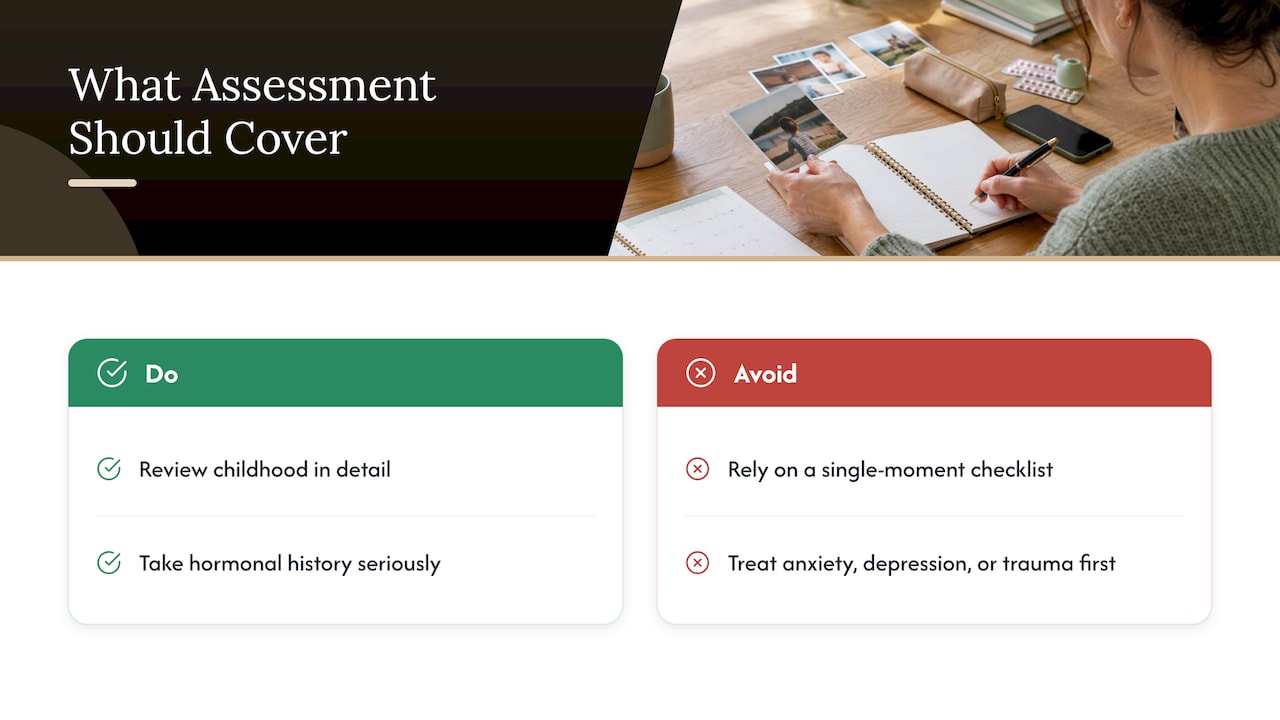
The clearest lesson from the evidence is that timing matters as much as symptoms do. A woman evaluated during a high-stress stretch of perimenopause looks different on paper than the same woman assessed five years earlier, and conventional advice rarely accounts for that. Most guidance online still treats ADHD assessment as a single-moment checklist, when the honest picture requires looking backward at childhood and sideways at hormonal timing simultaneously.
I think the biggest blind spot is comorbidity. Anxiety, depression, and trauma responses get treated first, and ADHD gets left as an afterthought, partly because treating the loudest symptom feels urgent and partly because clinicians undertrained in female presentations don’t always think to screen for it. If you take one thing from this, prioritize finding an assessor who asks about your childhood in detail and who takes hormonal history seriously, rather than one who hands you a checklist and calls it a diagnosis.
— Deane
We start every ADHD assessment with a free 15-minute connection call, so you can ask questions before committing to anything. Our clinics offer direct billing for many insurers, and you can choose telehealth or an in-person appointment depending on what works for your schedule. For current prices and billing details, please see our website.

Reach out through our assessment intake page when you are ready to take the next step.
This article is general information, not a substitute for advice from a qualified doctor. Consult a qualified healthcare professional about your own circumstances before acting on anything here.
The term is a clinical shorthand rather than a formal diagnostic criterion, and no single peer-reviewed source in the materials reviewed here defines it precisely.
Untreated ADHD in adults often shows up as chronic disorganization, missed deadlines, relationship strain from forgetfulness or emotional reactivity, and a pattern of starting tasks without finishing them. Comorbid anxiety, depression, and sleep disruption are common alongside these core symptoms, and reviews of female ADHD presentations note that internalized symptoms frequently go unrecognized for years.
“ADHD walk” is not a clinical or diagnostic term found in the research or guidelines reviewed for this article, and no standard definition exists in the sources consulted. If you have seen the phrase used to describe restless movement or pacing, it is best understood as informal shorthand rather than a recognized clinical sign.
There is no single, universally cited list of exactly twelve ADHD symptoms. Diagnostic frameworks instead group symptoms into inattentive and hyperactive-impulsive categories, each with roughly nine criteria, and a clinician combines these with rating scales like the ASRS and a developmental history during a formal evaluation rather than counting symptoms against a fixed list of twelve.
Pricing depends on the provider and whether your insurance offers direct billing, so it is worth asking during an initial call. We offer a free 15-minute connection call to walk through what an assessment involves and what direct billing may cover for you.
Related reading: How to get diagnosed with ADHD in Alberta, What an ADHD assessment costs, Can you develop ADHD later in life? and ADHD or anxiety in adults?.