
The therapy intake process is the short series of steps that gets you from “I think I need help” to your first real session: a first contact, some paperwork, and an initial interview where the therapist learns what brought you in. It is mostly conversation, you set the pace, and you are allowed to ask questions of your own. This guide walks through each step, the questions you may hear, what to prepare, and how a first couples session differs.
The American Psychological Association’s dictionary defines an intake interview as the initial interview with a therapist or counsellor, used to collect information about the concerns bringing you to therapy and some preliminary personal and family history. The point is to understand your needs well enough to plan appropriate care.
It is also the start of a relationship. Psychiatric News describes intake as both an initial evaluation of your current mental health and needs and the foundation for treatment planning and trust. So an intake is not an exam you can fail. There are no wrong answers, and nobody is grading you.
It also works in the other direction. You are assessing the therapist too: how they explain things, whether they listen, whether you can imagine telling them something difficult.
Every clinic arranges these a little differently, but most intakes follow the same path. Here is how it works with us, and what is typical elsewhere.

Many people hesitate here, so we make it low pressure. Every therapist at Supporting Wellness offers a free 15-minute connection call. You can use it to describe in a few sentences what is going on, ask about the therapist’s approach, and decide whether it feels like a fit before committing to anything. Our guide to the 15-minute consultation call covers what to ask and what to expect from it.
You do not need a physician referral to book with us. If you want a sense of who you might meet, our team pages, such as Ian Seitz, Loretta McConnel and Hannah Howell, introduce the therapists.
This is the admin step: which location or online option suits you (we are in Calgary, Red Deer and Cold Lake, and we also offer online counselling), which times work (evenings and weekends are available), and how you will pay. If you have benefits, ask about direct billing before your first visit. We explain how it works on our direct billing and insurance page.
You may be asked to fill in a form before or at the first session. It usually covers contact details, reasons for seeking therapy, health and medication information, and consent to treatment. We come back to what you are agreeing to below.
This is the first appointment with your therapist. Some clinics treat it as a full session, and some split the intake over one to three sessions. The therapist reviews your forms, asks follow-up questions, explains how they work and begins to shape goals with you.
Once there is enough information, the therapist and client use it together to set goals and develop a treatment plan, and that plan can change as therapy goes on. Nothing is locked in after the first hour.
The Louisiana Psychological Association’s consumer guide says first-session information commonly covers your present concerns, symptoms, past difficulties, and personal, family, social, developmental, medical and emotional history, as well as your relationships. Lifeline lists very common openers: why you came, what you want to achieve, whether you have been in therapy before, and what is happening in your life right now.
In practice that sounds like this:
That last question can feel abrupt. It is routine. Health Canada guidance notes that people with serious or potentially serious mental-health concerns, suicide risk or substance-use concerns often need consultation or referral to appropriate providers early. Therapists ask so they can make sure you get the right level of support from day one.
Yes. Lifeline says you do not have to share anything you are uncomfortable sharing and can proceed at your own pace. If a topic is too heavy for session one, say so. A good therapist will note it and return to it when you are ready. Trauma history is a common example: you rarely need to tell the whole story at intake. If trauma work such as EMDR is a possibility, our page on what to expect in your first EMDR session shows how the preparation phase is paced.
If you are seeing a clinician in Alberta, privacy law applies to the forms you sign. Alberta.ca explains that under PIPA organizations generally may collect personal information only for reasonable purposes and only as much as is reasonably needed. They usually must get your consent, explain the purposes, name someone who can answer privacy questions, and give you a reasonable opportunity to decline.
Sharing is limited too. Disclosure of your information generally requires consent and must be for reasonable purposes and limited to what is reasonably necessary. You can also ask to see the information held about you and request corrections in writing.
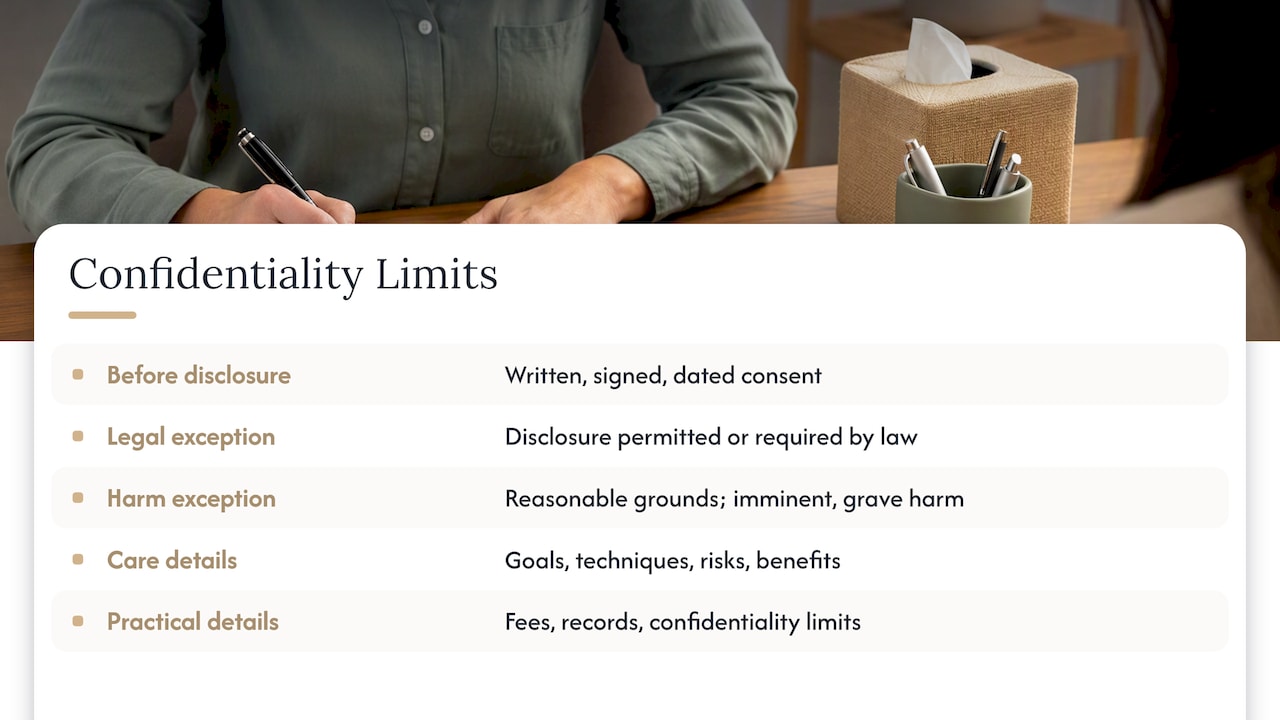
The College of Alberta Psychologists’ standards say psychologists must explain the limits of confidentiality and generally need informed, written, signed and dated consent before disclosing confidential information, unless disclosure is legally permitted or required. The same standards allow disclosure without consent where there are reasonable and probable grounds that it is necessary to prevent imminent and grave harm to you, another person, or public safety.
The Canadian Counselling and Psychotherapy Association’s standards add that counsellors should explain purposes, goals, techniques, risks, benefits, fees, records and confidentiality limits so you can make an informed decision. If that explanation does not happen, ask for it.
The intake runs both ways. Mind lists what a therapist should explain: their qualifications and professional registration, confidentiality, contact between sessions, their therapeutic approach, how long therapy might last, cancellation terms, fees where they apply, and how notes are stored. You should also have room to talk about your goals, accessibility needs and concerns, and you may be asked to sign an agreement showing you understand the service.
Use this as a checklist. If something is missing by the end of the first session, ask.
You do not need to prepare much, and you cannot do it wrong. A few small steps make the hour easier.
Nervousness is expected. Lifeline notes that nervousness and strong emotions can be normal, and that you can pace what you disclose. If you are not sure what to talk about, our article on what to talk about in therapy gives starting points.
Couples intakes have an extra layer: there are two people, and the therapist has to be fair to both.
At the outset of couples or family counselling, the CCPA standards say the counsellor should clarify who the client is, how the people are related, the limits of confidentiality, risks and benefits, and what information will be shared, when, how and with whom. A CCPA ethics article adds that consent matters especially here because disclosure requests need agreement among the participants, and consent can be revisited or withdrawn.
In plain terms, expect ground rules in the first session. For example: whether the therapist will keep a secret one partner shares in a private contact, and how that is handled.
You may also be looking at marriage and couples counselling in Calgary, where we use the Gottman Method among other approaches.
We have found that people carry more worry about the first session than about any later one. They fear being judged, being asked something they cannot answer, or discovering they picked the wrong person. That is why we built the connection call into how we work: you should be able to hear a therapist’s voice and ask your questions before you spend an hour in a room with them.
We also think a good intake should feel collaborative. You know your life; the therapist knows how change tends to happen. Goals come from both. If we ask about something and you are not ready, we would rather wait than push. Fit matters more than speed, and if a therapist is not right for you, saying so helps us find someone who is.
— Deane
We offer in-person sessions in Calgary, Red Deer and Cold Lake, plus online counselling, with individual, couples, family, child and adolescent, veterans and first responder, and Indigenous (NIHB) counselling, as well as assessments and specialized treatments like EMDR and Brainspotting. You can see everything on our services page.
If cost is a concern, our affordable counselling options are published at $100 for Calgary and $80 for Red Deer. Check each page for what is included and who it is for.

Ready to begin? Start with a free 15-minute connection call through our individual counselling page, or ask about direct billing when you reach out.
A typical intake session is a regular appointment, often around an hour, though some clinics spread it across several sessions. Ask how your clinic does it when you book. A short phone or video call beforehand, like our 15-minute connection call, is separate and does not replace it.
Not with us. You can book directly without a physician referral. Some insurance plans have their own requirements, so it is worth checking your coverage before your first visit.
That is common and nothing to apologize for. You can pause, slow down or skip a topic. Therapists expect strong emotions, and you can set the pace of what you share.
For individual therapy, you can ask the therapist whether it makes sense to bring someone, such as for support or to give background. For couples or family counselling, everyone attends and the therapist explains who the client is and how information will be shared.
Tell them, or simply look for someone else. Consumer guidance from psychologists encourages you to notice whether you feel emotionally safe enough to talk about personal difficulties and to keep looking if you do not.