
A Love Map is the part of your mind where you store what you know about your partner’s inner world: their worries, hopes, stressors, friends and small daily preferences. Dr. John Gottman made it the first floor of his Sound Relationship House because everything else in a relationship, including handling conflict, rests on it. You can build one with a few good questions and some steady curiosity, and this guide shows you how.
Gottman’s term for getting to know your partner’s world is Build Love Maps. A Love Map is simply what you know about your partner’s life, including the important things and the not-so-important ones.
The key word is detailed. The Gottman Institute describes the first floor of the Sound Relationship House as the place where partners come to know each other’s world. That includes fears, dreams, current stressors and inner life, not just surface preferences.
Here is how the difference looks in practice:
| Surface knowledge | Love Map knowledge |
|---|---|
| Knows your partner’s coworkers’ names | Knows which coworker is causing stress this month, and why |
| Knows their favourite music | Knows what song they put on when they need to feel like themselves |
| Knows they want a promotion | Knows what that promotion would mean to them and what scares them about it |
| Knows their mother’s name | Knows how the relationship with their mother shapes how they react to criticism |
If you can answer the right-hand column without guessing, your map is detailed. If you can only answer the left, you have a starting point, and that is a fine place to be.
The Sound Relationship House is the model behind Gottman Method couples therapy. A reference entry on the model explains that it forms the empirical basis for the therapy, drawing on research Gottman began in the 1970s at the University of Illinois and continued at the University of Washington.
The house has several levels. Love Maps sit on the lowest, then fondness and admiration, turning toward each other, the positive perspective, managing conflict, making life dreams come true and creating shared meaning. Trust and commitment hold up the sides.
Why start at the bottom? Think about what happens when a hard moment arrives, such as a job loss, a sick parent or a new baby. Partners who already know each other’s inner worlds can respond to the actual person in front of them. Partners with thin maps tend to guess, and guesses often miss.
The Gottman Institute makes this point too: knowing your partner’s world gives you the emotional footing to handle the challenges every long-term relationship meets, as laid out in its overview of the Sound Relationship House.
If you would like to see how the whole house is used in sessions, our page on the Gottman Method, what research shows and how we use it walks through it.
Three reasons come up again and again in our work with couples.
They make you feel known. Most of us want to be understood, not just loved in general terms. When a partner remembers the details, it communicates care without a grand gesture.
They protect you during stress. Stress changes people. Someone who is usually chatty may go quiet, or a calm person may become short-tempered. A partner with an up-to-date map can read that change as stress rather than as a personal attack.
They feed the rest of the house. Fondness, turning toward each other and shared meaning all need raw material. A Love Map supplies it: the specifics you can admire, ask about and build plans around.
None of this requires a perfect relationship. Couples often come to us feeling distant, and a few weeks of deliberate curiosity can change the tone.
The Gottman Institute’s guidance is that Love Maps are not a one-time assignment. They work best when they are part of a daily ritual of connection. Couples tend to do well when they approach it as ongoing, playful curiosity instead of a task to finish and file away.
That matters because your partner’s world keeps moving. Their stressors this month are not the stressors of last year.
Pick a time that is realistic, such as over dinner, during a walk or after the kids are asleep. Ask one question and listen to the full answer. A few starters:
Put your phone away while you do it. The goal is not to fix anything. It is to understand.
A yes or no question gets a yes or no answer. Open-ended questions invite stories, and stories are where the detail lives. Compare “Did you have a good day?” with “What was the best part of your day, and what was the hardest?”
Follow-ups matter as much as the first question. “What was that like?” and “Tell me more” show that you are actually interested.
Gottman offers a structured exercise. The Love Maps exercise is a printable from the Gottman Institute that you can use as a guide, and it includes a card-style question game. The idea is to take turns answering questions about each other, and then compare notes on what you got right and what surprised you.
A few ways to make it work:
Once you are comfortable, move from facts to meaning. These are written in our own words, in the spirit of the exercise:
Expect some answers to be uncomfortable. If a topic gets tense, pause it and come back later. The point is to learn, not to win.
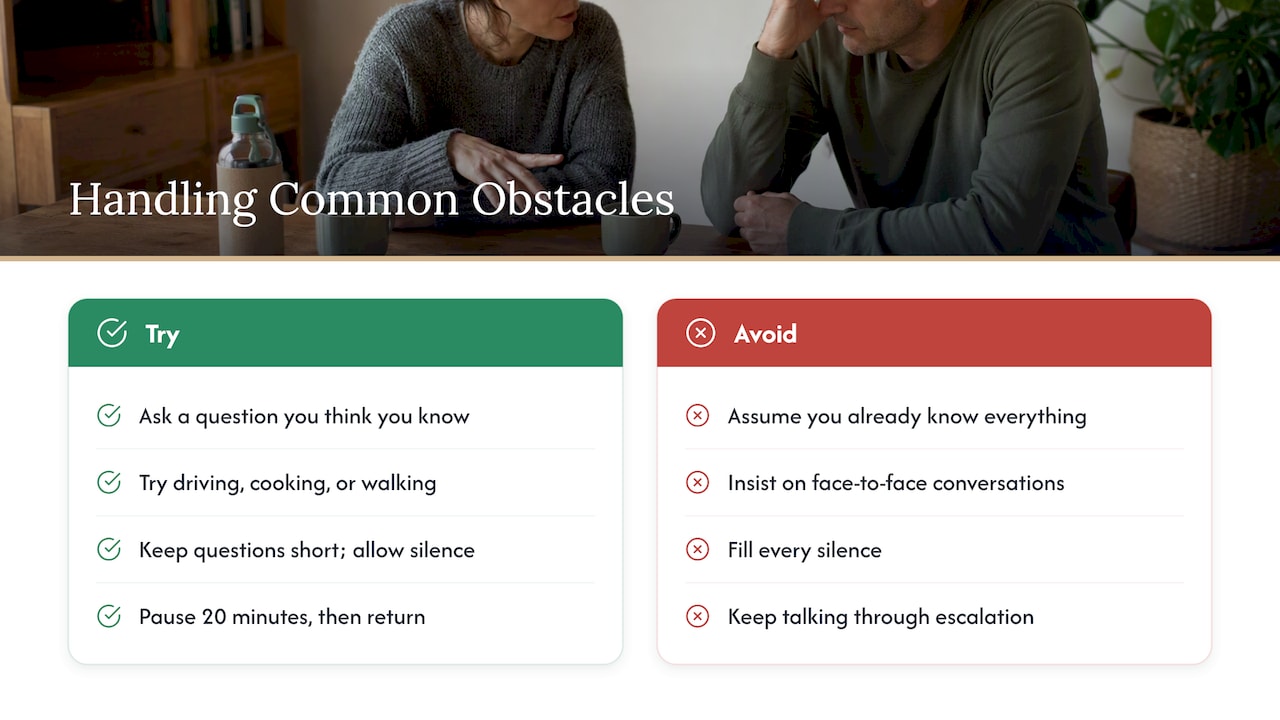
“We have been together twenty years. I already know everything.” Long-term couples often have the thickest assumptions and the oldest maps. Ask a question you think you know the answer to. You may be surprised.
“My partner does not like talking.” Try lower-pressure settings: driving, cooking, walking. Some people open up more side by side than face to face. Keep questions short and be comfortable with silence.
“It feels forced.” It may, at first. Awkwardness usually fades once the ritual becomes familiar. Start with five minutes.
“Every question turns into an argument.” This is worth taking seriously. The Gottman Method has a strong focus on calming down during conflict. A Canadian-clinic perspective we find useful: a study of Gottman Method couples therapy looked at couples who completed twelve weekly sessions and reported improved marital friendship and less physiological arousal during conflict, with benefits holding at a three-month follow-up. The takeaway for everyday life is that learning to settle your body during a tense moment is a skill. If your check-ins keep escalating, take a break of at least twenty minutes, then return.
For couples who recognize patterns such as criticism, defensiveness or stonewalling, our scripts for the Four Horsemen can help.
Early in a relationship, curiosity comes easily. The risk is assuming you have learned enough. Keep asking about family history, values and how each of you handles stress. If you are planning marriage, our list of premarital counselling topics gives you a way to turn those questions into real conversations.
Babies change the map overnight. Sleep, identity, money and priorities all shift. Many couples stop asking about each other because everything is about the baby. Even a five-minute daily check-in can protect the connection.
After years together, routines can replace curiosity. Anniversaries, retirements, health changes and children leaving home all redraw the map. Ask, as if for the first time, what your partner wants from the next chapter.
After a betrayal or a long period of distance, a Love Map can feel out of date. Rebuilding it is slow. A therapist can help set a pace so questions feel safe rather than interrogating.
When couples arrive in our Calgary and Red Deer offices, they often say some version of “we have just grown apart.” Looking closer, the distance is usually not a lack of love. It is that each partner’s picture of the other has stopped updating.
We like Love Maps because they are concrete. You do not need to talk about feelings in the abstract. You can start with a question about this week and build from there. That is a gentle entry point for people who are nervous about therapy.
We also see couples treat Love Maps as a test they can fail. We encourage the opposite. A gap in your map is not a failure. It is the next interesting conversation.
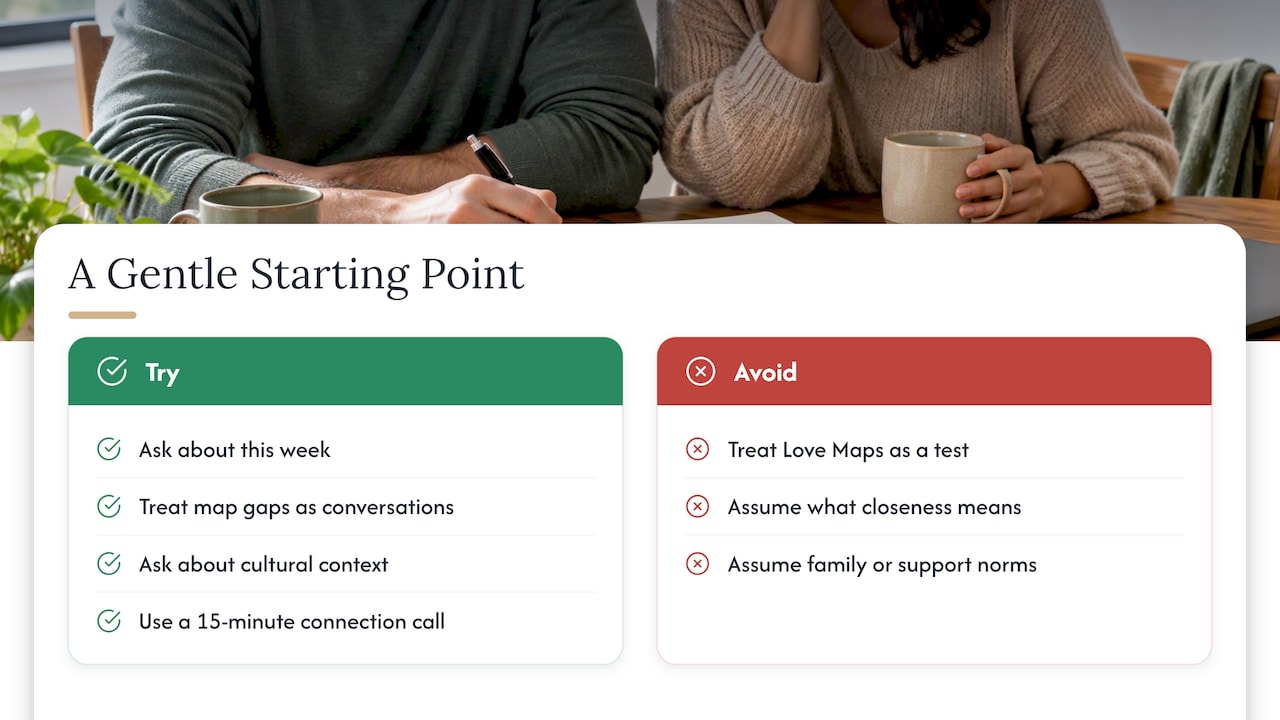
We work with couples and families across different backgrounds, and we have found that the best maps are built with cultural context in mind. What closeness looks like, how family is involved and what counts as support all vary. Asking rather than assuming is the best habit we can offer.
Finally, we offer a free 15-minute connection call with every therapist, because we believe it matters to feel comfortable with the person you work with before you begin.
— Deane
Self-guided exercises work for many couples. Consider professional support if:
If you ever feel unsafe in your relationship, contact a professional or local support service rather than working through exercises together.
In Gottman Method therapy, a therapist typically starts with an assessment of the relationship, then works through the levels of the house with you. Love Maps are often one of the early focus areas. You can read more about how the process can unfold in our article on how couples counselling improves communication and connection, and about setting goals for couples therapy.
Our therapists offer marriage and couples counselling in person and online, with direct billing to a wide range of insurers and no physician referral needed. Evening and weekend availability can make it easier to fit around work and family. Our team works with approaches including the Gottman Method.
You can learn more on our marriage and couples counselling page for Calgary, see all of our services, or book a free 15-minute connection call to ask questions before committing to anything.
A Love Map is your working knowledge of your partner’s inner world, including their stressors, dreams, worries, relationships and everyday preferences. It is the first floor of the Sound Relationship House. The more current and detailed it is, the better prepared you are to support each other.
There is no fixed schedule, and the Gottman Institute describes Love Maps as an ongoing practice rather than a one-time task. A brief daily check-in is a good habit, and a longer conversation every few months can catch bigger changes. Major life events are also a good prompt to ask again.
It is not a literal drawing. It is the mental record you hold: who matters to your partner, what is stressing them, what they hope for and what they fear. A quick test is to write down what you think your partner’s top three current worries are, then ask them to compare.
They are a foundation, not a cure-all. Many couples feel closer after building them, but conflict patterns, trust injuries or mental health concerns usually need more than questions. A therapist can help you decide what to work on first.
No. You can use the exercises on your own, and many couples do. Therapy helps when you feel stuck, when conversations become heated or when you want a guide who can notice patterns you cannot see from the inside.