
Blended family therapy is an evidence-based way to improve communication, align parenting, and reduce the conflicts that commonly arise when families merge. It addresses common issues that many stepfamilies face: breakdowns in communication, mismatched discipline, and unclear roles between stepparents and biological parents. With the right approach, families typically see clearer parenting plans, fewer arguments over the same recurring issues, and a steadier sense of who belongs where.
TL;DR:
- A randomized PMTO trial involving 110 stepfamilies found improved parenting practices benefited marital relationships and helped prevent child behavior problems from escalating over 24 months.
- PMTO usually runs for 8 to 13 sessions, and concrete parenting skills can engage stepparents more readily than beginning with couples therapy.
- Offer roughly five supportive comments for every correction during everyday interactions, so children do not experience a stepparent only as a disciplinarian.
- Check progress with the therapist every several sessions; if discipline patterns remain unchanged after three months, revise the format or add targeted support.
Blended family therapy treats the family as a connected system rather than hunting for a single person to “fix.” When one child seems to be the problem, or one stepparent feels blamed for every conflict, a systemic lens usually finds a pattern involving everyone, not a single cause. This approach draws on frameworks that reduce scapegoating by distributing responsibility for change across the family unit rather than isolating one member.
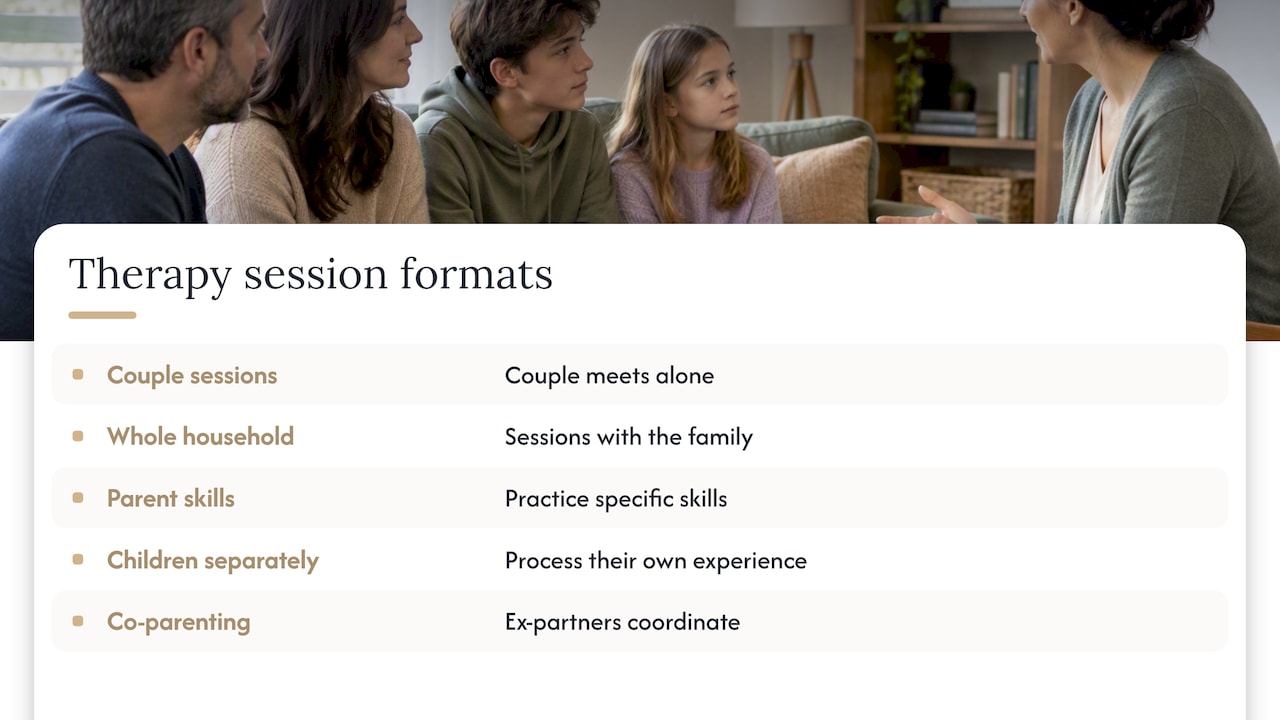
Sessions can include the couple alone, the whole household, a parent working on specific skills, or children meeting separately to process their own experience. Ex-partners sometimes join when co-parenting coordination is the goal. Across these formats, the work usually centers on the same handful of goals: open communication, clear boundaries between roles, a parenting approach both adults can stand behind, and space to grieve the family structure that existed before.
Most families arrive with a cluster of related problems rather than one isolated issue. Recognizing the pattern often brings relief on its own, since it confirms the struggle is common rather than a sign something is uniquely wrong.
Parenting counselling focused on strengthening parent-child bonds often runs alongside this work when a specific relationship needs extra attention.
Different methods target different parts of the problem, and a therapist often blends several within one treatment plan.
A randomized trial of the Oregon PMTO program involving 110 new stepfamilies found that improved parenting practices produced indirect benefits to marital relationship processes and helped prevent escalation of child behavior problems over 24 months. That finding matters because it suggests that starting with parenting skills, rather than diving straight into marital therapy, can be an efficient entry point: stepparents tend to engage more readily when the first focus is concrete, child-centered tasks rather than the couple’s relationship itself. Professional guidance from the APA similarly points to systemic and attachment-informed frameworks as the most useful foundation for stepfamily counseling.
A first session typically involves an assessment of family history, current stressors, and safety concerns, followed by collaborative goal-setting about what each person wants to change. Who attends varies: some therapists start with the couple, others bring in the whole household from the first meeting.
Co-parenting counseling is worth asking about directly if coordinating between two households is the main source of friction.
Small, consistent habits between sessions often matter more than the sessions themselves.
Pro Tip: Try the speaker-listener technique at the dinner table once a week on a low-stakes topic before using it for a real conflict, so the structure feels familiar when tensions are high.
If a couple is still early in blending households, reviewing premarital counseling topics can help surface expectations before they turn into recurring arguments.
Persistent conflict that doesn’t ease with time, a child’s behavior getting worse rather than better, one parent feeling consistently burned out, or any safety concern are all signs it’s time to bring in outside support rather than keep managing it alone.
In the short term, families often notice fewer blowups, clearer agreed-upon rules, and calmer family meetings within the first several weeks of focused work. Longer term, the goal is a stable co-parenting arrangement, visible improvement in a child’s adjustment, and a family identity that feels settled rather than provisional. The same PMTO trial noted earlier found that early parent-focused work can prevent escalating child behavior problems over time, which is a strong argument for addressing parenting friction before it hardens into a bigger pattern.
Not every family therapist has specific experience with stepfamily dynamics, and that distinction matters. Look for someone trained in systemic or family-systems approaches, since blended families often need a therapist comfortable working with shifting configurations of people rather than a fixed couple or single child.
Ask directly about experience with co-parenting across households, loyalty conflicts, and stepparent role-building, since these come up far more often in blended families than in first-marriage households. A therapist who can speak concretely about PMTO, EFT, or Gottman-based communication work, rather than offering vague reassurance, is usually a good sign they work from an evidence base rather than instinct alone.
Practical fit matters too. Consider whether the therapist offers a brief introductory conversation before booking, since a short connection call can tell you a lot about comfort and approach before committing to a full session. Confirm logistics up front: direct billing to your insurer, evening or weekend availability if your schedule is tight across two households, and whether online sessions are an option when coordinating in-person attendance across co-parenting arrangements is difficult. Finally, trust your own read of the fit. If a parent or teenager feels dismissed or unheard in an early session, that’s worth raising directly or looking elsewhere, since engagement from every family member is part of what makes the work succeed.
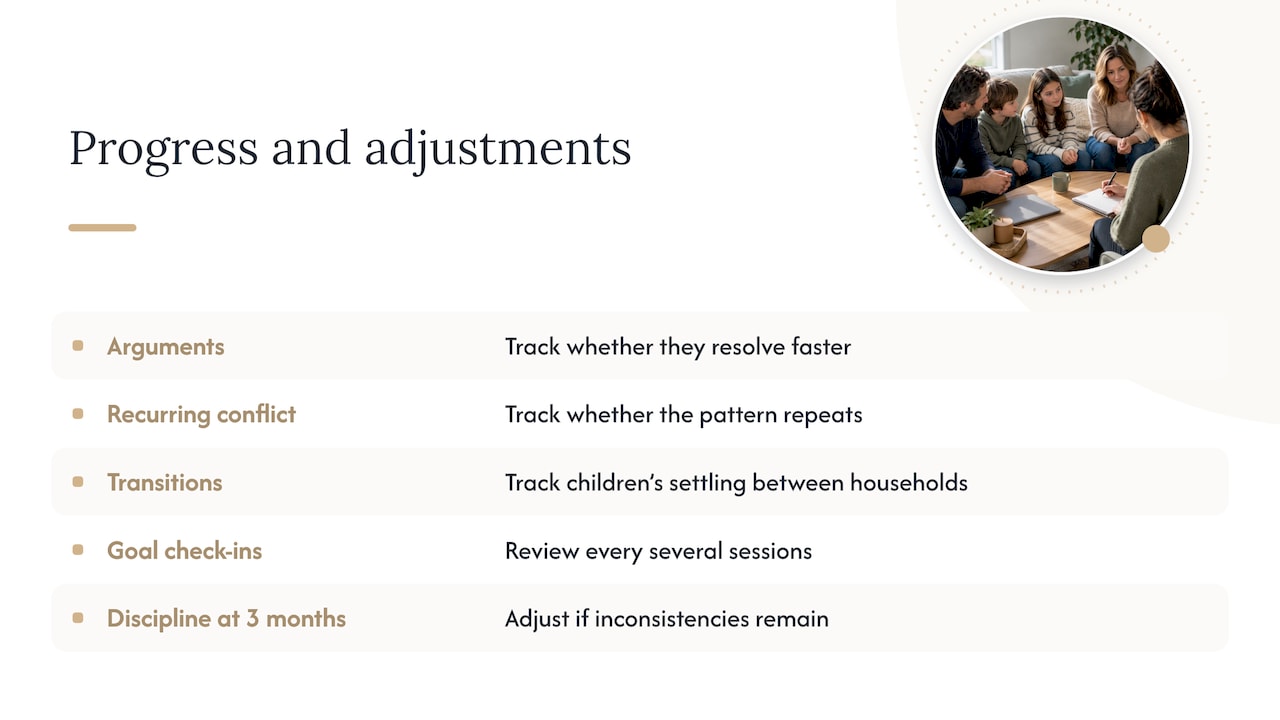
Progress in blended-family therapy is usually visible in specific, nameable changes rather than a vague sense of things being “better.” Track whether arguments resolve faster, whether the same conflict keeps recurring in the same form, and whether children seem more settled around transitions between households.
A useful habit is checking in explicitly with your therapist every several sessions about whether the original goals still make sense. If three months in, discipline inconsistencies remain exactly where they started, that’s a signal to adjust the approach rather than keep repeating it. Sometimes the fix is switching formats, moving from whole-family sessions to a parent-only block focused on co-parenting skills, or bringing in a specific modality like EMDR if a parent’s unresolved grief from a previous relationship keeps resurfacing. Family counselling that stalls is not a sign the family failed; it’s information that the plan needs recalibrating.
Pay attention too to whether gains outside the therapy room are holding. A family that handles one holiday season smoothly but reverts to old patterns the next month may need a booster session rather than a full restart.
A persistent myth is that therapy means something has gone seriously wrong. In practice, many families start counseling proactively, before the wedding or move-in date, specifically to build skills rather than repair damage.
Another misconception is that love should happen naturally between stepparents and stepchildren, and that needing structure to build the relationship is a failure. Attachment research points the other way: relationships, especially across a household transition, usually grow through small, repeated, predictable interactions rather than instant affection.
Some assume therapy will mean picking a side between biological parent and stepparent. A systemic approach does the opposite: it treats the family as an interconnected unit and avoids placing blame on any single member. Finally, many believe results should appear within a session or two. Real change, particularly in parenting consistency and trust-building, tends to unfold over months, with early sessions producing quick relief and deeper patterns taking longer to shift.
Blended families rarely need to be told their situation is complicated. What tends to help more is a steady, practical plan built on methods with real evidence behind them, including Gottman-based communication work, EMDR, and brainspotting where past trauma is part of the picture. Families coordinating across two households often need flexibility, which is why a free 15-minute connection call and multiple clinic locations can help make that first step easier. Progress with blended families is rarely instant, and we see our role as a steady partner in that pace, not a quick fix.
— Deane
We offer family counselling built specifically around the kinds of patterns blended families bring to us, from co-parenting friction to stepparent role confusion.

If reading this has clarified what your family is working through, booking a family counselling session is a direct next step, and the connection call is there if you want to talk it through first.
This article is general information, not a substitute for advice from a qualified doctor. Consult a qualified healthcare professional about your own circumstances before acting on anything here.
Consistency between the two adults, clear and age-appropriate communication with children, and patience with the stepparent-stepchild relationship tend to matter more than any single technique. Structured approaches like speaker-listener communication and unified co-parenting responses, both used in family counselling, give families a concrete starting point.
Most recurring family drama traces back to unclear roles or inconsistent responses between households rather than any one person being difficult. A systemic approach that looks at the whole pattern, rather than blaming one family member, tends to reduce the drama more reliably than addressing each incident separately.
Communication breakdowns, inconsistent discipline across households, loyalty conflicts between biological parents and stepparents, and unclear stepparent authority are the most frequent issues we see. Holiday scheduling and daily logistics often escalate these underlying tensions rather than causing them outright.
Family conflict refers to ongoing disagreement or tension between family members, often rooted in mismatched expectations, unclear roles, or unresolved past issues rather than a single dispute. In blended families, it frequently centers on parenting consistency, loyalty between biological and step-relationships, or logistics across two households.
Therapists commonly draw on systemic family-systems approaches, Parent Management Training (PMTO), Emotionally Focused Therapy, and Gottman-based communication techniques, often combining several within one treatment plan. A randomized PMTO trial found that improved parenting practices indirectly benefited marital processes and helped prevent escalating child behavior problems over 24 months.
Related reading: When one family member is struggling and Adolescent counselling.