
Co-parenting counseling is child-focused, skills-based support that helps separated or divorced parents communicate better, manage conflict, and build a workable parenting plan. It tends to help most when arguments about the kids are frequent, schedules keep breaking down, or a court has recommended it, though joint sessions are not appropriate when family violence is present. If you recognize your situation here, the next step is simple: book a consult, or ask about an individual intake if your co-parent won’t participate.
TL;DR:
- Co-parenting counseling is most beneficial when arguments about children are frequent, schedules are inconsistent, or a court has recommended it, but not suitable when family violence is present.
- Sessions focus on practical skills like calm communication, shared planning, and handling conflict, often including psychoeducation, role-playing, and homework between meetings.
- Structured programs typically last a series of short sessions, with some clinicians offering online or in-person formats and alternations between joint and individual sessions depending on family needs.
- Safety screening is critical; when family violence exists, solo or supervised interventions are safer, as joint sessions could pose real risks to victims and children.
- Cost considerations include variable fees, limited insurance coverage, and affordable community or group options, especially for families with safety concerns or limited resources.
Co-parenting counseling is not about repairing a romantic relationship. It is future-oriented, built around one question: how do two separate households raise a child well together? Where couples therapy often works through relationship history and emotional repair, co-parenting counseling sets that history aside and focuses on what happens next: pickups, school decisions, holidays, and how two parents talk to each other without putting a child in the middle.
A few things distinguish it from other family services:
Because the focus is practical rather than relational, sessions can feel more like structured problem-solving than traditional therapy, which is often a relief for parents who dread rehashing old wounds.
If you’re wondering whether it’s time to reach out, a few patterns tend to show up consistently among parents who benefit:
If your co-parent refuses to participate, you’re not stuck. An individual intake, a mediated session, or a coach-led approach can still move things forward, even without full cooperation on the other side.
Sessions vary depending on what your family needs. Some clinicians see both parents together; others alternate with single-parent sessions, especially early on or when tension runs high. Both in-person and online formats are common, and many parents start with a brief, structured program rather than open-ended therapy.
A typical session draws on:
Most programs produce something concrete: a written parenting plan, a communication protocol, a shared calendar, or homework to practice between sessions. Many parents complete a short series of sessions focused on specific skills, then check back in periodically rather than committing to indefinite ongoing therapy.
Pro Tip: Bring a specific recent conflict to your first session rather than a general complaint. It gives the therapist something concrete to work through with you.
Much of the work is learning to communicate in ways that don’t escalate. A few examples you can start using before your first session:
Department of Justice Canada guidance recommends exactly this kind of respectful, businesslike communication, and suggests parallel parenting or structured tools like email and co-parenting apps when face-to-face contact is too conflictual. Homework between sessions often includes practicing scripted exchanges, setting up a shared calendar, or scheduling brief check-ins to review how the week went.
Fees vary by provider and region, and when a judge orders counseling, the order often specifies how costs are split between parents. Insurance coverage can be inconsistent: some plans require a clinical diagnosis before they’ll reimburse sessions framed as individual therapy, which doesn’t always fit neatly with co-parenting work.
If cost is a barrier:
Before recommending joint sessions, clinicians screen for family violence and coercive control. This isn’t a formality: when abuse is ongoing, sitting two parents in a room together can put the victimized parent, and sometimes the children, at real risk.
A meta-analysis of 27 randomized controlled trials found co-parenting programs produce a small but statistically significant benefit for parents’ well-being and co-parenting quality (effect size g = 0.21), a modest but real effect that underscores why screening matters: the benefit only holds when the model fits the family’s actual safety situation.
Not every therapist does this work the same way, so it’s worth asking a few direct questions before booking.
Pro Tip: Treat the first call like an interview. A good fit matters more here than credentials alone, since you’ll need to trust this person with some genuinely difficult conversations.
What tends to move the needle isn’t rehashing who did what. It’s practicing specific skills: calmer language, clearer plans, fewer surprises for the kids. Methods like the Gottman Method, EMDR, and Brainspotting give therapists structured ways to work through the communication patterns and old wounds that keep resurfacing in co-parenting conflict.
A free 15-minute connection call, offered before any commitment, is a low-friction way to find out whether a particular therapist feels like the right fit, whether you’re looking for in-person support in Calgary, Red Deer, or Cold Lake, or an online session from wherever you are.
Walking in prepared makes the first session more productive and less draining. A few things worth doing beforehand:
Write down the two or three issues that come up most often, whether that’s handover timing, communication tone, or disagreements about school decisions. Vague frustration is harder to work with than specific examples.
Think through what a workable week actually looks like for your child, not just what feels fair to you. Therapists often start by asking what the child’s routine currently is and where it breaks down.
If you have an existing parenting plan or court order, bring a copy. It gives the therapist a starting point rather than having you describe it from memory.
Consider what you’re not willing to compromise on, and separate that from what’s negotiable. Walking in with everything as non-negotiable tends to stall progress quickly.
If you’re nervous about the first session, that’s normal. Most parents arrive guarded, especially if past attempts at communication went badly. A good therapist will spend part of that first session simply setting expectations and helping you feel less defensive before diving into specifics.
Finally, consider whether individual prep, like journaling recent conflicts or talking to a friend about your goals for the sessions, might help you walk in clearer about what you actually want to get out of it.

Progress in co-parenting counseling is usually tracked through concrete, observable changes rather than a single test or score. Are handovers happening without incident? Are messages between parents shorter and less charged? Is the child showing fewer signs of distress around transitions?
Therapists often revisit the parenting plan periodically to see whether it’s actually being followed, and whether it needs adjusting as kids get older or circumstances change. Homework completion, such as whether scripted communication templates are actually being used, is another practical marker.
Counseling tends to wind down naturally once a few things are true: communication has stabilized, the parenting plan is working day to day, and both parents feel equipped to handle new disagreements without outside help. That doesn’t mean conflict disappears entirely, but it becomes manageable without a session every week.
Some families return periodically for a tune-up, especially around major transitions like a child starting school, a move, or a new partner entering the picture. That’s a normal use of the service, not a sign that the earlier work failed.
The conventional advice on this topic leans heavily on vague encouragement: “communicate better,” “put the kids first.” That’s true but not useful on its own. What the evidence actually supports is narrower and more practical: structured skills training, specifically psychoeducation and communication practice, produces a measurable, if modest, benefit for co-parenting quality.
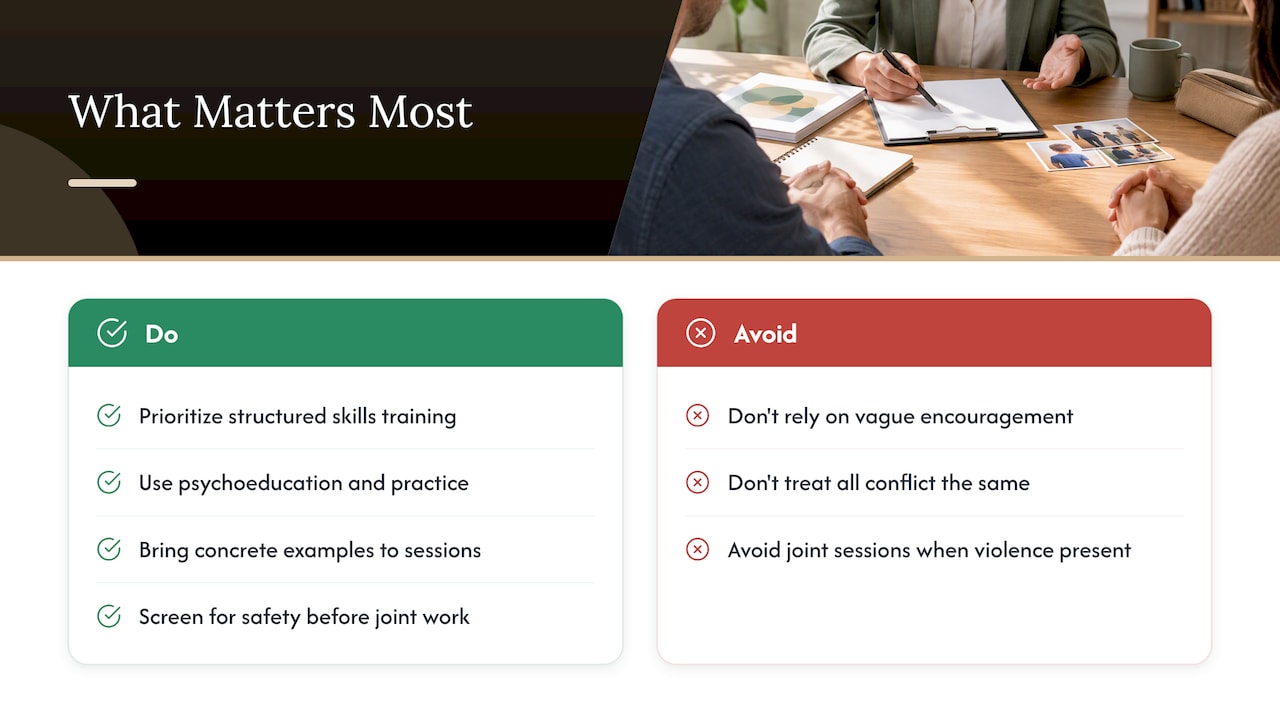
Where most advice falls short is treating all conflict the same way. A disagreement about bedtime routines and a pattern of coercive control are not the same problem, and they don’t call for the same solution. Safety screening isn’t a bureaucratic step to get through before the “real” work starts. It’s the work that determines whether joint sessions are even appropriate.
If you take one thing from this, prioritize specificity over sentiment. Walk into counseling with concrete examples, not just a general sense that things are hard. And if your family’s situation includes any pattern of violence or control, start with individual support rather than pushing for joint sessions that weren’t built for your circumstances.
— Deane
We offer parenting and family counseling designed to help separated parents build calmer communication and workable routines for their kids, delivered in person or online to suit your schedule.

If you’re ready to talk through your options, you can learn more about our parenting counselling services and book a connection call to get started.
Keep communication short, factual, and focused on logistics rather than emotion. Department of Justice Canada guidance recommends protecting kids from adult conflict by keeping exchanges respectful and businesslike, even when the relationship itself is strained.
The 7-7-7 rule refers to a custody schedule with alternating periods of care between parents on a regular cycle. It’s one option among many parenting schedules, and whether it fits your family depends on your child’s age, school routine, and how far apart the two households are.
Common mistakes include arguing in front of the children, sending emotionally charged messages instead of factual ones, and failing to agree on consistent rules between households. Inconsistent follow-through on a parenting plan, or changing schedules last minute without discussion, also tends to drive ongoing conflict.
Parallel parenting, where each parent manages their own household with minimal direct contact, often works better than trying to force collaboration with someone who won’t engage constructively. Limiting communication to essential, written exchanges and working with a therapist individually can help you set boundaries without relying on the other parent’s cooperation.