
Yes, premarital counseling helps most engaged couples by improving communication, conflict skills, and planning before marriage. A 2003 meta-analytic review found that the average participant saw about a 30% increase in outcome success, landing ahead of roughly 79% of couples who skipped it. We treat this evidence as a starting point, not a guarantee, and we build sessions around what actually moves the needle for each couple.
TL;DR:
- Couples facing blended families, prior divorces, significant debt, or past trauma should start earlier, since these factors can add more issues to address.
- Most programs involve four to eight sessions with homework, covering communication, recurring conflicts, finances, family backgrounds, and intimacy; later meetings often emphasize skill practice.
- Research finds modest, consistent communication gains, especially in observed behavior, but evidence that counseling reduces divorce over time remains mixed and varies by couple.
- Before booking, confirm your counselor’s credentials and methods, ask about direct billing or sliding scale fees, and check whether insurance covers that professional designation.
The benefits of premarital counseling show up in specific, learnable skills rather than vague reassurance. Here is what tends to shift once couples put in the work:
Communication work often starts with something as simple as a daily check-in: each partner shares one high point and one low point from the day, without interruption. It sounds basic, but couples who practice this consistently report fewer blowups over small issues, because the habit of listening is already built before a real conflict arrives.
Conflict resolution training usually targets the patterns that do the most damage: criticism, defensiveness, contempt, and stonewalling. Naming these patterns gives couples language for what is happening in the moment, which makes it easier to pause before a disagreement spirals.
Couples heading into marriage with blended families, prior divorces, or significant debt tend to benefit the most, since they are often navigating more variables at once. Couples with fewer complicating factors still benefit, typically through faster conflict de-escalation and clearer financial agreements rather than crisis prevention.
Pro Tip: Bring a real disagreement from the past month into your first session rather than a hypothetical one. Working through an actual conflict gives your counselor something concrete to coach.
Premarital counseling comes in a few formats, and picking the right one matters as much as showing up.
Most programs run four to eight sessions, with homework between appointments, worksheets, conversation prompts, or practice exercises you try at home before the next meeting. Sessions commonly cover communication habits, recurring conflict patterns, finances, family-of-origin influences, and intimacy. A therapist trained in an integrative approach will typically structure early sessions around assessment and later ones around skill practice, rather than treating every meeting the same way.
The strongest evidence for premarital counseling comes from a 2003 meta-analytic review of outcome research across multiple prevention programs.
A meta-analysis of premarital prevention programs found the average participant was better off than the majority of non-participants on relationship skills and quality. That is a meaningful edge before a marriage even begins.
The honest takeaway is that premarital counseling reliably builds skills couples use, even though evidence on whether it changes long-term divorce rates is mixed. Skill-building is the measurable, replicated win.
Getting the logistics right makes the difference between counseling that fits your life and counseling that becomes one more wedding-planning stressor.
Pro Tip: Call ahead and ask what credentials your counselor holds and which methods they use. A short connection call before booking saves you from mismatched expectations later.
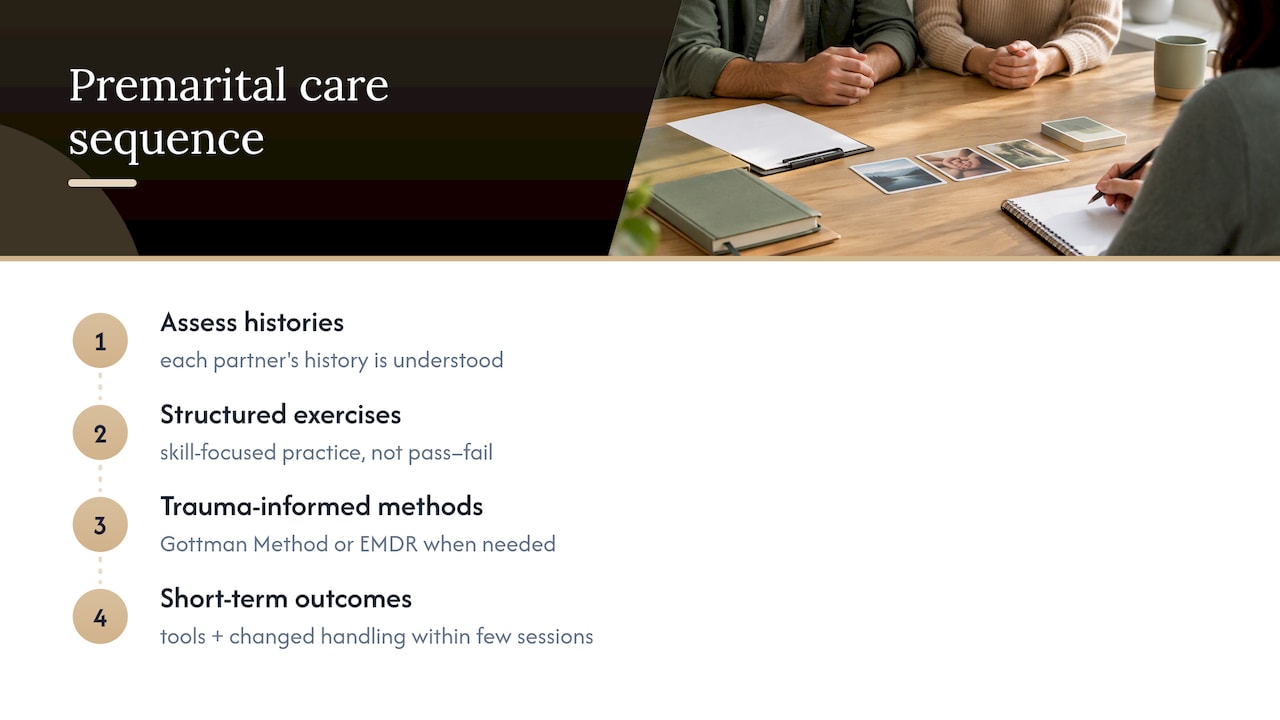
We approach premarital counseling as collaborative and skill-focused rather than a pass-fail evaluation of your relationship. Sessions lean on structured exercises, sometimes drawing on the Gottman Method or EMDR when past trauma is shaping present-day conflict, so couples leave with tools, not just insight.
Couples often report that naming a recurring argument out loud, with a neutral third person in the room, changes how they handle it at home within a few sessions. The course of care usually starts with understanding each partner’s history before moving into shared skill practice.
— Deane
We offer marriage and couples counselling for engaged partners who want practical skills before the wedding, not just a conversation about feelings. Sessions run in-person or online, and direct billing may be available for clients depending on their insurance plans.
If premarital work surfaces deeper relationship patterns, a hypnotherapy approach is one complementary option some couples explore alongside structured counseling. For couples ready to start, our marriage and couples counselling page outlines what to expect, and our guide to premarital counseling topics helps you prepare for session one.
This article is general information, not a substitute for advice from a qualified doctor. Consult a qualified healthcare professional about your own circumstances before acting on anything here.
Definitions vary, but a common version suggests checking in on your relationship at three days, three weeks, and three months after a major event or decision, like starting counseling or moving in together. It is an informal habit some couples use to track progress, not a clinical standard.
Most couples start three to six months before the wedding, giving enough time for four to eight sessions without rushing through homework between appointments. Couples managing blended families or significant past conflict often benefit from starting earlier.
Avoid ultimatums, blame-heavy accusations, or bringing up a partner’s past mistakes as ammunition rather than as something to work through together. Counselors typically redirect these moments toward naming the underlying need instead of relitigating old arguments.
The purpose is to build communication and conflict skills, clarify expectations around finances and family roles, and strengthen emotional intimacy before the wedding. Research shows participants tend to outperform non-participants on these relationship measures.