
Both EMDR and trauma-focused CBT are well-supported treatments for trauma and PTSD, and neither one wins outright. EMDR often helps people process distressing memories faster and without extensive talking, while CBT builds cognitive skills and structured exposure exercises you can practice between sessions. The right choice depends on your symptoms, your comfort with each method, and how well you connect with your therapist. Below, you will find the evidence and a practical checklist for choosing.
TL;DR:
- Both EMDR and trauma-focused CBT are equally supported by evidence and can be effective, with no clear overall winner.
- EMDR tends to produce faster symptom relaxation with less verbal disclosure required, making it suitable for memory-heavy or shame-sensitive cases.
- Trauma-focused CBT offers structured homework and skill-building, which appeals to those who prefer concrete progress tracking and face avoidance symptoms.
- Long-term outcomes show little difference between the therapies, emphasizing completion and ongoing support over modality choice.
- Matching the therapy to personal preferences, treatment tolerability, and therapist experience significantly influences success.
The two approaches start from different premises. Trauma-focused CBT works through cognitive restructuring: you learn to identify unhelpful thought patterns tied to the trauma, then gradually face trauma-related memories or situations through structured exposure exercises. EMDR takes a different route. It asks you to briefly recall a distressing memory while your therapist guides bilateral stimulation, usually eye movements, taps, or tones, a process thought to ease the emotional charge of the memory by taxing your working memory rather than requiring you to narrate the event in detail.
Session structure reflects that split. CBT sessions typically involve psychoeducation, worksheets, and homework such as thought records or gradual exposure tasks you complete outside the therapy room. EMDR sessions tend to stay within the session itself, with less take-home work, though preparation and stabilization exercises often come first.
A few practical differences stand out:
A large systematic review of 114 randomized-controlled trials covering 8,171 participants found that both trauma-focused CBT and EMDR produce clinically important improvements in PTSD symptoms and are recommended as first-line treatments. Dropout rates and how well you tolerate the treatment’s core mechanism, whether that is narrative exposure or nonverbal memory processing, often matter more to your outcome than which label the therapy carries.
The strongest evidence for trauma treatment comes from large reviews pooling many trials rather than any single study. That matters because individual trials can be small or inconsistent, while a systematic review shows the broader pattern.
**A meta-analysis of several studies found EMDR modestly ahead of CBT on short-term symptom reduction, though this advantage often did not hold at longer follow-up (source).
The honest picture is one of heterogeneity. Study quality varies, follow-up periods are inconsistent, and pooled results shift depending on which trials are included. No review declares a universal winner. The practical takeaway holds steady across the literature: both treatments are supported, and the deciding factors are usually your presentation, your preferences, and your clinician’s experience with the specific protocol.

Clinicians often lean toward EMDR when a client’s trauma is heavily memory-based, when verbalizing the event feels overwhelming or shame-inducing, or when faster symptom relief is a priority. Because EMDR does not require detailed disclosure of what happened, it can work well for clients who freeze up when asked to describe traumatic content aloud.
Trauma-focused CBT tends to fit better when phobic avoidance is central, when structured skill-building appeals to you, or when you want concrete homework you can track between sessions. It also has strong support for anxiety disorders more broadly, including through exposure-based protocols delivered individually, in groups, or through guided internet programs.
A few other factors shape the decision:
Uncertainty about the first session is one of the biggest barriers to starting therapy. Here is a general outline of what to expect from each approach.
Some emotional activation after either type of session is common. Pacing matters, and a competent therapist will check that you are stabilized before ending a session, not just when time runs out. Supporting Wellness outlines this process in more detail in its guide to what to expect in your first EMDR session.
Choosing between EMDR and CBT does not have to be a guessing game. A short checklist and a few direct questions can clarify the decision.
Pro Tip: Bring a written list of questions to your first consultation call so nerves do not crowd out the details you actually need to compare providers.
Therapists sometimes sequence the two rather than choosing one exclusively. A common model teaches coping and grounding skills through CBT techniques first, then moves into EMDR memory processing once you feel more stable, followed by a consolidation phase to reinforce gains.
Reasons clinicians combine approaches include:
This kind of integration depends heavily on clinician skill and is better described as a practical, individualized plan than a single standardized protocol with its own evidence base.
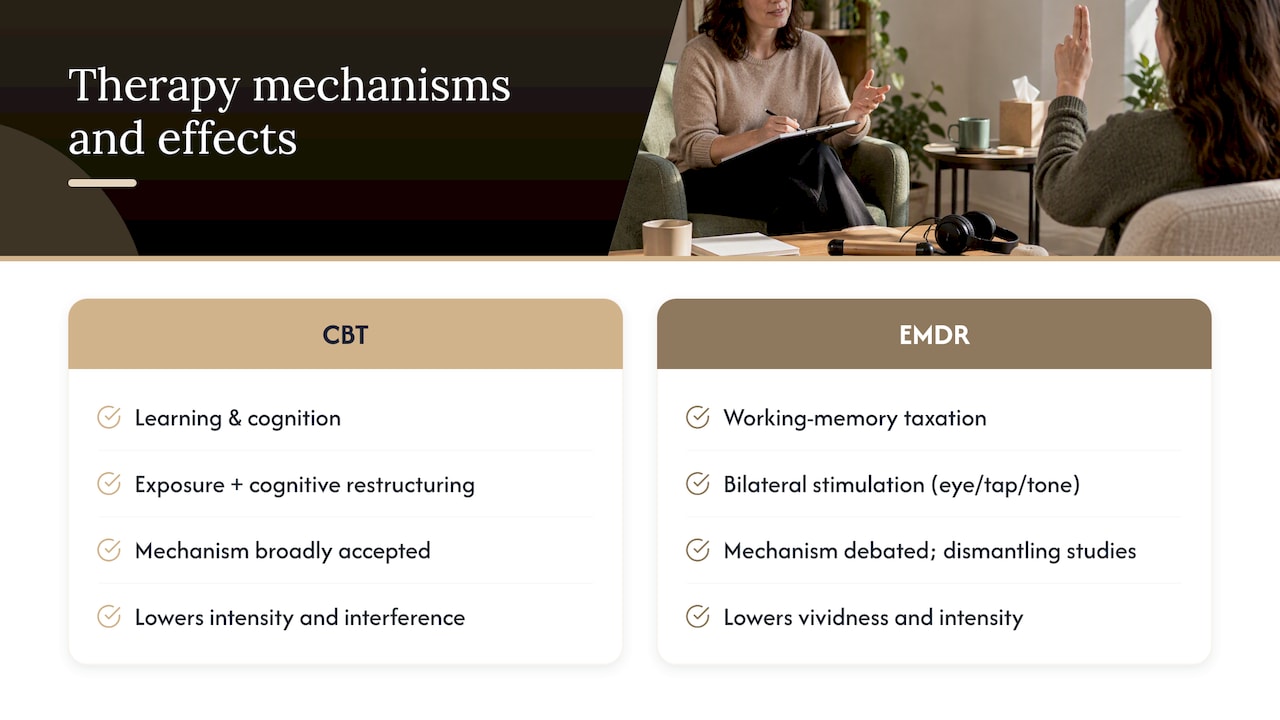
CBT’s effect on emotional processing is generally understood through learning and cognition: repeated, structured exposure to trauma reminders, paired with cognitive restructuring, helps weaken the link between a memory and the fear response it triggers, while new, more balanced beliefs replace distorted ones over time.
EMDR’s mechanism is less settled. The original theory proposed that bilateral stimulation mimics eye movements seen in REM sleep, supporting memory reprocessing. More recent theoretical and dismantling work suggests a different explanation: holding a memory in mind while simultaneously performing a bilateral task taxes working memory, which appears to reduce the vividness and emotional intensity of the memory as it is recalled. Dismantling studies indicate that the specific bilateral stimulation, whether eye movements, taps, or tones, may not be strictly necessary for EMDR to work, though it remains the standard delivery method and is adjusted when eye movements are not practical for a client.
Neither mechanism should be described in absolute terms. CBT does not erase a memory, and EMDR does not overwrite it. Both appear to change how intensely a memory is experienced and how much it interferes with daily functioning, which is the outcome that matters most in symptom relief.
Costs for EMDR and CBT vary by provider, session length, and whether sessions are billed individually or as part of a broader treatment plan. Neither approach has a fixed national price, and coverage depends heavily on your specific insurance plan and whether the provider offers direct billing.
Some clinics offer reduced-rate options for clients without insurance coverage. Supporting Wellness, for example, lists Affordable Counselling Calgary at 100 CAD per session and Affordable Counselling Red Deer at 80 CAD per session as lower-cost entry points, alongside standard-rate individual therapy. Many insurers cover psychological services, including EMDR and CBT, under extended health benefits, though the specifics of what is covered and at what rate depend entirely on your individual plan. It is worth calling your insurer directly to confirm coverage details before booking, and asking a prospective clinic whether they offer direct billing so you are not paying out of pocket and waiting on reimbursement.
Short-term symptom reduction is only part of the picture. What happens months after treatment ends matters just as much, and this is where the evidence gets murkier. Some meta-analyses that show an early advantage for EMDR over CBT on symptom reduction find that gap narrows or disappears at later follow-up points, suggesting the two approaches may converge over time even when their short-term trajectories differ.
Relapse prevention is not a formal add-on module in either therapy so much as a byproduct of how thoroughly the original treatment was completed. Clients who finish a full course of either therapy, rather than dropping out partway through, tend to hold onto their gains better. This is one reason therapists emphasize completion and consistent attendance as much as they emphasize choosing the “right” modality in the first place. Neither EMDR nor CBT is guaranteed to prevent symptoms from resurfacing during a later stressful period, and a booster session or brief return to therapy is a normal, not a failed, part of long-term care.
The therapy that works best is rarely the one with the largest effect size in a pooled analysis. It is the one you can tolerate, trust, and actually complete. Emotional safety looks different for different people: some clients want a therapist who moves slowly and checks in often, while others want to get into the difficult material quickly.
A therapist’s ability to adapt pacing to your needs, rather than following a rigid script, is one of the strongest predictors of a good outcome. This includes recognizing when you need more stabilization before memory work begins, adjusting bilateral stimulation methods if eye movements feel uncomfortable, or shifting from homework-heavy CBT to a lighter touch if life circumstances make between-session practice unrealistic. Cultural background, prior experiences with the mental health system, and comfort discussing trauma verbally versus nonverbally all factor into which approach, and which specific therapist, is the better fit. A good first conversation with a provider should surface these preferences before treatment begins, not after.
The research is clear that both EMDR and trauma-focused CBT belong in the same tier of evidence-based trauma treatment, and I think the more useful question readers should be asking is not “which one is better” but “which one am I more likely to finish.” A treatment with a slightly larger effect size in a meta-analysis does you no good if you drop out after three sessions because the pacing felt wrong or the exercises felt invalidating.
I would also push back on the idea that CBT’s structure makes it less compassionate than EMDR’s gentler-seeming process. Structure can be exactly what someone needs to feel safe, especially if unpredictability was part of the original trauma. The homework and worksheets that sometimes get criticized as clinical or cold are, for many people, the part that makes progress feel tangible and earned.
— Deane
If you are weighing EMDR against CBT and are not sure which fits your situation, that uncertainty is common and worth working through with a clinician rather than alone. Supporting Wellness offers both EMDR and CBT-based counseling, delivered in person in multiple locations or online, and every new client can start with a free 15-minute connection call to talk through symptoms, preferences, and logistics before committing to a treatment plan.

That conversation is designed to help match you with a therapist and approach that fits your needs, not to sell you on a single modality. If trauma or PTSD symptoms are part of what brought you here, you can learn more about EMDR therapy or explore individual counseling and therapy to book a connection call and start the conversation.
This article is general information, not a substitute for advice from a qualified doctor. Consult a qualified healthcare professional about your own circumstances before acting on anything here.
Neither is universally more effective. A large systematic review found both trauma-focused CBT and EMDR produce clinically important improvements in PTSD symptoms, while a separate meta-analysis found EMDR modestly ahead in the short term with the gap often narrowing over time.
Some clinicians are cautious about EMDR because its original mechanism, the idea that eye movements mimic REM sleep, has been challenged by newer research pointing to working-memory taxation instead. This has led some therapists to prefer treatments with a longer track record or more established theoretical grounding, though guideline reviews still list EMDR among the strongest evidence-based options for PTSD.
CBT is sometimes described this way when its structured, skills-focused format feels clinical rather than emotionally attuned, particularly if homework and worksheets replace time spent processing feelings. This is a critique of delivery and fit rather than a flaw in the approach itself, and a skilled therapist adapts the pacing and tone to avoid this experience.
No. Dismantling studies have questioned the original theory behind bilateral stimulation, suggesting working-memory load explains the effect better than REM-mimicry, but this refines the understanding of mechanism rather than discrediting the treatment. EMDR remains listed alongside trauma-focused CBT as a first-line treatment in major reviews, including the 114-trial systematic review.