
Current high-quality evidence does not support neurofeedback as a routine stand-alone treatment for ADHD: a large systematic review found no meaningful benefit on probably-blinded symptom measures, though small effects showed up in restricted analyses and for processing speed. Some personalized or multimodal programs may offer more promise as an adjunct to first-line care. If you are weighing this option, talk with a clinician, including one at a clinic like Supporting Wellness, about the evidence and how you would measure progress.
TL;DR:
- Neurofeedback shows minimal blinded benefit for ADHD symptoms but may offer small improvements in processing speed and short-term inattention.
- Personalized and multimodal neurofeedback approaches might be more effective than fixed protocols, although evidence remains limited.
- Neurofeedback is best considered an adjunctive, not primary, treatment after proven options like medication or behavioral therapy have been tried.
- Typical courses involve 20 to 40 sessions, with progress tracked through standardized ratings and sometimes QEEG assessments.
- Long-term benefits are uncertain, often fading within six months, making ongoing monitoring essential if used as part of treatment.
The most rigorous look at neurofeedback for ADHD comes from a JAMA Psychiatry systematic review and meta-analysis covering 38 trials and 2,472 participants. It found no meaningful group-level benefit on probably-blinded total ADHD symptoms, though restricted analyses limited to standard protocols showed small effects, and processing speed improved modestly even when overall symptom scores did not move.
That gap between blinded and unblinded results matters. When parents or teachers know a child received active treatment, their ratings tend to run more favorable than when the data collector cannot tell which group a participant was in. This observer bias is one reason researchers increasingly treat blinded outcomes as the more trustworthy measure of whether neurofeedback actually changes symptoms.
A 2022 meta-analysis published in Scientific Reports found a small additive benefit when neurofeedback was combined with medication, based on parent-reported inattention shortly after treatment, but that benefit lost statistical significance by the six-month follow-up.
Putting these findings together:
The practical takeaway is modest: neurofeedback is not a proven cure, but it is not nothing either. It belongs in the conversation as a possible adjunct, not as a replacement for established care.
Neurofeedback is built on an operant-conditioning idea: a person watches or listens to real-time feedback generated from their own brainwave activity, and the brain gradually learns to shift that activity toward a target pattern through repeated reinforcement. Practitioners differ widely in which pattern they target and how.
Some practitioners build protocols around a baseline quantitative EEG (QEEG) reading, arguing that personalization, matching the protocol to a person’s specific brainwave profile, produces better outcomes than a standardized approach applied to everyone. The critical review of personalized and multimodal neurofeedback lends some support to that idea, though the evidence base is still thin.
Pro Tip: Ask any clinic directly whether they use QEEG-guided personalization or a standardized protocol, and ask them to explain why they chose that approach for your situation.
Clinical guidance from the NICE guideline on ADHD diagnosis and management places structured psychological interventions, such as CBT, and medication ahead of neurofeedback, which is not recommended as a routine stand-alone treatment. That does not rule it out. It simply means neurofeedback tends to make the most sense for people who have already tried, or are actively using, evidence-based first-line options.
People most often considering neurofeedback include families looking for a non-pharmacological addition to an existing treatment plan, adults or children who have not tolerated medication well, and those already engaged in multimodal care who want another layer of support alongside therapy or coaching.
Before adding neurofeedback to a plan, it helps to bring a short list of questions to your clinician:
Comorbid anxiety, learning differences, or sleep problems can all shift priorities, so a fuller evaluation often comes before deciding on neurofeedback specifically.
Expectations vary by clinic and protocol, so it helps to ask specific questions before committing time or money.
When evaluating a clinic, check staff qualifications, how they measure outcomes, whether they use QEEG, and whether they can speak honestly about sham-controlled trial evidence and its limits.
Neurofeedback carries a generally low physiologic risk profile; it is not invasive and does not involve medication side effects. The bigger issues are methodological and practical rather than safety-related.
Pro Tip: Ask your provider directly how they distinguish a true treatment effect from a placebo response, and whether they can point to blinded outcome data for the protocol they are recommending.
Medication and CBT currently have stronger evidence behind them than neurofeedback for reducing core ADHD symptoms, which is why most clinical guidance treats them as the starting point rather than neurofeedback. That does not make neurofeedback irrelevant, just secondary in most care pathways.
A reasonable sequence looks like this:
Caregivers should keep simple records, scores, behavior logs, teacher feedback, so that a go or no-go decision on continuing neurofeedback rests on data rather than impression alone.
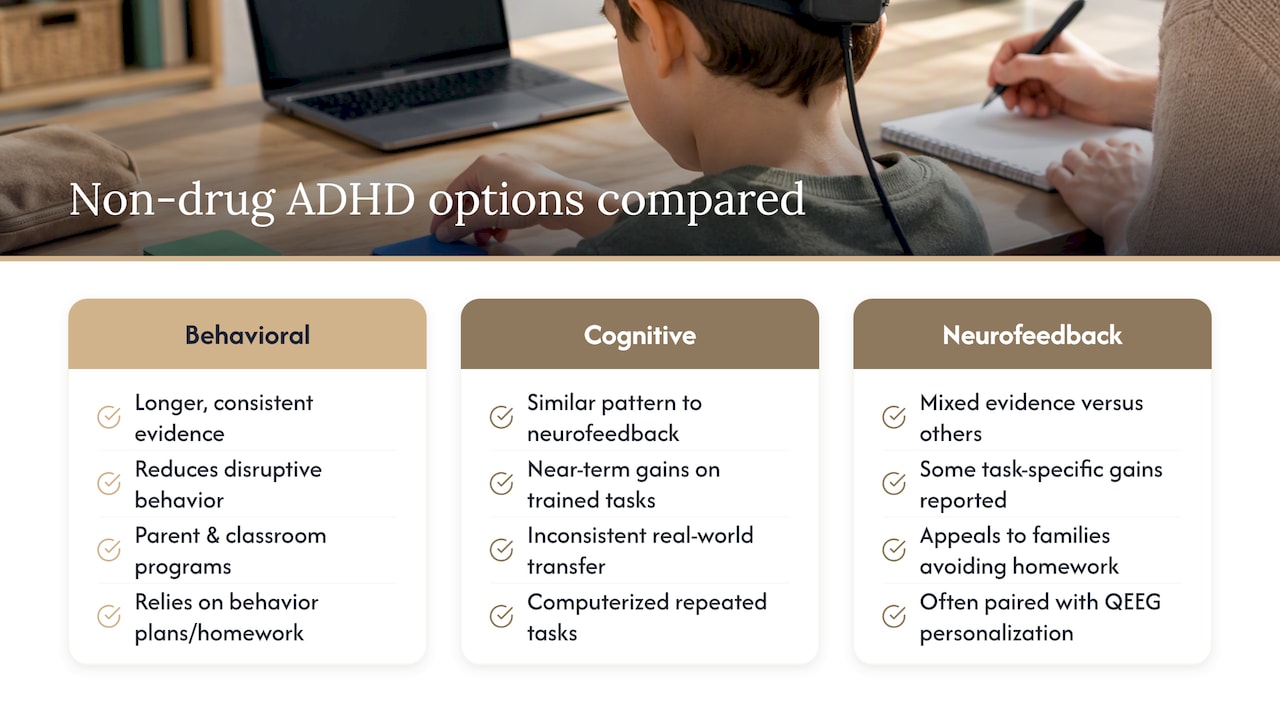
Neurofeedback is one of several non-pharmacological options families consider, and it is worth seeing how it compares to the others rather than treated in isolation.
Behavioral therapy, including parent training and classroom-based behavioral interventions, has a longer and more consistent evidence base for reducing disruptive behavior and improving functioning, which is part of why guidance bodies like NICE place it ahead of neurofeedback. Cognitive training programs, which aim to strengthen working memory or attention through repeated computerized tasks, show a similar pattern to neurofeedback: some near-term gains on the trained task, but inconsistent transfer to broader, real-world ADHD symptoms.
Where neurofeedback differs is in its mechanism and its appeal to families who want an approach that does not rely on homework-style practice or behavior plans. It is also the option practitioners most often pair with personalization through QEEG, which some reviewers believe may explain the stronger results seen in multimodal programs compared with standardized protocols.
For practical day-to-day support alongside any of these approaches, simple behavioral strategies, like the ones outlined in this guide to ADHD focus strategies for adults, can complement clinical treatment without requiring a major time or cost commitment.
None of these non-drug options currently outperforms medication on its own for core symptom reduction, so the realistic framing is additive: each may contribute something, but none replaces a full evidence-based plan built around your specific situation.
The evidence on durability is mixed and depends heavily on what you compare it to. A review of follow-up findings in European Child & Adolescent Psychiatry found that some studies report sustained within-group improvements compared to non-active controls, meaning people who received neurofeedback stayed better than their own starting point over time. But when neurofeedback is compared against an active control like medication, the comparison often favors medication instead.
The additive effect seen when neurofeedback is combined with medication tells a similar story. The 2022 meta-analysis in Scientific Reports found a short-term boost in parent-reported inattention that was no longer statistically significant at the six-month mark. That pattern, early gains that soften over time, shows up often enough in this literature that it is worth expecting rather than treating as a surprise.
What this means practically is that a course of neurofeedback is rarely a one-and-done intervention. If it helps, it may need periodic reinforcement, and progress should be checked with the same standardized measures used at baseline rather than assumed to hold steady on its own.
Supporting Wellness offers NeurOptimal Dynamical Neurofeedback alongside ADHD assessments, with locations in Calgary, Red Deer, and Cold Lake and a free 15-minute connection call before any commitment. An initial consultation typically covers your goals, relevant history, and how progress will be tracked using standardized measures, so you know what to expect before a first session.
— Deane
If you’re weighing whether neurofeedback has a place in your ADHD care, the most useful next step is a conversation, not a commitment. A free 15-minute connection call lets you ask direct questions about evidence, measurement, and fit before scheduling anything.

Supporting Wellness offers a few starting points depending on where you are in the process:
Direct billing is available to a range of insurers, which can simplify the logistics once you decide on a plan. Neurofeedback is one option among several, and the right starting point is usually an individual counselling assessment that looks at your full picture before adding any single therapy.
This article is general information, not a substitute for advice from a qualified doctor. Consult a qualified healthcare professional about your own circumstances before acting on anything here.
The strongest evidence, a 38-trial systematic review, found no meaningful benefit on blinded total symptom measures, though small effects appeared in restricted analyses and for processing speed. Personalized or multimodal programs show more promising signals, but neurofeedback is not currently supported as a stand-alone cure.
This is not a term tied to a specific guideline or systematic review covered here, and its definition varies depending on the source. Rather than guess at a figure, it is best discussed directly with a clinician familiar with your diagnostic framework.
Medication and structured psychological interventions such as CBT carry the strongest evidence and are typically recommended as first-line options under guidance like the NICE recommendations. Neurofeedback and other non-pharmacological approaches are generally considered secondary or adjunctive rather than stand-alone replacements.
ADHD is understood to be highly heritable based on twin studies estimating about 70 to 80 percent heritability, though genetics alone do not explain every case and genetic testing is not currently useful for diagnosis or treatment planning, as explained in this overview of ADHD. Environmental and developmental factors also play a role alongside genetic predisposition.
Session counts reported in practice commonly range from 20 to 40, though this reflects clinical experience rather than a single research-backed standard. Progress should be tracked with standardized rating scales so you and your provider can judge whether continuing makes sense.