
The main sleep therapy for insomnia is cognitive behavioural therapy for insomnia, usually shortened to CBT-I. It is a structured talk-therapy program that targets the thoughts and habits keeping you awake, and it is widely recommended as the first approach before sleep medication. If you have been lying awake for weeks, you do not have to keep white-knuckling through it. This guide explains what sleep therapy involves, what to expect, when to see a doctor first, and how to get started in Alberta.
Insomnia means having trouble falling asleep, staying asleep, or getting good-quality sleep even when you have enough time and a suitable place to sleep. The NHLBI describes short-term insomnia as something that can follow stress or changes in your schedule or surroundings. A hard week at work, a move, a new baby or a period of grief can all do it.
For many people the sleep returns once the stress passes. For others it doesn’t. The night-time worry itself, the clock-watching, the extra coffee and the long weekend lie-ins start to hold the problem in place. Sleep specialists call these perpetuating factors. The American Academy of Sleep Medicine’s provider fact sheet notes that perpetuating factors such as inadequate sleep hygiene and negative ideas about insomnia are mostly responsive to intervention. That is the hopeful part: the habits and beliefs that keep insomnia going are the same things therapy can change.
Some people fall asleep fine and then wake at 3 a.m. with a racing mind. Others cannot switch off at bedtime. Researchers describe hyperarousal as heightened physical, emotional or mental activity that makes it harder for the body to disengage from the environment and fall asleep. The same review cautions that hyperarousal is neither necessary nor sufficient for chronic insomnia, so it is one piece of the picture rather than the whole explanation.
Another useful idea is sleep reactivity: how strongly stress disrupts your sleep. Research reviewed in this paper suggests it is a trait that can predict future insomnia and often feeds into emotional reactivity, and the reverse. In plain terms, if stress tends to wreck your sleep, and poor sleep makes stress harder to manage, the two can keep each other going. Breaking that loop is what sleep therapy is designed to do.
CBT-I is a structured, multisession psychological program that focuses on sleep-specific thoughts and behaviours and combines several treatments, according to Ontario Health’s quality standard on insomnia disorder, published in February 2025. It is not a general chat about your night-time worries, and it is not medication. It is a set of specific skills taught by a trained clinician, practised at home and adjusted week to week.
The same standard says CBT-I should be offered as soon as possible after an insomnia diagnosis. It also notes that CBT-I can be delivered individually or in groups, in person or virtually, and that self-guided resources are suggested when clinician-led care cannot start right away. That is Ontario’s standard, but the approach itself is the same wherever you live.
Alberta’s own patient information points the same way. MyHealth Alberta lists CBT-I among the treatments for insomnia, alongside relaxation exercises, regular bedtimes and wake times, and limiting alcohol.
CBT-I typically includes cognitive therapy, stimulus control, sleep restriction, relaxation therapy and sleep hygiene, per the Ontario Health standard. Here is what each looks like in daily life.
This part looks at beliefs that make sleep harder. Examples: “If I don’t get eight hours, tomorrow is ruined,” or “My brain is broken.” A therapist helps you test these thoughts and replace them with more accurate ones. The goal is to lower the pressure around sleep, because pressure keeps the body alert.
The aim is to strengthen the link between your bed and sleep. Typical instructions include going to bed only when sleepy, using the bed only for sleep and intimacy, and getting up for a short time if you have been awake for a while, then returning when drowsy. It can feel odd at first. The idea is that a bed where you lie frustrated and awake teaches your brain the wrong lesson.
This is the part people worry about, and it is worth understanding clearly. Your therapist uses your sleep diary to set a time-in-bed window close to the amount you are actually sleeping, then widens it as your sleep becomes more consistent. It can leave you tired in the first days, which is why it should be guided by a clinician rather than improvised. If you have a health condition that makes drowsiness risky, such as certain medical conditions, a job that requires alertness like driving or operating equipment, or a history of seizures or bipolar disorder, tell your therapist and your doctor before starting.
Breathing exercises, progressive muscle relaxation and mindfulness help lower the body’s tension before bed. They work best as a skill you practise during the day, not an emergency tool at 2 a.m.

This covers the basics: consistent wake time, limiting caffeine and alcohol, a dark and quiet room, and a wind-down routine. On its own, it is rarely enough for chronic insomnia. Within CBT-I, it supports the other parts.
| Component | What you do | What it targets |
|---|---|---|
| Cognitive therapy | Examine and reframe sleep-related thoughts | Worry about sleep, catastrophizing |
| Stimulus control | Use the bed only for sleep, leave it when wide awake | Bed-wakefulness association |
| Sleep restriction | Follow a set time-in-bed window, widened over time | Irregular, fragmented sleep |
| Relaxation | Breathing, muscle relaxation, mindfulness | Physical and mental tension |
| Sleep hygiene | Adjust caffeine, alcohol, routine, environment | Habits that undermine sleep |
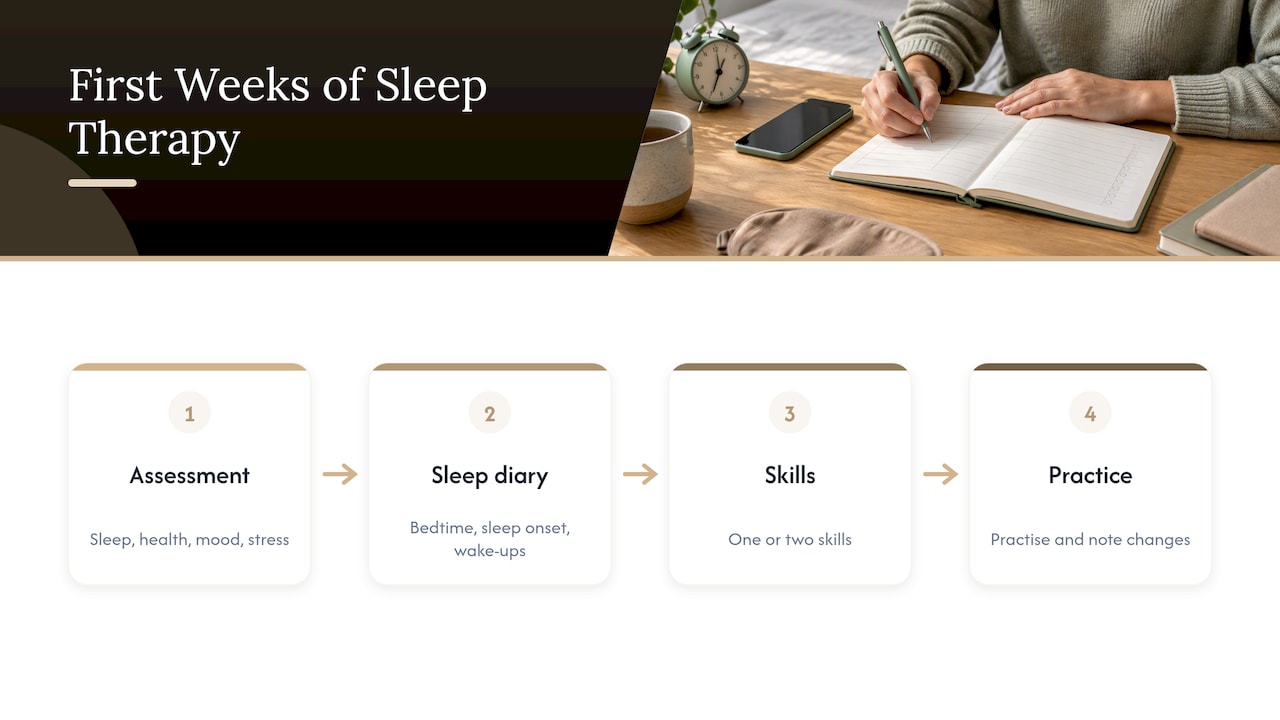
You will usually begin with an assessment: how long sleep has been a problem, what your nights look like, your health, medications, mood and stress. You will probably be asked to keep a sleep diary, noting when you got into bed, how long you think it took to fall asleep, wake-ups and when you got up. That record guides the plan.
After that, sessions focus on one or two skills at a time. Between sessions you practise and note what happens. Some people feel more tired before they feel better, particularly when sleep restriction begins. That is a normal part of a structured plan, and it is a good reason to have a clinician adjusting it with you.
We do not promise a set number of nights or a guaranteed result, and neither should anyone offering sleep therapy. What we can say is that the approach is built on changing the things that keep insomnia going, and that its recommendation as a first-line option is well established. The College of Family Physicians of Canada, in a March 2024 review of chronic insomnia treatment, notes that despite strong clinical endorsement of CBT-I as first-line treatment, it remains underused, with sedatives often prioritized instead.
Therapy is a good step, but insomnia is sometimes a symptom of something else: sleep apnea, restless legs, pain, thyroid problems, hormone changes, or side effects from medication. A physician can check for these.
Health Canada’s labelling standard for sleep aids says to consult a physician if sleeplessness continues for more than two weeks. Book an appointment sooner if you notice loud snoring with gasping, chest pain, severe daytime sleepiness while driving, thoughts of harming yourself, or sleeplessness alongside a very low or unusually high mood. In Alberta you can also call 811 for health advice at any hour, as MyHealth Alberta notes.
Hormonal change is a common and under-discussed cause, especially in midlife. If that sounds like you, this list of questions about progesterone for sleep is a useful set to bring to a medical appointment.
You can do both at once. Seeing a doctor to rule out medical causes and starting therapy to address sleep habits and thoughts are not competing choices.
Insomnia rarely shows up alone. Worry, low mood and past trauma all raise the body’s alertness at night, and poor sleep makes each of them harder to manage the next day. This is the loop described by the sleep reactivity research above.
That is why we look at the whole person. If your nights are tied to anxiety, our individual counselling in Calgary can address the worry itself alongside your sleep habits. If nightmares or disturbed sleep follow a distressing event, trauma-focused work such as EMDR therapy may be part of the conversation. Our article on EMDR versus CBT explains how those approaches differ, and you can read about how CBT and DBT can be blended if emotional intensity is part of the picture.
If low mood is draining your energy and sleep, how to help someone with depression offers practical guidance for you or someone close to you. Teens have their own patterns; see our guide to teen depression therapy.
We see sleep problems in almost every kind of counselling room. A parent juggling work and kids, a veteran whose nights are shaped by hypervigilance, a student whose worry starts the moment the lights go off. Rarely is it only about sleep.
That is why we believe the best sleep therapy sits inside good overall care. Evidence-based therapy teaches you skills for sleep, and the same relationship also gives you room to talk about what is keeping you alert. Our team includes registered provisional psychologists and other clinicians trained in methods such as EMDR and Brainspotting, and we work with individuals, couples and families, so we can look at how sleep affects the whole household.
We also know that starting therapy feels like a big step when you are exhausted. That is why every therapist offers a free 15-minute connection call. You can ask about their approach to sleep, find out whether it feels like a fit, and decide with no pressure. We offer direct billing to a wide range of insurers, no physician referral is needed, and we have evening and weekend availability so that therapy fits around your work and family.
Insomnia can feel permanent at 3 a.m. It is not a character flaw, and in most cases it is a problem that responds to the right support.
Deane
When you look for sleep therapy, a few questions help:
If you work shifts, have young kids or live outside the city, online sessions can make a difference. We offer online counselling for Calgary and in Red Deer, and in Cold Lake too through our online counselling page.
These do not replace therapy, but they are safe, low-risk habits that align with what Alberta’s health information recommends.
If you try these for a couple of weeks with little change, that is useful information. It is a sign to bring in professional support, not a sign you failed.
If you are in Calgary, Red Deer or Cold Lake, or prefer online sessions, the easiest first step is the free 15-minute connection call. You can describe your sleep, ask about the therapist’s approach and see whether it feels right. Our Calgary individual counselling page is a good starting point, and our full list of services shows how we support couples, families, children, seniors, veterans, first responders and Indigenous clients, with direct billing available for many insurers. If cost is a concern, we also publish pages for affordable counselling in Calgary and in Red Deer.

If poor sleep is straining your relationship, you may also find our guide on how couples counselling improves communication useful, since tired partners often argue more.
CBT-I is recommended as a first-line treatment for chronic insomnia, and it targets the habits and beliefs that sustain the problem rather than only masking symptoms. The College of Family Physicians of Canada has noted that it is underused while sedatives are often prioritized. Medication can still have a place for some people, so decide with your physician.
Yes. Ontario Health’s standard notes CBT-I can be delivered in person or virtually, individually or in groups. Online sessions can be convenient if you work shifts or have young children. You will still need to keep a sleep diary and practise skills between sessions.
If sleeplessness has gone on for more than two weeks, Health Canada’s labelling standard advises consulting a physician. A doctor can check for medical causes such as sleep apnea or medication effects. A therapist can work on thoughts, habits, stress and mood, and many people benefit from both.
No, you do not need a physician referral. You can book directly, and we offer a free 15-minute connection call with every therapist first. We also direct bill to many insurers, so check your plan’s psychological coverage.