
Family therapy helps because it treats the family as the place where a problem is lived, not just the person who seems to carry it. Parents, children and partners learn to talk, set boundaries and respond to each other differently, and those changes tend to last because everyone is practising them together. If you are in Calgary, Red Deer or Cold Lake and wondering whether this is the right step, at Supporting Wellness you can book a free 15-minute connection call with a therapist first, so you can ask your questions before committing to anything.
Family therapy is a form of counselling where the unit being helped is the family, not one individual. The American Psychological Association describes it as psychotherapy aimed at improving relationships and behaviour patterns in the family as a whole and in its smaller groupings, such as the parents or the siblings.
CAMH, Canada’s largest mental health teaching hospital, explains that the approach aims to change how families interact, to increase understanding and improve communication, without placing blame. It is used when the family’s patterns contribute to one member’s difficulties, for example a child’s, and also when one person’s difficulties affect everyone else and the others need help coping. Both the person who prompted the visit and the rest of the family can benefit.
That last point matters if you are the parent who feels like you are only there to “bring the child in.” You are part of the solution, and you are also allowed to get support for yourself in the process.
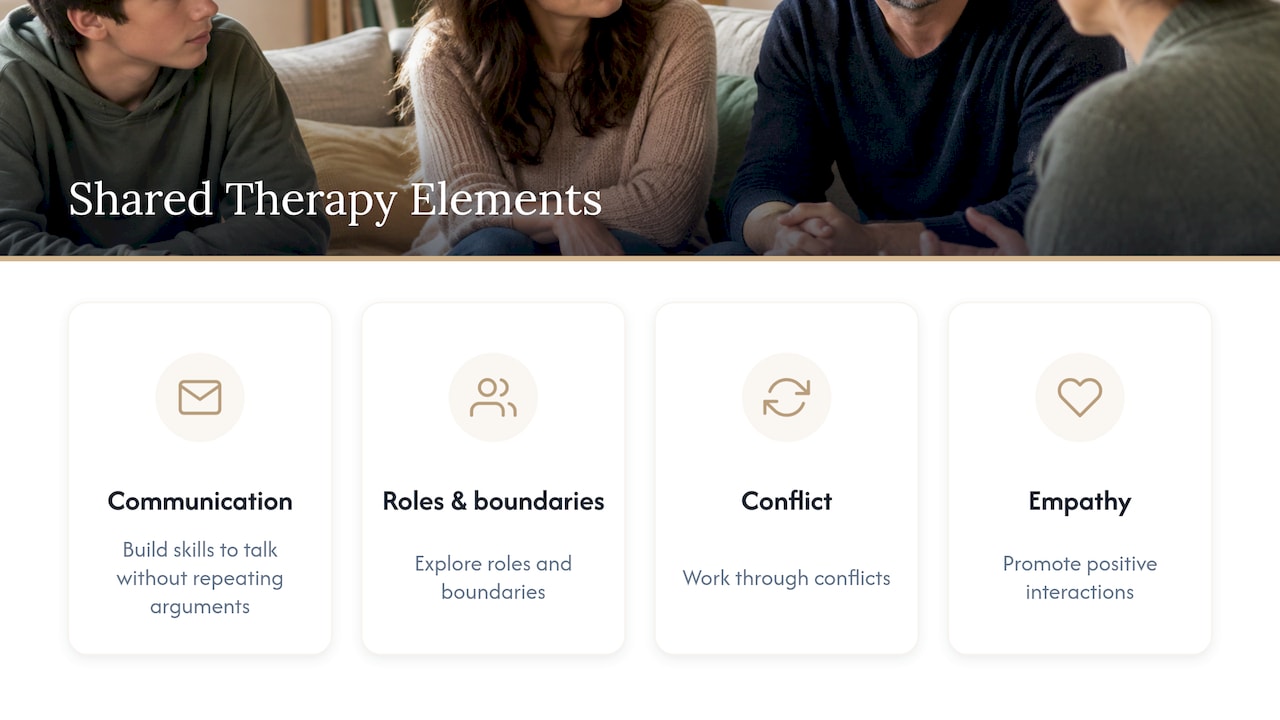
The most common goal is simply being able to talk without it turning into the same argument. The Knowledge Institute on Child and Youth Mental Health and Addictions lists the shared elements of family-focused approaches in Canada: building communication skills, exploring roles and boundaries, working through conflicts, and promoting empathy and positive interactions. In practice that can mean learning to say what you need without blaming, and to hear what a teenager is actually asking for underneath the slammed door.
Families often drift into roles nobody chose: the child who acts as peacemaker, the parent who is always the enforcer, the older sibling who is half a parent. A therapist helps you see these patterns and rebalance them, so responsibilities and authority sit where they belong. This is especially useful for blended families, where roles are still being negotiated. If that is your situation, our page on blended family therapy explains how we approach it.
The research is encouraging. A 2025 review in the Journal of Family Therapy reports that an updated meta-analysis of 65 studies found small-to-medium effects of systemic therapy on children’s psychiatric problems. The average treated child did better after therapy than 72% of children on a waiting list. The same review concludes that systemic interventions are as effective as other psychosocial treatments, and more effective for some problems, including infant mental health and externalizing behaviour problems (acting out, defiance, aggression). It also finds that online and digital formats work, which is helpful if evenings are hectic or you live outside a major centre.
When one family member is living with depression, anxiety, ADHD or a substance use problem, everyone adjusts around them. Family sessions give the rest of the household accurate information and shared strategies. HealthLink BC notes that family therapy can help reduce symptoms in conditions such as eating disorders or alcohol use problems, and that a specific therapy or medicine may be added alongside it when needed. That is why we often combine family sessions with individual work. Our page on when one family member is struggling walks through how this looks, and the article on family therapy versus individual therapy helps you decide on the mix.
Family therapy is not only for crises. HealthLink BC points out it can be used before a big transition, such as when a couple with children from previous marriages marries and wants everyone to learn to live together. Starting early often means starting with less hurt to repair.
HealthLink BC lists situations where family therapy has been used successfully: conflict between parents, a child with behaviour or school problems, children or teens who struggle to get along, and a family member with a chronic mental illness or substance use disorder. In our work these commonly show up as:
If your child is dealing with a mood condition, Alberta Health Services’ care instructions for parents suggest asking your doctor or service provider about family therapy, along with parent education and looking after your own wellbeing. At Supporting Wellness, you do not need a physician referral to book.
Family therapy is not one method. The APA notes that models vary widely in length, orientation, techniques and goals. The Mental Health Commission of Canada’s glossary names four common approaches: structural, strategic, systemic and narrative family therapy. In everyday terms:
Structural therapy gives a good picture of what happens in a session. A 2023 peer-reviewed article describes the techniques: family mapping (a diagram of who is close, who is distant and where boundaries sit), joining (the therapist adapting to the family’s own language), enactment (acting out a conflict in the session), shifting boundaries, and reframing. Reframing helps because it presents conflict as learned behaviour that serves a purpose in the family, which removes blame and makes change feel possible.
Enactment is worth a closer look. Instead of describing last night’s argument, you and your teen might talk through a small disagreement while the therapist watches. The therapist can then interrupt the usual script and coach a different response in real time. That is where new habits start.
Our team also uses the Gottman Method, which is built around couples’ communication, and trauma-focused therapies such as EMDR and Brainspotting. These are often used alongside family sessions when one person is working through a difficult experience, so that individual healing and family support move together. Our Family Counselling Calgary page lists who we work with.
HealthLink BC describes the therapist’s role: teaching how families function, keeping the focus on the whole family rather than one member, identifying conflicts and anxieties, and developing strategies to resolve them. Therapists may give active assignments, such as parents handing certain responsibilities to children. The number of sessions depends on how complex the concerns are and how willing family members are to take part, and not everyone has to attend every session.
A typical early stage looks like this:
If some family members are reluctant, that is common, and it is a conversation to have with your therapist rather than a reason to wait. Starting with the people who are ready is often fine.
CAMH suggests you can tell therapy is working when you are meeting the goals you set at the start, over time. Results rarely appear overnight, and it can feel harder at first as issues come to the surface. Practical signs include fewer repeated arguments, quicker repair after conflict, more honest conversations, and children or teens who are willing to join.
CAMH also reports that only about 15% of successful therapy is explained by the model or technique, and that the relationship between therapist and client is the most important factor. That is the reason we offer a free 15-minute connection call with every therapist: you can see whether the person feels right for your family before the first session. If you are unsure about progress later, bring it up and schedule a time to review how things are going. Therapists can adjust their approach when they know what you want.
Families usually arrive tired. One person has been the “problem” for so long that everyone, including that person, has stopped expecting anything to change. What we see as the real benefit of family therapy is that it gives the household a shared language and a shared plan.
That is why we built our practice around collaboration. Our multidisciplinary team brings together counsellors, assessment services and specialized therapies, so a family can get support for a child, a parent and the relationship between them without starting over each time. We offer evidence-based and culturally safe care, including for veterans, first responders and Indigenous clients.
We also try to remove the small barriers that stop people from starting. There is no physician referral required, we offer evening and weekend availability, and we direct bill a wide range of insurers. The first step is a free 15-minute call, where you can say what is happening and ask who would be the best fit.
Change at home does not have to wait until things are perfect or until everyone is on board. It can start with one conversation.
Deane
If you recognize your household in this article, the simplest next step is to speak with a therapist. We offer in-person family sessions in Calgary, Red Deer and Cold Lake, and online sessions for families who prefer to meet from home. Direct billing to a wide range of insurers can ease the paperwork.
Explore family counselling in Calgary to see how it works and book your free 15-minute connection call.

Living elsewhere in our area? We also have pages for Red Deer and Cold Lake, and details on online counselling.
It depends on what you are working on and how involved each family member is. According to HealthLink BC, the number of sessions varies with the severity of the concerns and willingness to take part. Your therapist can suggest a rough timeline after the first sessions and revisit it as you go.
Not every member needs to be at every session. Therapists often begin with whoever is willing and bring others in as it becomes useful. Younger children may join for part of a session, and parents may meet separately for some of the work.
Tell your therapist. CAMH advises discussing your concerns openly, including what has or has not worked before, so the therapist can adapt their style. Reviewing your original goals together shows what has shifted and what still needs attention.
Alberta Health Services lists support available around the clock: Health Link at 811, the Addiction and Mental Health Helpline, 211 Alberta, Kids Help Phone at 1-800-668-6868 (or text CONNECT to 686868), and 988 for a suicide crisis. If anyone is in immediate danger, call 911. Family therapy can then support the longer-term work at home.