
CBT (cognitive behavioural therapy) helps you change unhelpful thoughts and behaviours so your feelings shift. ACT (acceptance and commitment therapy) helps you make room for difficult thoughts and feelings while you act on what matters to you. Both are structured, evidence-based talk therapies, and the better fit depends on your concerns, your preferences and how you want to work. At Supporting Wellness we offer a free 15-minute connection call with every therapist, so you can talk through which approach suits you before you book.
Both therapies are practical. You work on specific problems, you often practise skills between sessions, and your therapist explains what you are doing and why. Neither is about talking endlessly about the past. The Canadian Mental Health Association (CMHA) describes ACT as similar to CBT, with the difference that ACT focuses on accepting difficult experiences rather than changing thoughts or behaviours to avoid difficult feelings.
That difference in direction is the heart of the choice.
CBT starts from the idea that how you interpret events affects how you feel and what you do. CAMH describes it as focused on the here and now, on day-to-day problems, and on how your perceptions affect your feelings and behaviour.
In practice, Arch and Craske’s 2008 comparison of the two therapies explains that CBT uses tools such as:
Example: you avoid speaking up at work because you are sure colleagues will judge you. In CBT, you and your therapist write down that prediction, plan a small, manageable step such as sharing one comment in a meeting, and then compare the outcome with what you expected. Over time the prediction loses its grip.
ACT does not set out to argue with the thought. The Association for Contextual Behavioral Science says ACT targets six core processes: acceptance, defusion, being present, a transcendent sense of self, values and committed action.
Two terms are worth knowing:
According to Arch and Craske, ACT uses metaphors and experiential exercises to change the role a thought plays, with the goal of tolerating thoughts and sensations mindfully rather than changing them.
Example: the same fear of speaking up. In ACT, you might name what you value, such as contributing and being seen as a team member, notice the worry as a passing thought, and speak up with the worry still there.
| CBT | ACT | |
|---|---|---|
| Main aim | Change unhelpful thoughts and behaviours to reduce distress | Accept difficult experiences and act on your values |
| Approach to a worrying thought | Examine it and test whether it holds up | Notice it, step back from it, and let it be |
| Typical tools | Thought records, behavioural experiments, exposure | Defusion, mindfulness, values work, committed action |
| Focus | Symptoms and the patterns that maintain them | Flexibility and a life guided by values |
| Structure | Time-limited, structured, often 10 to 20 sessions | Often delivered over about 4 to 12 weekly sessions in research studies |
The session figures come from CARMHA at Simon Fraser University for CBT and from the Scottish NHS Matrix for ACT research formats. Your own plan will depend on your goals. Our guide on how many therapy sessions you will need explains what shapes that number.
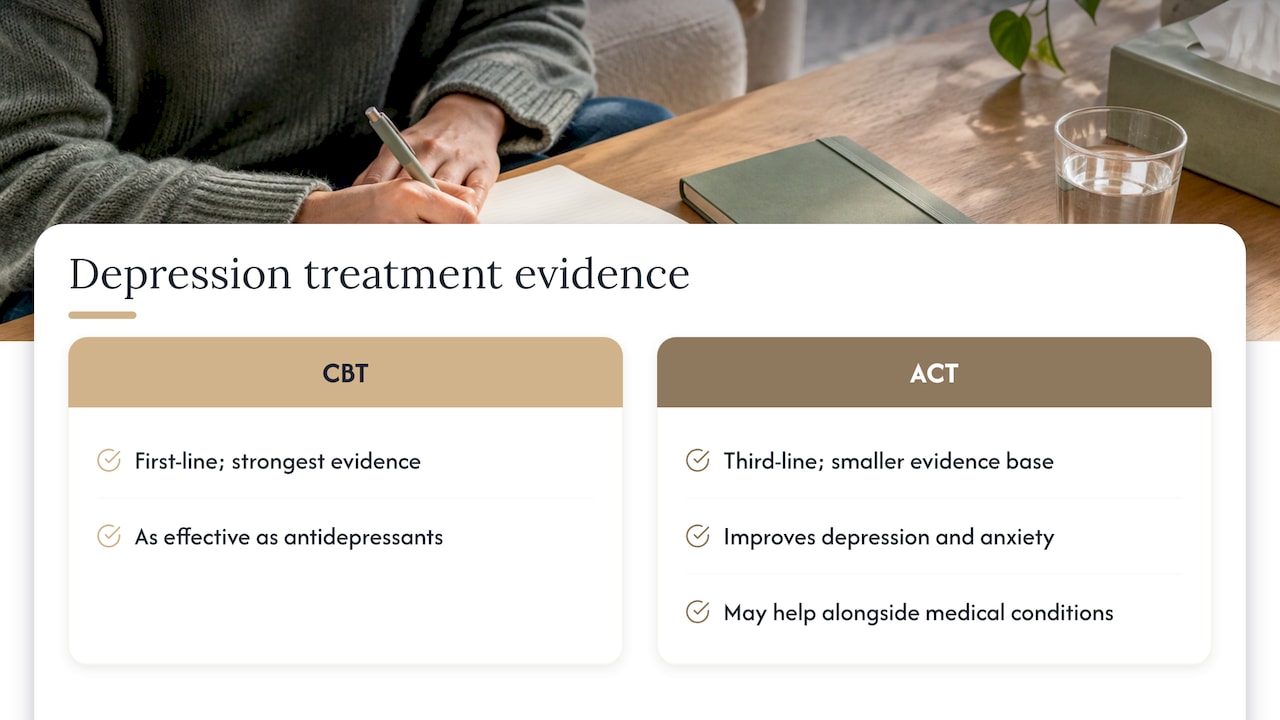
The CANMAT 2016 guidelines give CBT the strongest level of evidence as a first-line psychological treatment for major depression, and note that meta-analyses found it as effective as antidepressant medication. The same guidelines describe ACT as showing improvement in depressive symptoms and anxiety across several meta-analyses, with a smaller evidence base, and place it as a third-line option. They add that ACT may be particularly valuable when someone is also living with a medical condition.
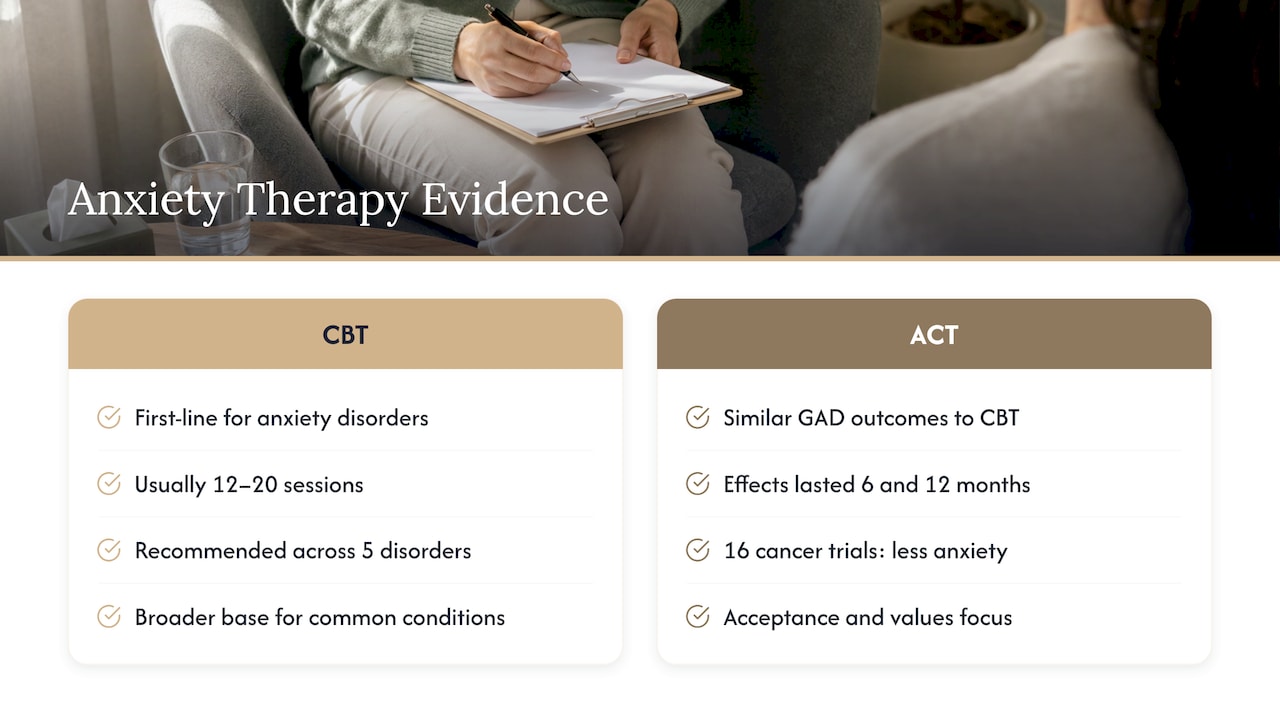
CAMH states that CBT has the best evidence base for anxiety disorders and is first-line, with 12 to 20 sessions usually sufficient, according to its guidance on anxiety psychotherapy. A 2024 consensus review reports that all guidelines it examined recommend CBT for panic disorder, social anxiety, generalized anxiety, OCD and PTSD, with exposure as a first-line element.
ACT has promising results as well. The Scottish NHS Matrix reports randomized trials in generalized anxiety disorder where ACT improved anxiety and depression to a similar degree as CBT groups, with effects lasting at 6 and 12 months. A 2024 meta-analysis of 16 trials in people with cancer found ACT significantly reduced anxiety and depression compared with controls.
The takeaway: both have solid support, CBT has the broader base for common conditions, and ACT can be a strong match when acceptance and values are what you want to work on.
CMHA says the choice depends on your diagnosis, the concerns you want to address and your understanding of the problem. These questions can help you think it through.
CBT may suit you if:
ACT may suit you if:
Many people benefit from both. A skilled therapist often draws on skills from several approaches. CAMH notes that if progress with CBT is slow, the therapy can be adjusted to fit you, so you do not necessarily have to start over with a different method.
CAMH notes that people who choose CBT generally do better than those assigned to it without a say. CMHA adds that when you feel safe and supported, you are in a better position to take on the harder parts of therapy. That is why feeling understood is part of the treatment, not an extra. Research on confidence and feeling supported in any care setting points the same way: when you feel at ease, you engage more fully.
CMHA suggests asking a prospective therapist about:
It also recommends using an introductory session to notice whether you feel comfortable, understood and listened to without judgment. Our free 15-minute connection call with every therapist is designed for exactly that. For more on the process, see how to choose the right therapist.
CBT and ACT are two options among several. If your main concern is trauma, you might look at EMDR versus CBT. If intense emotions and relationships are the focus, our comparison of CBT and DBT is a useful next read. For couples, see EFT vs Gottman. If you are unsure whether you need a therapist or a medical prescriber, read psychologist vs. psychiatrist. Anyone in crisis or thinking of self-harm should call or text 9-8-8, Canada’s Suicide Crisis Helpline, or go to the nearest emergency department.
We do not think you have to pick a label before you pick a therapist. Many people arrive asking whether they need CBT or ACT, and what they really want to know is whether someone will understand them and help them feel better.
That is why we offer a free 15-minute connection call with every therapist. You can describe what is going on, ask how your therapist works, and see how the conversation feels. Our practice is collaborative and family-oriented, with a multidisciplinary team that includes evidence-based and culturally safe care, and we support individuals, couples, families, veterans and first responders.
Evidence-based therapy works best when it matches the person. We take your goals, your history and your preferences seriously, and we are glad to adjust as therapy goes on.
Deane
We offer in-person and online counselling in Calgary, Red Deer and Cold Lake, including anxiety counselling, depression counselling, and PTSD and trauma counselling. You do not need a physician referral, we direct bill a wide range of insurers, and we have evening and weekend availability. For Calgary, our affordable counselling option is $100, and in Red Deer it is $80. You can also explore individual counselling and therapy in Calgary or see all our services.

No. They are related, and ACT grew out of the same behavioural tradition, but the aims differ. CBT teaches you to change thoughts and behaviours to change feelings, while ACT teaches you to accept difficult experiences and move toward your values.
CAMH describes CBT as having the best evidence base and being first-line for anxiety disorders. ACT has trial results showing comparable improvement in generalized anxiety. The better choice is the one that suits your concern and that you feel comfortable working with.
Yes. CANMAT’s 2016 guidelines list CBT as a first-line psychological treatment for major depressive disorder, and meta-analyses found it as effective as antidepressant medication. A therapist can help you decide whether it fits your situation.
CAMH says 12 to 20 sessions are usually sufficient for anxiety disorders with CBT. CANMAT’s public guide says most psychological treatments for depression take 12 to 16 sessions, with benefits expected after 4 to 6. Your plan will be set with your therapist.