
EMDR and Somatic Experiencing (SE) both aim to ease the lasting effects of trauma, but they start from different places. EMDR is a structured, eight-phase therapy that helps you reprocess a distressing memory so it stops feeling current. SE is a body-first approach that works with physical sensations and the nervous system rather than with the story of what happened. If you want the approach with the larger, better-tested research base and a clear beginning, middle and end, EMDR is where most people start, and it is one of the specialized treatments we offer at Supporting Wellness in Calgary, Red Deer and Cold Lake.
EMDR stands for Eye Movement Desensitization and Reprocessing. The American Psychological Association describes it as a structured, time-limited therapy with eight phases: history and planning, preparation, memory activation, desensitization, installing a positive belief, a body scan for leftover physical tension, an orderly close to the session, and reassessment at the next visit. The “bilateral stimulation” most often used is side-to-side eye movements.
The theory behind it, called the Adaptive Information Processing model, holds that symptoms come from memories that were stored in a stuck, unprocessed way. A 2025 review explains that EMDR combines exposure, work with emotions and body sensations, cognitive reprocessing and dual-attention tasks such as alternating eye movements.
Somatic Experiencing was developed by Peter Levine. Researchers describe it as a bottom-up therapy that directs attention to internal body sensations rather than to thoughts or emotional content. It is not exposure therapy, and it avoids directly evoking intense traumatic memories.
Its model is that trauma symptoms persist when a defensive response, such as fight, flight or a prolonged freeze, could not be completed. According to a 2021 scoping review, SE aims to change the stress response through a gradual “discharge” of arousal and new, corrective body experiences.
Not in the way reviews categorize it. A 2025 review of PTSD treatments places EMDR in the group of trauma-focused psychotherapies, and treats Somatic Experiencing and Sensorimotor Psychotherapy as body-oriented therapies focused on awareness of internal sensation. That said, EMDR is not mind-only. Its body scan phase and its attention to sensations mean the body is part of the work.
The clearest difference is what you spend the hour doing.
| EMDR | Somatic Experiencing | |
|---|---|---|
| Starting point | A specific memory or target, chosen with your therapist | Present-moment body sensations |
| Role of the memory | Briefly held in mind while attention is shifted back and forth | Approached indirectly and gradually |
| Typical tools | Eye movements, tappers or tones; a positive belief; a body scan | Tracking sensation, pacing, resourcing, touch in some cases |
| Structure | Eight defined phases | Moment-to-moment, guided by what your body does |
| Aim | Reduce the distress a memory carries and shift the belief attached to it | Settle nervous system arousal and complete defensive responses |
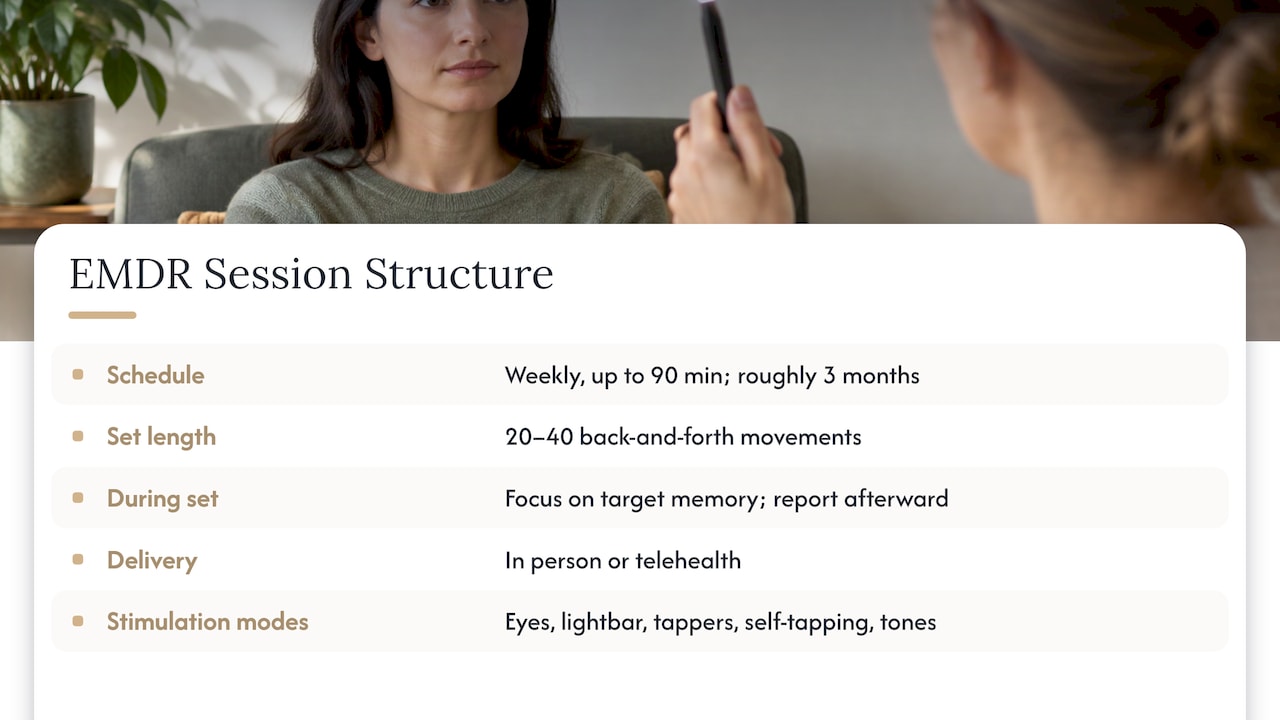
The US National Center for PTSD describes EMDR as typically given in weekly sessions of up to 90 minutes over roughly three months. During the desensitization phase you follow sets of 20 to 40 back-and-forth movements while focusing on the target memory, then report what came up. The same page notes bilateral stimulation can be delivered in person or by telehealth, using eye movements, a lightbar, tactile tappers, self-tapping or audio tones.
The length varies a lot with what you are working on. A single event usually takes fewer sessions than years of complex trauma. Our guide to how many EMDR sessions people typically need walks through the factors, and the eight phases and how they map to treatment length.
SE sessions are slower and more exploratory. You are guided to notice sensations such as warmth, tightness or trembling, and to move between a charged area and a calmer one. A 2025 review notes that somatic psychotherapies emphasize moment-to-moment attunement and co-regulation with the therapist, which can reduce overwhelm and create new experiences of mastery. In the 2021 scoping review, practitioners and clients named resource-orientation and the use of touch as key features of the method.
This is where the two approaches differ most, and it is worth knowing before you choose.
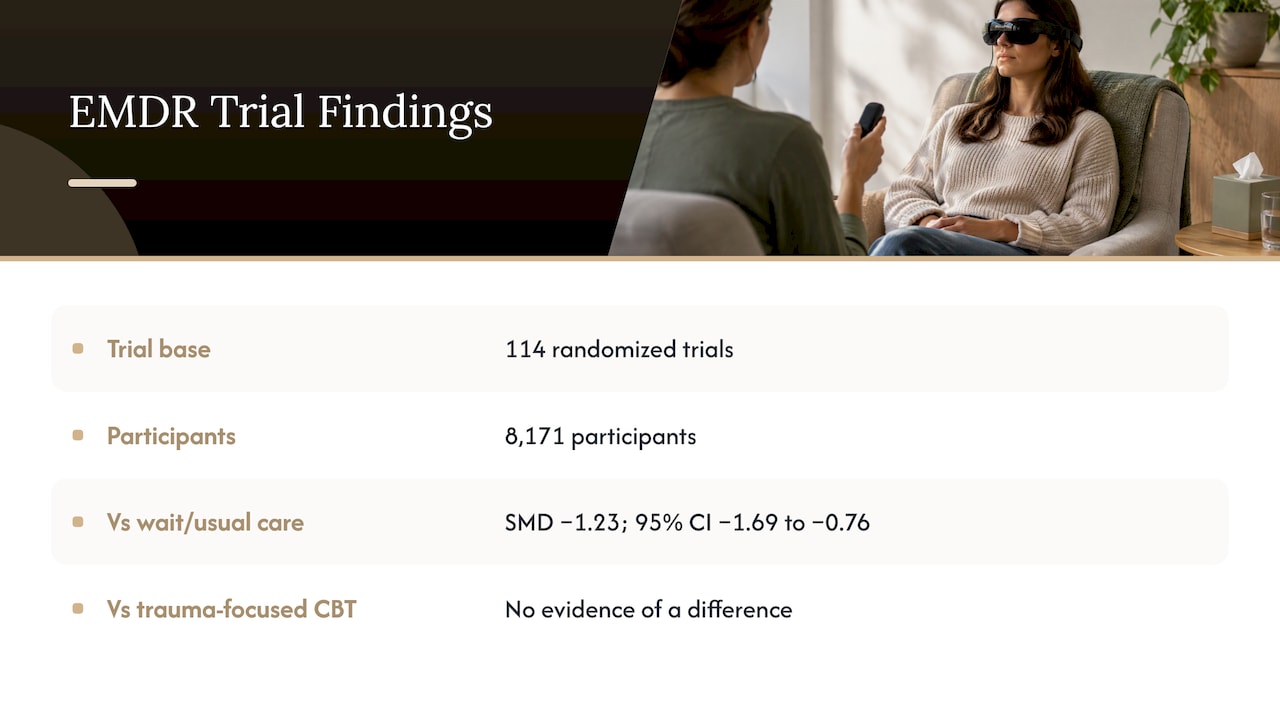
A 2020 systematic review and meta-analysis pooled 114 randomized trials with 8,171 participants. It found robust evidence that trauma-focused CBT and EMDR have clinically important effects. Compared with wait list or usual care, EMDR showed a standardized mean difference of -1.23 (95% CI -1.69 to -0.76), and there was no evidence of a difference between EMDR and trauma-focused CBT. In plain terms: EMDR performed far better than no treatment and about as well as the best-established talk therapy for trauma. If you are weighing those two, our page on EMDR vs CBT and the evidence from 114 trials goes further.
The 2021 scoping review screened 83 articles and included 16. It found preliminary evidence of positive effects on PTSD-related symptoms, body symptoms and well-being, and called the results promising while noting that more rigorous randomized research is needed. A 2025 review adds that somatic psychotherapies are not yet endorsed by clinical guidelines, partly because there are still few studies.
That is a statement about how much has been tested, not a verdict that SE does nothing. Many people find body-based work valuable, and the same 2025 review notes that about half of people treated for PTSD do not respond to first-line treatments, which is why researchers are exploring newer modalities.
CAMH, Canada’s Centre for Addiction and Mental Health, states that psychological treatments for PTSD show moderate to large effect sizes with no clear evidence that one modality is superior. Much of the benefit likely comes from common factors: a coherent rationale, psychoeducation and a safe relationship with your therapist. The practical takeaway is that fit with your therapist matters as much as the label on the method.
No single question settles it, but these usually point the way.
Therapists do blend approaches. The 2025 review describes SE’s gradual, back-and-forth exposure style as one of several reimagined approaches to exposure, and notes that combination strategies, such as activating a memory before processing it with EMDR, are being explored. For most people, one well-delivered approach with a therapist you trust is the right place to begin, and you can adjust as you go.
Whichever approach you choose, you will likely be asked to practise calming skills between appointments. Grounding and mindfulness are two of the most common, and they work differently, so it helps to understand how grounding differs from mindfulness and when each is useful. Your therapist can tailor these to what you are working on.
The APA notes EMDR’s side effects are similar to other psychotherapies: temporary increases in distressing emotions or uncomfortable physical sensations, and sometimes tiredness or more vivid dreams after reprocessing sessions. These are expected to ease as treatment progresses. Tell your therapist what you notice between sessions so the pace can be adjusted. If you ever feel unsafe or at risk of harming yourself, contact your doctor or local emergency services right away.
When someone comes to us asking about EMDR or somatic work, the real question underneath is usually “What will it ask of me, and will I be safe?” We think that question deserves an unhurried answer.
Our practice is built around evidence-based care. EMDR sits at the center of that for trauma because it is structured, time-limited and backed by a large body of trial evidence. That structure also helps people feel in control: you know the phases, you know what the body scan is for, and you can pause.
We also know that trauma is felt in the body, which is why we offer Brainspotting alongside EMDR, and why our therapists pay attention to sensation, pacing and regulation in every session. Veterans, first responders, families and Indigenous clients are often carrying experiences that need a culturally safe, collaborative setting, and our multidisciplinary team is set up for that.
The first step does not need to be a decision about method. A free 15-minute connection call lets you ask questions and see whether the therapist feels right. That relationship matters more than any acronym.
Deane
Our therapists offer EMDR and Brainspotting in person and online, with locations in Calgary, Red Deer and Cold Lake. You do not need a physician referral, we offer evening and weekend availability, and we direct bill to a wide range of insurers. Every therapist offers a free 15-minute connection call, so you can talk through your history and goals before you book.

If cost is a concern, our Affordable Counselling Calgary page lists a $100 one-off option, and Affordable Counselling Red Deer lists $80 one-off. For trauma-focused care in the city, start with individual counselling and therapy in Calgary, or see all of our services, including veterans and first responder counselling and online sessions.
Neither has been shown to be superior across the board. EMDR has a large body of randomized trials behind it, while Somatic Experiencing research is promising but smaller. CAMH notes that no single modality has clear evidence of being better, and that the therapeutic relationship carries a lot of the benefit.
Reviews classify them separately. EMDR is a trauma-focused psychotherapy using dual-attention tasks, while Somatic Experiencing is a body-oriented approach centered on internal sensation. EMDR does include a body scan phase, so the body is not ignored.
The US National Center for PTSD describes typical delivery as weekly sessions over about three months. A single event may need fewer sessions, and complex trauma more. Your therapist will review progress with you as you go.
No physician referral is needed at Supporting Wellness. You can begin with a free 15-minute connection call with one of our therapists to ask questions about EMDR and see how it would fit your situation.