
Firefighters, paramedics, police officers, dispatchers and corrections staff carry what they see on shift long after the shift ends. That is a normal human response to repeated exposure to trauma, and it responds well to the right care. The most direct route is counselling with a therapist who understands trauma and offers evidence-based methods such as EMDR. At Supporting Wellness, we offer PTSD and trauma counselling in Calgary, plus Red Deer and Cold Lake, with a free 15-minute connection call so you can meet your therapist before you commit to anything.
This guide explains what repeated trauma can do, which signs matter, what support exists in Alberta and Canada, how workers’ compensation fits in, and how families can help without burning out themselves.
A single hard call can stay with anyone. First responders face them over and over. A 2017 systematic review of 27 studies found that duty-related trauma exposure is associated with posttraumatic stress disorder, depression, suicidality, anxiety, alcohol use and sleep disturbances.
A 2026 narrative review of the research names PTSD as the most common occupational mental health condition among first responders. It points to three kinds of risk: cumulative trauma, moral injury and organizational stress. Moral injury means the distress that comes from an event that conflicts with your own sense of right and wrong, for example a call where you could not do what you believed was needed. The same review notes that police officers may meet about three traumatic events every six months.
The Government of Alberta’s first responders’ mental health grants page cites research that up to 45% of first responders report at least one mental disorder. It also notes that operational stress and trauma often reach families, especially spouses and partners.
It is not only the incidents. In a 2024 qualitative study of first responders, people described back-to-back trauma that led to burnout, numbness and demoralisation. Unpredictable shifts, poor sleep, heavy workloads and staff shortages made it worse, and there was little time to process what had happened. The same study lists burnout, anger problems, physical pain and strained family relationships among the effects of occupational trauma.
If burnout is part of your picture, this overview on minimizing burnout risk covers the wider professional context. Burnout and trauma often overlap, and both are worth talking through with a therapist.
No single sign means you have PTSD, and only a qualified clinician can diagnose it. These are the patterns that the research above connects with duty-related trauma, and that people close to you often see first:
The last one deserves action now. If you or someone you love is thinking about suicide, call or text 9-8-8, Canada’s suicide crisis helpline, or call 911 if there is immediate danger. For everything else on the list, a conversation with a therapist is a reasonable next step, and you do not have to wait until it feels unbearable.
There is more help than most people realize, and it comes in layers. You can use more than one at a time.
OSI-CAN is a peer support initiative run by CMHA Alberta Division and the Centre for Suicide Prevention. It runs more than 20 free, confidential, non-judgemental peer groups across three provinces, along with family support groups. Talking with people who have worn the same uniform helps many first responders feel less alone.
The federal action plan on PTSD and trauma in public safety personnel focuses on research, prevention, early intervention, stigma reduction and treatment. The 2018 and 2023 federal budgets provided $31.7 million for it, including the Canadian Institute for Public Safety Research and Treatment (CIPSRT) and PSPNET, an online therapy program designed for first responders and other public safety personnel.
Peer groups and online programs are valuable, and many people also want a private, personal space with a registered clinician. That is where we come in. Our team offers in-person and online PTSD and trauma counselling as well as veterans and first responder counselling. Two of the approaches our therapists use for trauma are:
A therapist can also help with the daily effects: sleep, anger, relationships, and the habits you have built to cope.
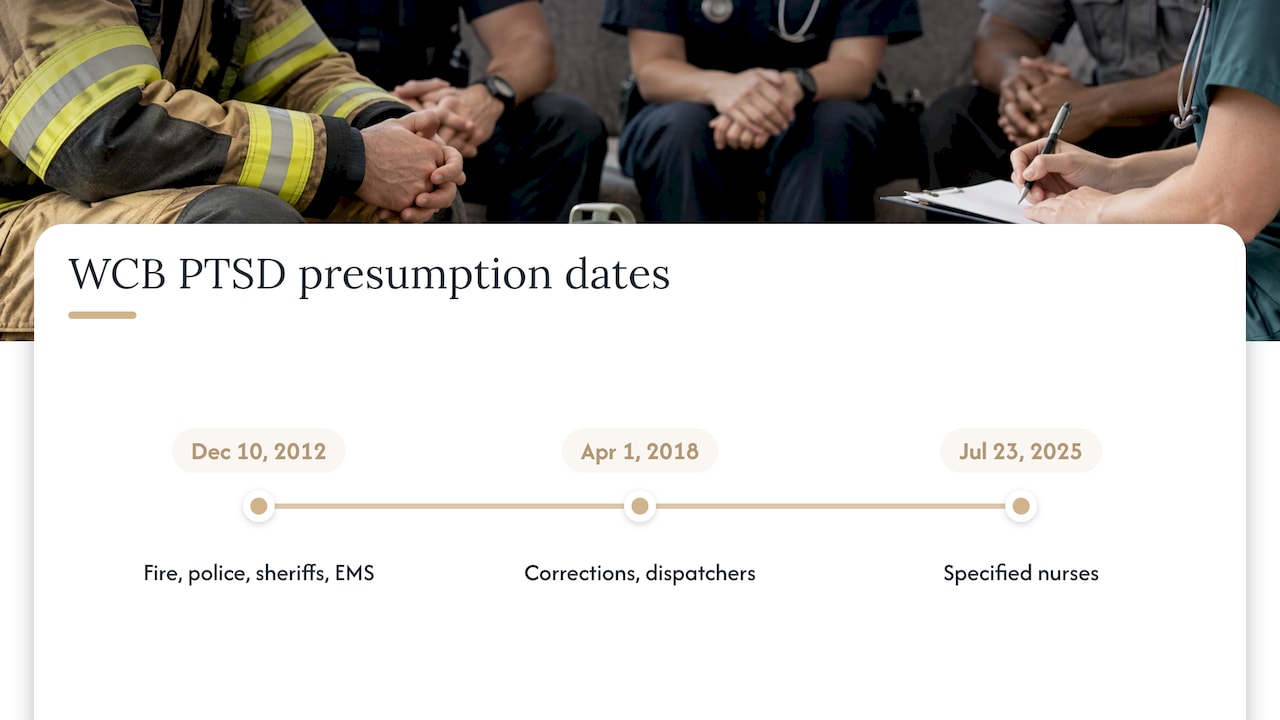
Many first responders do not realize that their employer’s compensation board may cover treatment. In Alberta, WCB presumes that confirmed PTSD is work-related for firefighters, police officers and sheriffs, emergency medical responders and primary and advanced care paramedics for injuries on or after December 10, 2012. Coverage was extended to correctional officers and emergency dispatchers on or after April 1, 2018, and to specified nurses on or after July 23, 2025.
“Presumed” means you do not have to prove that the job caused the condition. A diagnosis is still required, and the WCB document describes how claims are handled. The same document says most workers with a work-related psychological injury begin with counselling from a community psychologist, with medication managed by their family doctor, and that injured workers may choose their own treatment provider.
Across Canada, the Association of Workers’ Compensation Boards says psychological injuries are compensable and treated on par with physical injuries in every jurisdiction, with health care, rehabilitation and wage-loss benefits. The details of your own claim, including which provider and sessions are covered, are best confirmed with WCB directly.
Recovery is not always quick, which is a good reason to start sooner. A 2025 study of Ontario mental stress injury claims from 2014 to 2023 found that most claims involved time away from work, with a median claim length of 14.4 months. Return to work was more likely after a single-event injury than after cumulative exposure. That second finding is the one many first responders recognize: the harm often builds across years of calls rather than one night.
The practical takeaway is that waiting rarely makes it easier. The AWCBC document also notes that CCOHS recommends individualized return-to-work plans, which may include reduced hours, modified duties or a low-stress workspace. A therapist who knows your work can support those conversations with you.
You will have the best experience with a therapist who fits you, so it is fair to ask questions first. Consider:
Our team covers each of these. We offer evening and weekend availability, direct billing to a wide range of insurers, no physician referral requirement and a free 15-minute connection call with every therapist. In that call you can ask how they work and whether it feels right. If budget is a concern, we also offer affordable counselling in Calgary at a published price of $100, and affordable counselling in Red Deer at $80.
Families usually see the change before the first responder admits it. A 2022 paper by O’Toole, Mulhall and Eppich found that spouses and family members often notice behavioural changes first. It also found that paramedics with high perceived family support are less inclined to take sick leave for mental health concerns, and it calls for practical education that prepares families to offer psychological first aid.
In practice, that can look like this:
Alberta is also funding family-focused help. A grant-funded Wounded Warriors Canada workshop series for first responder families covers caregiver burnout, emotional regulation, boundary setting and communication, with full-day in-person sessions across urban and rural Alberta.
When strain reaches the whole household, therapy can include more than one person. We offer family counselling in Calgary, couples counselling using the Gottman Method, and a page on what to do when one family member is struggling.
We hear a version of the same sentence from first responders: “Other people have it worse.” It is usually the reason they wait. We see it differently. You do not need to hit a crisis point to deserve support, and the research shows why early help matters: trauma exposure builds, and so do its effects on sleep, mood and family life.
That is why we built our practice around removing the small obstacles. A free 15-minute connection call lets you speak with a therapist before you book. You do not need a physician referral. We offer evening and weekend availability, and direct billing to a wide range of insurers, so therapy can fit around your shifts and your coverage.
We also treat trauma as something that touches a whole family. Our multidisciplinary team offers evidence-based and culturally safe care, from EMDR and Brainspotting for the person carrying the memories to couples and family counselling for the people living alongside them. Our veterans and first responder counselling is there for you in Calgary, Red Deer and Cold Lake.
Asking for help is a skill, just like the ones you use on the job. We would be glad to help you practise it.
Deane
If you are ready to talk to someone, start with a free 15-minute connection call. You can ask about our approach to first responder trauma, how EMDR or Brainspotting would work for you, and how direct billing applies to your insurance. Our veterans and military counselling and PTSD and trauma counselling pages explain what to expect, and you can reach our full list of services from the Supporting Wellness home page.

We see clients in person in Calgary, Red Deer and Cold Lake, and online. If you are a family member, you are welcome to call first on your own behalf.
Not at Supporting Wellness. You can book directly, and you can start with a free 15-minute connection call. If you are making a workers’ compensation claim, your WCB case manager can explain what they need from you, and WCB says injured workers may choose their own treatment provider.
Alberta WCB presumes that confirmed PTSD is work-related for firefighters, police officers and sheriffs, emergency medical responders and paramedics, with coverage extended to correctional officers, emergency dispatchers and specified nurses from later dates. Your own claim depends on a diagnosis and on WCB’s decision, so confirm the details with them directly.
Peer support, such as OSI-CAN’s free groups, connects you with people who have shared experiences. Counselling gives you one-to-one time with a registered clinician who uses structured methods such as EMDR or Brainspotting to treat trauma symptoms. Many first responders use both.
Start by describing what you notice and how you feel, rather than diagnosing them. Offer practical help with a first step, and keep your own friendships and supports going. Couples or family counselling can also give everyone a structured place to talk, and you are welcome to book a connection call for yourself.