
Neurofeedback, also called EEG biofeedback, is a non-invasive way of training your brain’s own activity patterns, and it is being studied for anxiety, panic, social anxiety and trauma-related symptoms. Sensors on your scalp pick up brainwave activity, a computer reflects it back to you, and over a series of sessions your brain practices settling into steadier patterns. At Supporting Wellness we offer NeurOptimal® Dynamical Neurofeedback® in Calgary, and many people begin with a free 15-minute connection call to ask questions before they decide.
If anxiety has been wearing you down and you want to understand this option before you book anything, this guide covers what neurofeedback is, what researchers have reported, what sessions look like, how many you may need, and how it fits with talk therapy.
Your brain produces small electrical rhythms all the time. An EEG (electroencephalogram) is the tool that records them through sensors placed on the scalp. Neurofeedback uses that recording as live feedback. A Canadian health technology review describes it as brainwave biofeedback that monitors activity from electrodes on the scalp, with training that aims to help a person shift patterns of cortical activity, the activity in the brain’s outer layer.
You may see the terms “EEG biofeedback” and “neurofeedback” used for the same thing. Regular biofeedback is a related but different method: it usually tracks body signals such as heart rate or muscle tension. If you want the distinction in detail, our page on neurofeedback vs biofeedback walks through it.
Researchers Micoulaud-Franchi, Jeunet, Pelissolo and Ros wrote in a 2021 review that anxiety disorders and PTSD are linked to disruptions in the brain’s arousal circuits and stress systems. They describe EEG neurofeedback as a non-drug, non-invasive method in which the person and the computer both take part in a learning process that modulates arousal-related brain activity.
In plain terms: anxiety often feels like your system is stuck on high alert. Neurofeedback is built around helping the brain practice a calmer, more flexible state, and it does this through repetition rather than through insight or conversation.
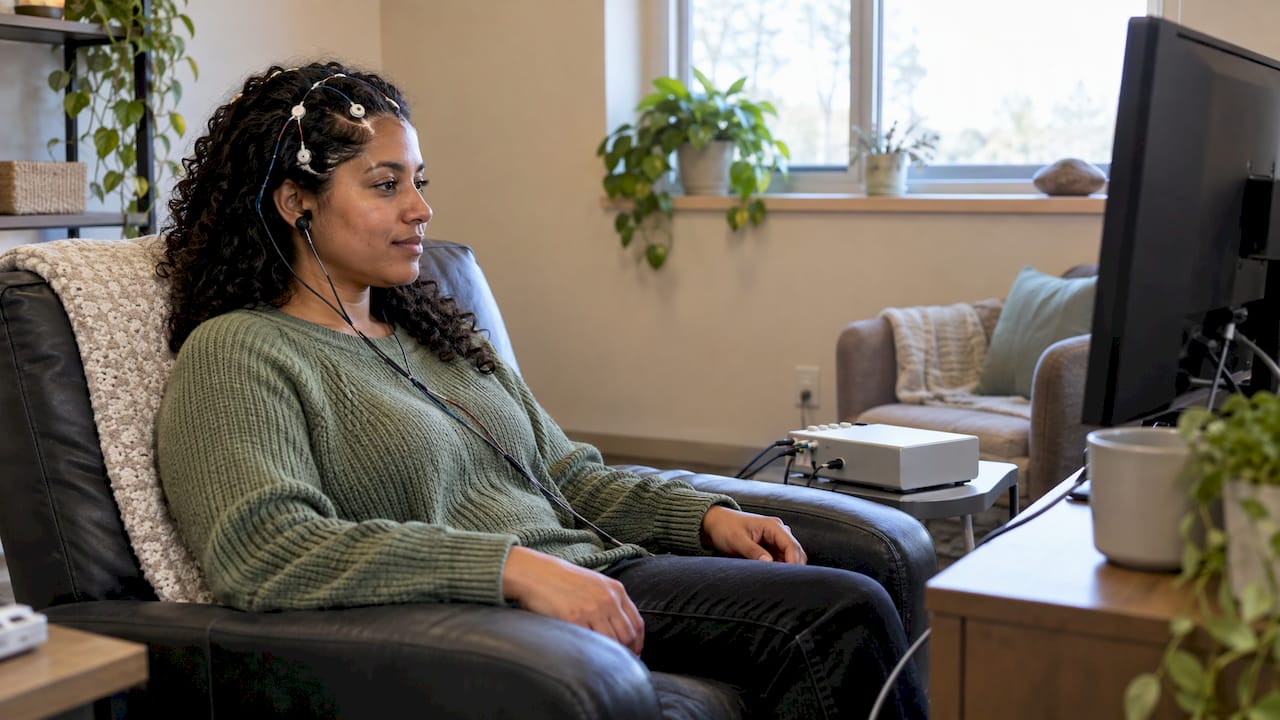
You sit comfortably while sensors are placed on your head and ears. You do not have to do anything difficult. Depending on the system, the feedback may be a sound, a visual, or a film that responds to your brain activity. You are not being shocked, and nothing is sent into your brain. To see how our own system is set up, read how NeurOptimal neurofeedback works.
Neurofeedback research on anxiety spans several conditions and several training approaches. Here is what a few of the published studies reported.
| Study | Condition | What was reported |
|---|---|---|
| Cho et al., 2018 systematic review | Anxiety symptoms, 22 clinical trials | Every paper reported a statistically significant decrease in anxiety symptoms, and no significant adverse events were reported. The most common training targeted alpha waves, sensorimotor rhythm (SMR) or theta waves. |
| Prospective study of 100 adults | Anxiety | Eight weeks of EEG neurofeedback at five sessions a week reduced severe anxiety on the Hamilton Anxiety Scale and moderate and severe anxiety on Taylor’s Manifest Anxiety Scale. |
| Pilot study, 12 people | Social anxiety | Fifteen sessions over 6 to 8 weeks improved neurofeedback performance and reduced threat-related attention bias and symptom severity. |
| Case study, 2023 | Agoraphobia | Eighteen sessions of alpha/beta neurofeedback combined with CBT were followed by significant improvement on the Panic and Agoraphobia Scale. |
| Canadian trial, 2023 | PTSD | PTSD severity scores fell significantly from baseline after treatment and at three-month follow-up, and 60.0% no longer met diagnostic criteria at follow-up. |
These studies used different equipment, different training targets and different session counts, so they are not a recipe for any one person. They do show why neurofeedback is being taken seriously as a way to help people who live with anxiety, and why clinicians describe it as a skills-based, non-drug option.
One point worth knowing: the NeurOptimal® approach we use is a specific system, and the studies above used a range of protocols. Your therapist can explain how our approach works and what to expect from it in your situation.
There is no single number, because it depends on the person. The International Society for Neuroregulation and Research (ISNR) states that the number of sessions needed for significant, sustained improvement typically ranges from 10 to 40. Sessions are commonly scheduled two or more times a week, especially during the first 10 to 20, and a course is usually completed in four to seven months.
The ISNR’s position paper adds that the number of sessions is a joint decision between you and your clinician, based on your diagnosis, how you respond, other conditions and the stressors in your life. That is a sensible way to run it. A good plan is reviewed as you go, not locked in on day one.
Here is a realistic way to think about the early weeks:
For anxiety disorders, CAMH, Canada’s largest mental health teaching hospital, states that CBT (cognitive behavioural therapy) is the first-line psychotherapy and has the best evidence base. That makes talk therapy a strong foundation, and neurofeedback is often considered as something that sits alongside it. The agoraphobia case above is one example: neurofeedback was paired with CBT in that report.
This is one of the strengths of seeing a multidisciplinary team. Rather than choosing one method and hoping, you can build a plan around what your anxiety looks like:
If you take medication for anxiety, keep taking it as prescribed and talk with your prescriber before changing anything. Neurofeedback is not a reason to stop or adjust a prescription on your own.
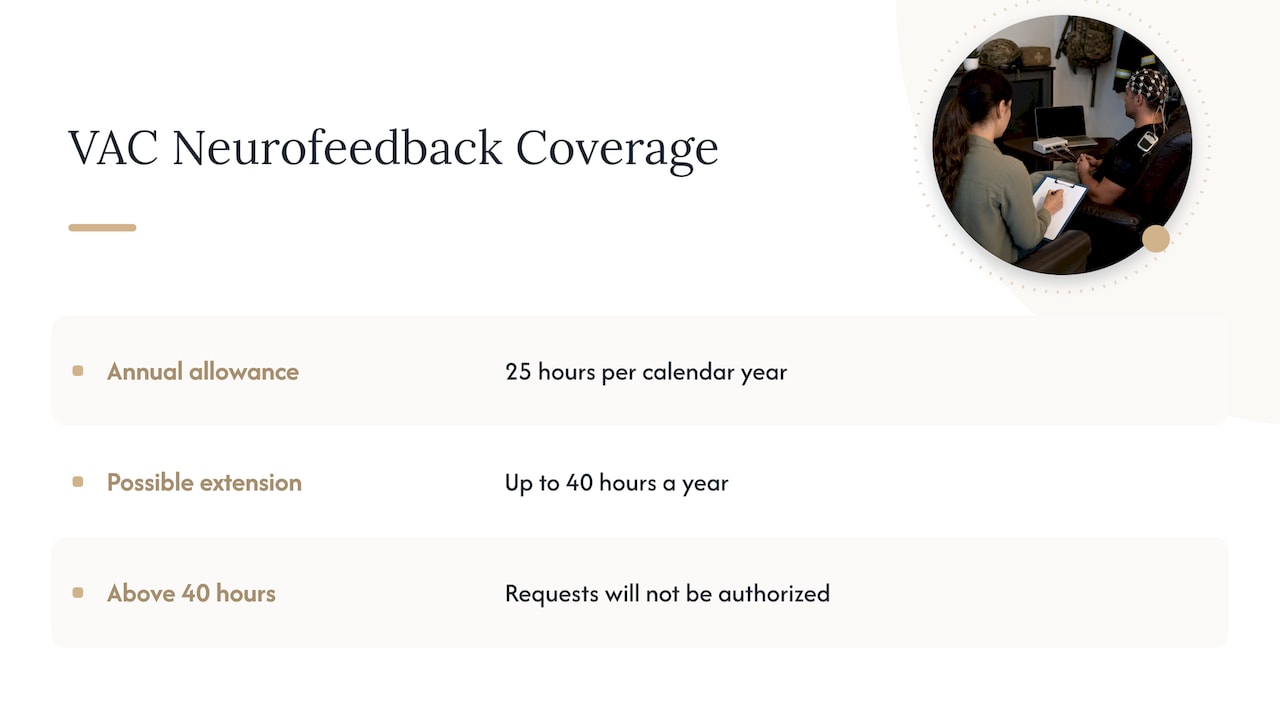
If you served or work in emergency response, you may be weighing neurofeedback for anxiety that came from the job. Veterans Affairs Canada (VAC) has a policy on it. A VAC Medical Services Bulletin effective 1 July 2025 states that VAC approves 25 hours of neurofeedback per calendar year as an adjunct to first-line evidence-based treatment for PTSD, generalized anxiety disorder or major depressive disorder. Extensions may be considered up to 40 hours a year, and requests above 40 hours will not be authorized.
The same bulletin sets conditions you should know about before you start. You need a clinical recommendation from your first-line treating mental health professional and a treatment plan stating the condition, the first-line treatment, the number of sessions recommended and the duration. The service is not available to family members under that program. Check the current bulletin or ask your VAC case manager for the details that apply to your file.
We provide veterans and first responder counselling and NeurOptimal® neurofeedback, and we direct bill a wide range of insurers. If your coverage comes through VAC, a work benefits plan or another route, our team can talk through how it is usually handled when you reach out.
Neurofeedback is non-invasive, and the 2018 systematic review above found no significant adverse events reported across 22 trials. Researchers Thibault and Raz note that reports of negative effects remain anecdotal after almost six decades of research.
Still, some people feel temporary effects. The ISNR position paper says informed consent should cover possible side effects such as fatigue, headache, anxiety and difficulty falling asleep, as well as fees, how often and how long treatment is expected to run, and your right to stop at any time without penalty. If you notice any of these, tell your therapist so the schedule or approach can be adjusted. Our page on neurofeedback side effects lists what to expect and what to do.
See your family doctor or a psychologist for an assessment first if:
Many people find neurofeedback appealing when:
It asks for a regular schedule over weeks or months. If your calendar is tight, evening and weekend availability can help.
We offer NeurOptimal® Dynamical Neurofeedback® at our Calgary clinic, along with counselling for anxiety, PTSD and trauma, EMDR and Brainspotting, so your plan can combine approaches under one roof. Every therapist offers a free 15-minute connection call, so you can ask about neurofeedback, how sessions work and how billing is handled before you commit. No physician referral is needed, and we direct bill a wide range of insurers. Read more on our NeurOptimal neurofeedback in Calgary page, or see all our services.
If you would like to start with talk therapy for anxiety, see our individual counselling in Calgary.
Anxiety rarely has one cause, so we do not think it has one answer. In our work, the people who feel most supported are the ones who are listened to first and offered options second.
That is why our team brings several evidence-based approaches together: counselling, EMDR, Brainspotting and NeurOptimal® neurofeedback. Neurofeedback gives people a way to work on regulation without having to explain or relive anything in the session, which can be a relief when you are tired of talking about your worries. For others, therapy conversations are exactly what helps, and we are glad to begin there.
We built the practice to remove barriers: a free 15-minute connection call with every therapist, no physician referral, evening and weekend appointments, direct billing to a wide range of insurers, and care that is culturally safe for veterans, first responders and Indigenous clients. Our view is simple: you should be able to meet your therapist, ask your questions and choose a plan that fits your life.
Deane
Studies of neurofeedback in generalized anxiety, social anxiety, agoraphobia and PTSD have reported symptom reductions in the people studied, and a 2018 review of 22 clinical trials found every paper reported a decrease in anxiety symptoms. Results vary between people, protocols and equipment. A connection call is a good way to talk through what may be realistic for you.
Yes, the terms are used for the same method: recording brain activity with an EEG and giving you feedback on it so your brain can learn steadier patterns. Standard biofeedback is a related approach that often tracks body signals such as heart rate or muscle tension.
The ISNR describes a typical range of 10 to 40 sessions, often scheduled two or more times a week at the start. Your therapist will go over the plan with you and review it as you progress, since the number depends on your goals and how you respond.
Coverage depends on your plan, so check what your benefits say about neurofeedback or psychological services. We direct bill a wide range of insurers. Veterans may have coverage through VAC, which approves 25 hours a year under conditions set out in its bulletin. Reach out to us and we can talk through your situation.
No physician referral is needed to book with us. If you plan to claim through Veterans Affairs Canada, VAC requires a recommendation from your first-line treating mental health professional, so speak with them about that step.