
An articulation disorder is trouble physically making individual sounds, such as a lisp or “wabbit” for “rabbit”. A phonological disorder is a pattern of sound errors that affects a whole group of sounds, such as always dropping the last sound of a word. Both are speech sound disorders, both respond to speech therapy, and a child can have both at once. If you are wondering which one your child has, you are asking a good question, and a speech-language pathologist (SLP, the professional who assesses and treats speech and language) can give you a clear answer. At Supporting Wellness, speech therapy is one of the services we offer, and we are glad to talk it through with you.
The simplest way to separate the two is to ask whether the problem is the sound itself or the rule the child is applying.
According to Surrey Schools’ speech-language pathology team, articulation refers to the way sounds are made using the lips, jaw, tongue, palate and vocal cords. An articulation problem shows up as omitted, added, substituted or distorted individual sounds. Phonology refers to predictable, rule-based error patterns that usually apply to more than one sound.
Northwestern University’s speech and language center puts it this way: a child with an articulation disorder has difficulty physically producing the intended sound. A child with a phonological disorder can produce the sounds but uses them in the wrong places.
| Articulation disorder | Phonological disorder | |
|---|---|---|
| What is affected | How a specific sound is physically produced | How sounds are organized into patterns |
| Typical scope | One or two sounds | Many sounds, following a pattern |
| Example | “Wabbit” for “rabbit”, a lisp on /s/ | “Tea” for “key”, “tan” for “can” |
| Effect on understanding | Often mild; speech is usually still understood | Often a bigger effect on how well others understand |
| Therapy focus | Teaching the child to make the sound | Teaching the child the sound pattern or contrast |
Articulation errors are about the mechanics. The child’s mouth has not learned to make a particular sound correctly. UCF’s Communication Disorders Clinic describes articulation disorders as usually involving one or two sound errors, for example:
ASHA, the American Speech-Language-Hearing Association, lists four common error types for individual sounds: omissions (leaving a sound out), substitutions (one sound replaces another), additions (an extra sound is inserted) and distortions (the sound is made, but not quite correctly, such as a lateral /s/ where air escapes over the sides of the tongue).
A child with an articulation disorder often has speech that is mostly understandable. Parents may notice that one sound keeps coming out the same wrong way.
Phonological errors are not random. The child applies the same simplification again and again, so the mistake shows up across many words. UCF’s clinic lists these common patterns:
Because one pattern touches many words, a child with a phonological disorder can be hard to understand even for family. Northwestern gives a useful example: a child may say “th” for “s” in “sun” but use “s” in place of “ch” in “chew”, producing “soo”. The child can make the sound, but is placing it in the wrong spot.
The Newfoundland and Labrador government’s K-12 communication disorders handbook notes that children with phonological disorders are usually more severely affected than those with articulation disorders. That is one reason an assessment is worth doing sooner rather than later when speech is hard to follow.
Yes, and this is common enough that clinicians do not always try to separate them. ASHA notes that it is often difficult to clearly tell articulation errors from phonological errors, and that a single child may show both. The two kinds of error may need different treatment approaches.
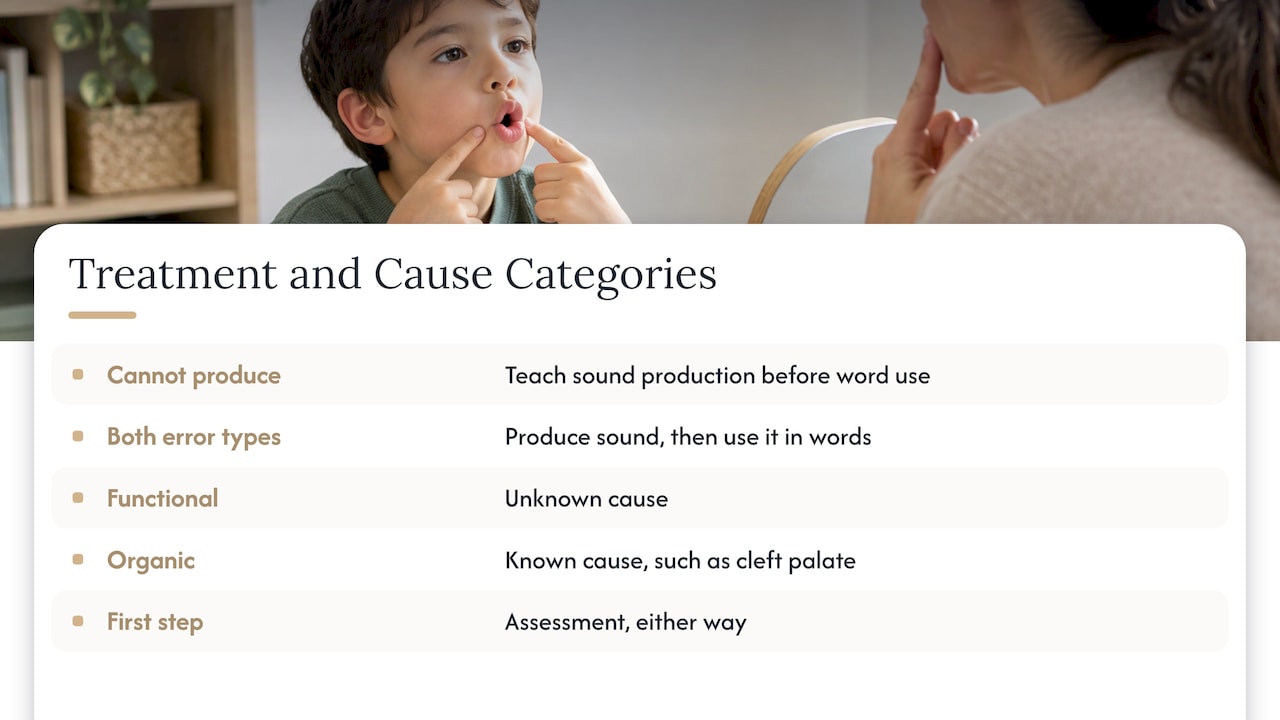
Northwestern explains why this matters. If a child cannot yet make a sound, teaching them where to use it will not help. If both are present, therapists often blend the approaches: first help the child produce the sound, then work on using it correctly in words.
Most speech sound disorders have no known cause. Some are linked to developmental disorders, hearing loss, neurological conditions or genetic syndromes, according to Northwestern. Surrey Schools describes the two groups as “functional” (unknown cause) and “organic” (a known cause such as cleft lip or palate, or hearing difficulty). Either way, the right first step is the same: an assessment.
You do not have to work out which type your child has. That is the SLP’s job. Based on Surrey Schools’ description, an assessment may include:
ASHA adds that SLPs look at which sounds a child says correctly in different word positions, the types of errors, how those errors are spread across words, whether a pattern affects a whole class of sounds, and how consistent the errors are. They combine standardized tests with single-word testing and samples of connected speech, such as telling a story or describing a picture.
Afterward, the SLP works with you and, where relevant, your child’s teacher to set goals. You will leave knowing which sounds and patterns to focus on.
The approaches differ because the problems differ.
The focus is on the sound itself. The Newfoundland and Labrador handbook describes programming that begins with discriminating and practicing the sound on its own, then moves to syllables, words, phrases and sentences, and finally to everyday spontaneous speech.
ASHA describes a general three-stage sequence for speech sound disorders:
Here the target is the pattern, not one sound. ASHA explains that phonological therapy is often organized in cycles of 5 to 16 weeks, with one or more patterns targeted in each cycle. Cycles repeat until the pattern appears in the child’s spontaneous speech. Some approaches use contrasting word pairs, such as “key” and “tea”, so the child learns that the sound difference changes the meaning of the word.
Progress is usually gradual and happens in stages: a sound or pattern appears first in practice words, then in sentences, then in daily talk. Home practice between sessions helps carry new skills into real life. Your therapist can show you simple ways to do this without turning every conversation into a drill.
Speech sounds develop in a predictable order. Surrey Schools notes that by around age 4, most children can be understood by unfamiliar adults. A child who does not make all speech sounds, or who cannot be understood by others, by the time they enter school may have a speech sound disorder. Surrey Schools recommends screening or assessment by an SLP when you have concerns.
It can help to know what is typical first. This guide to speech sounds by age walks through which sounds children usually produce between 2 and 6 years. Our own pages on child speech milestones and signs your child might need a speech therapist cover similar ground.
You may want to book sooner if:
If you are also unsure whether your child’s difficulty is a delay or a disorder, our article on speech delay vs. disorder explains the difference. If speech seems effortful or the child struggles to coordinate the movements, apraxia vs. dysarthria is worth reading, since those are different conditions from the ones described here. For a wider view, see when to see a speech therapist.
If you are worried about hearing, ask your family doctor or an audiologist (a hearing specialist) for a hearing test. It is a standard part of looking into any speech concern.
A few practical points can ease the worry.
Sometimes a speech concern sits alongside attention, learning or emotional difficulties. In that case, a psychoeducational assessment can give a fuller picture of how your child learns.
Our perspective
Parents often arrive with one worry: “Will my child be understood?” We think the most helpful answer is a clear one. An assessment should tell you which sounds and patterns are involved, what to work on first and how you can help at home.
Our practice is collaborative and family-oriented, with a multidisciplinary team. We believe speech work goes best when parents are part of it, because the sounds your child practices in session need a place to live in everyday conversation. We offer free 15-minute connection calls with every therapist, so you can describe what you are noticing and see whether we feel like the right fit before you commit to anything.
You do not need a physician referral, and we offer evening and weekend availability for busy families.
Deane
Speech therapy is part of our range of services, alongside counselling for children, teens and families, and assessments including psychoeducational and ADHD assessments. We offer direct billing to a wide range of insurers, so you can check your coverage before you book. You can see everything we provide on our services page, and families in northern Alberta can learn about speech therapy in Cold Lake.
Start with a free 15-minute connection call. Tell us what you have noticed, and we will help you find the next step.
A lisp is an articulation difficulty. It involves the way one sound, usually /s/ or /z/, is physically produced, so it is a distortion of an individual sound. A speech-language pathologist can assess it and teach your child the correct tongue placement.
Neither is a simple label of severity, but phonological disorders usually affect understanding more, because a pattern touches many words. According to the Newfoundland and Labrador handbook, children with phonological disorders are generally more severely affected. Both types respond to therapy when children receive an assessment and a plan that suits them.
Yes. ASHA notes that a single child may show both kinds of errors, and that they may need different treatment approaches. Therapists often blend the two approaches, helping the child make the sound first, then use it correctly in words.
By around age 4, most children can be understood by unfamiliar adults, according to Surrey Schools. If your child is entering school and is hard to understand, or does not make all their speech sounds, it is a good time to arrange an assessment with an SLP.