
Therapy for a child with ADHD usually combines three things: parent training in behaviour strategies, support at school, and counselling that builds skills like organization and emotional regulation. Medication is sometimes added for children aged 6 and older. Canadian pediatric guidance describes this as an individualized plan, not a single treatment. If you are in Calgary, Red Deer or Cold Lake, we can help you begin with a free 15-minute connection call.
Most parents picture a child sitting in an office talking to a therapist. For ADHD, the picture is different, especially for younger children. Much of the work happens at home and at school, and parents are often the ones learning new skills.
The Canadian Paediatric Society (CPS) recommends an individualized, multimodal plan. It combines psychoeducation (explaining ADHD to the child and family), parent and school interventions, general health support, and medication when indicated. The plan is built on shared goals and checked over time.
In practice, the parts of that plan look like this:
If you searched for parent training for ADHD, you are on the right track. It is one of the best-supported forms of help for young children.
Parent training is behaviour-management training delivered by a mental-health professional, in person, in groups or online. According to CHADD, it teaches caregivers to:
None of this means you were parenting wrong. ADHD changes how a child responds to instructions, delays and rewards, so the usual approaches can fall flat. Parent training gives you tools that fit the way your child’s brain works.
The U.S. Centers for Disease Control and Prevention says parent training in behaviour management is effective for improving children’s behaviour, self-control and self-esteem, and that it works best in young children when parents deliver it. The CPS clinician guide reports that parent-rated outcomes improved for ADHD symptoms, social skills and academic performance.
The CDC notes that parents typically attend 8 to 16 sessions. The American Academy of Pediatrics adds that behaviour therapy works by setting specific, achievable goals, giving consistent rewards and consequences, and continuing long enough to shape behaviour. Expect practice, small adjustments and patience, not a quick fix.
Here is an example of how one strategy might be set up with a therapist. It is an illustration, not a prescription.
Changing one behaviour at a time keeps the plan realistic for a busy household.
| Age | Usual starting point | Notes |
|---|---|---|
| Under 6 | Parent behaviour training | CPS identifies this as first-line. Evidence for stimulant medication in this age group is weak and Health Canada has not approved it for children under 6. |
| 6 and older | Parent training, school supports, skills training; medication may be considered | Medication decisions are made with a physician or pediatrician. |
| Older children and teens | Counselling, organizational-skills training, school and home supports | Teens take on more of the work themselves, with parents in a coaching role. |
Parent training is only part of the picture. Children with ADHD often benefit from direct support too. Counselling can help a child understand how their mind works, handle frustration, and rebuild confidence after months of hearing “pay attention.”
The CPS clinician guide describes organizational-skills training as an established intervention that targets planning, time management and organization. It is generally added to other treatments rather than used alone. Think of it as practical coaching: how to pack a school bag, break a project into steps, or keep track of homework.
Social skills matter too. Many children with ADHD interrupt, miss social cues or struggle to wait their turn, and friendships can suffer. Parents can reinforce this work at home with practical steps for helping kids make friends, such as arranging short, structured playdates and rehearsing what to say beforehand.
For families who also want to see how family dynamics play into daily life with ADHD, our guide on family therapy for ADHD in Canada explains how that work gets started. We also have a page on ADHD therapy.
ADHD shows up in the classroom as much as at home, so therapy works best when school is part of it. CADDRA, the Canadian ADHD Resource Alliance, says treatment should address school accommodations and daily strategies, and it provides an educational-accommodation letter template that clinicians can adapt.
Strategies commonly used at school and at home include:
The CDC lists these among behaviour supports for school and home. One tool worth asking your child’s teacher about is a daily report card. The CPS clinician guide reports that these can improve compliance with classroom rules, academic productivity and classroom behaviour, especially when parents and teachers cooperate.
A simple way to start is to share what you are practising at home with your child’s teacher, and ask what they see at school. Consistency between the two settings is what makes strategies stick.
The CPS notes that regular meals, exercise, adequate sleep and reduced screen exposure can support attention and mood. The same source cautions that many alternative treatments have not been tested as thoroughly and may carry risks, so talk to your child’s doctor before adding supplements or special programs.
These habits do not replace therapy. They make therapy easier to benefit from, because a rested, fed and active child is better able to practise new skills.
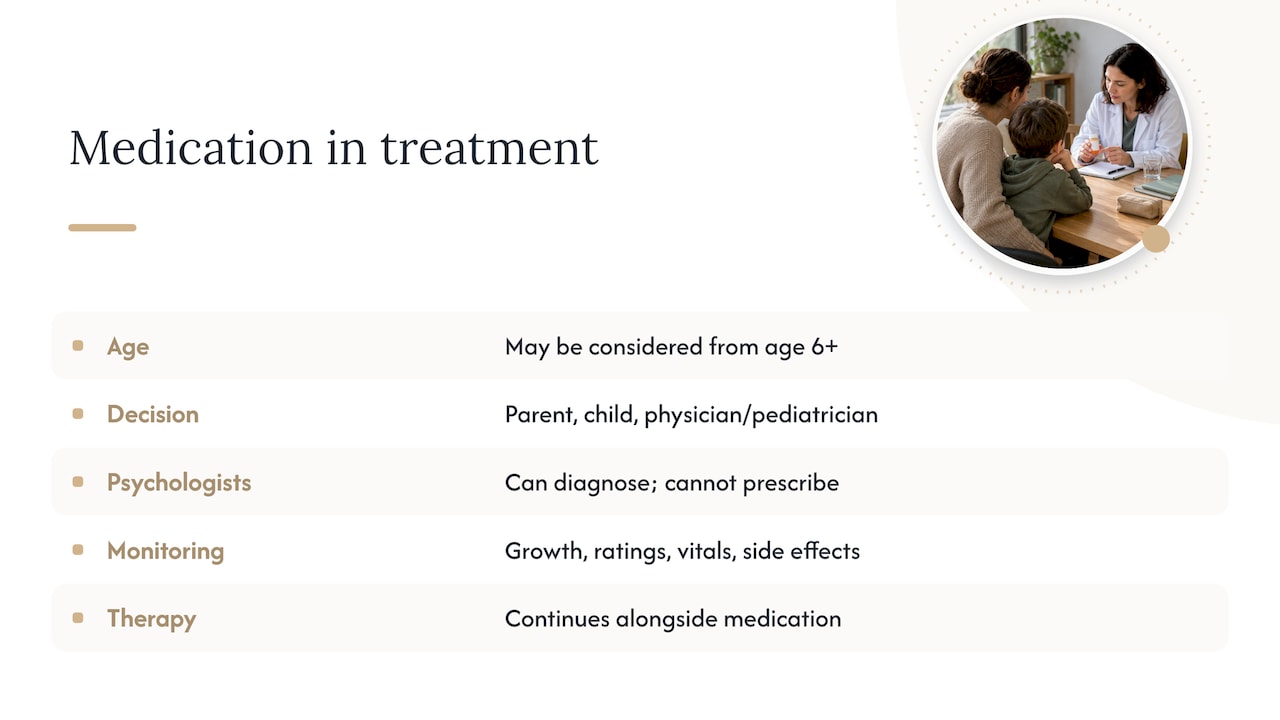
Some families worry that therapy and medication are an either-or choice. Canadian guidance treats them as parts of one plan. Medication may be considered for children aged 6 and older, and the decision belongs to you, your child and a prescribing physician or pediatrician. Psychologists can diagnose ADHD, but they cannot prescribe medication, according to CADDAC.
If you want to understand what medication does and does not do, our page on whether ADHD medication changes a child’s brain is a good starting point. When medication is part of the plan, CADDRA recommends regular monitoring that includes growth charts, rating scales, vital signs and side-effect profiles. Therapy continues alongside it, helping with skills that a pill does not teach.
Your other likely question is how a pediatric ADHD assessment works. Therapy is most useful when it is based on a clear picture of your child’s strengths and difficulties, so many families start here.
In Canada, assessment may involve a family physician, a general or developmental pediatrician, a child and adolescent psychiatrist, a neurologist or a psychologist, as CADDAC describes. Which professional is right depends on your child’s situation and what you need from the result.
The Canadian ADHD Practice Guidelines state that rating tools alone cannot diagnose ADHD. A diagnosis requires a diagnostic interview plus medical history, psychosocial information and clinical presentation. CADDRA’s child pathway begins with general mental-health screening for other conditions that can look like ADHD or occur alongside it. It then moves through questionnaires, medical review, an ADHD-specific interview, feedback, treatment recommendations and follow-up.
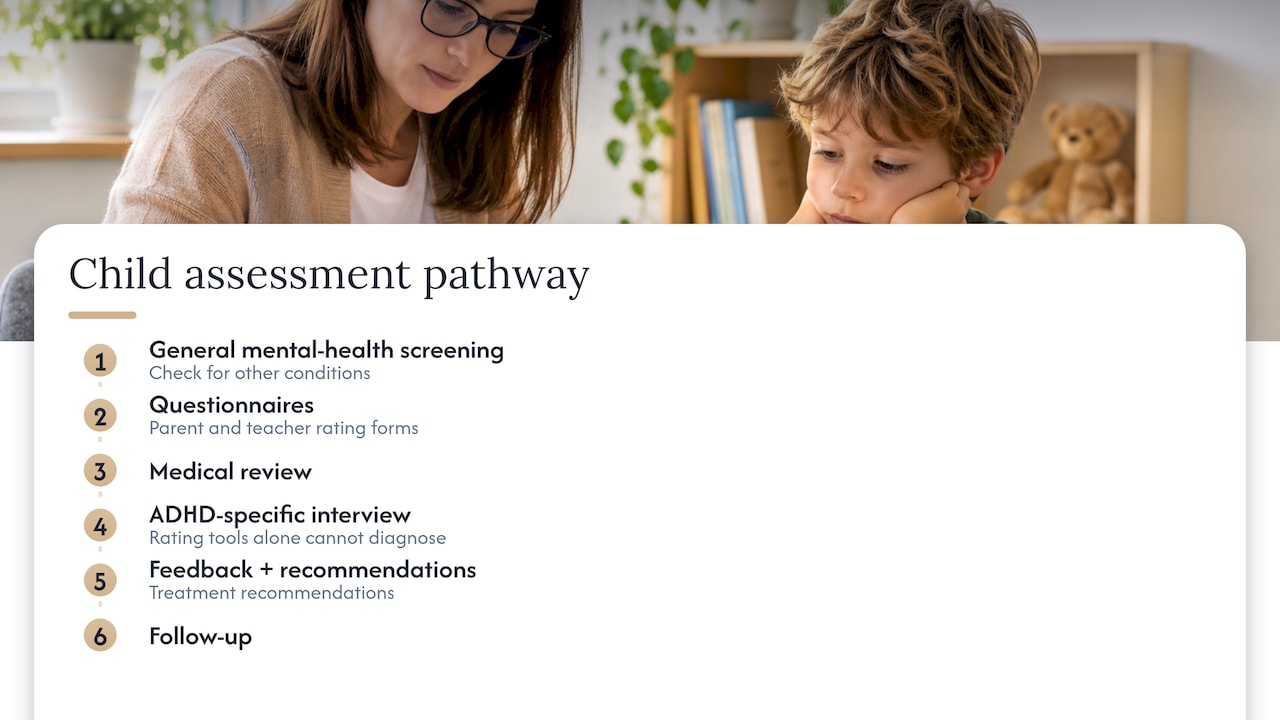
Parent and teacher rating forms are a standard part of this. CADDRA lists tools such as SNAP-IV, the WFIRS-P functional-impairment measure, and alternatives including Vanderbilt, Conners and the Strengths and Difficulties Questionnaire, all in the child assessment pathway.
The guidelines recommend reviewing developmental history, teacher information, report cards and previous assessments when giving feedback and treatment recommendations. Before your appointment, gather:
Our step-by-step page on the ADHD assessment process goes through what to expect, and our ADHD assessments page explains how we offer them. If you want more background first, see what parents should know about ADHD assessments.
You do not need to wait for a crisis. The CDC advises parents to talk with a healthcare provider when a child’s behaviour or emotions are severe or last a long time, so that the child gets an accurate diagnosis and treatment. Signs that it may be time include:
Anxiety, low mood and learning difficulties can occur alongside ADHD or look like it, which is one reason a thorough assessment matters.
ADHD is not treated once and finished. CADDRA describes it as needing long-term, regular follow-up whether or not medication is prescribed, with more frequent visits during medication adjustments and life transitions such as a new school. Plan for check-ins when your child changes grades, and expect your strategies to evolve as your child grows.
Our perspective
When families call us about a child with ADHD, they are often tired and worried they have already done something wrong. We want to say plainly: you have not. Our practice is built around the idea that a child does best when the whole family is supported, which is why we are collaborative and family-oriented, with a multidisciplinary team.
We believe the first step should feel easy. That is why every therapist offers a free 15-minute connection call, so you and your child can see whether it feels like a fit before committing to anything. You do not need a physician referral, and we offer evening and weekend availability because school and work schedules are real.
We also think therapy for ADHD works best when it is practical. Parent strategies, school coordination and skill-building for your child are the heart of it, and we pair them with assessments, counselling and, where it suits the family, other services we offer.
Deane
Supporting Wellness Psychological & Family Services offers child and adolescent counselling, family counselling, ADHD assessments and psycho-educational assessments, in person in Calgary, Red Deer and Cold Lake, and online. We offer direct billing to a wide range of insurers, so check your benefits for psychology coverage.

If cost is a concern, our affordable counselling pages list $100 in Calgary and $80 in Red Deer. You can see everything we offer on our services page, or start with a free connection call through our website. For parents who want support for themselves, our page on parenting counselling explains how we work with caregivers.
For many children, particularly younger ones, behavioural approaches are the first step. CPS identifies parent behaviour training as first-line for children under 6. For older children the plan is individualized, and your child’s physician can talk through whether medication should be added.
The CDC says parents typically attend 8 to 16 sessions. Your therapist will adjust that to your child’s age, goals and how quickly the strategies take hold. Follow-up afterward is common as your child grows.
No. We do not require a physician referral. You can start with a free 15-minute connection call with a therapist, and we will explain the next steps. Check your insurance plan for coverage, as we offer direct billing to many insurers.
Bring recent report cards, teacher comments, any previous assessments and notes on developmental history and how symptoms show up at home. Canadian guidelines recommend reviewing exactly this kind of information when making a diagnosis and recommendations.
No. Counselling and parent support can help when a child is struggling with attention, emotions or behaviour, whether or not an assessment has been done. An assessment helps clarify what is going on and which supports fit best.