
In Calgary, a psychoeducational assessment is a private, fee-for-service evaluation, and the total depends on what your child or you need assessed. The fee covers the whole process: intake, testing, scoring, the written report and the feedback session. We do not publish a flat price for assessments at Supporting Wellness. We give you a clear quote after a free 15-minute connection call, so you know the cost before you commit.
If you are comparing clinics, this guide explains what is inside the fee, what moves it up or down, and how to reduce what you pay out of pocket.
A psychoeducational assessment looks at how a person learns, thinks and pays attention. A psychologist uses standardized tests, interviews, questionnaires and observations to understand strengths and difficulties in areas such as reading, writing, math, memory, processing speed, attention and reasoning.
People usually seek one for a few reasons:
The outcome is a written report with findings, a diagnosis when criteria are met, and practical recommendations for home, school or work. That report is what schools, universities and funding bodies tend to look for, which is why the quality of the process matters as much as the price.
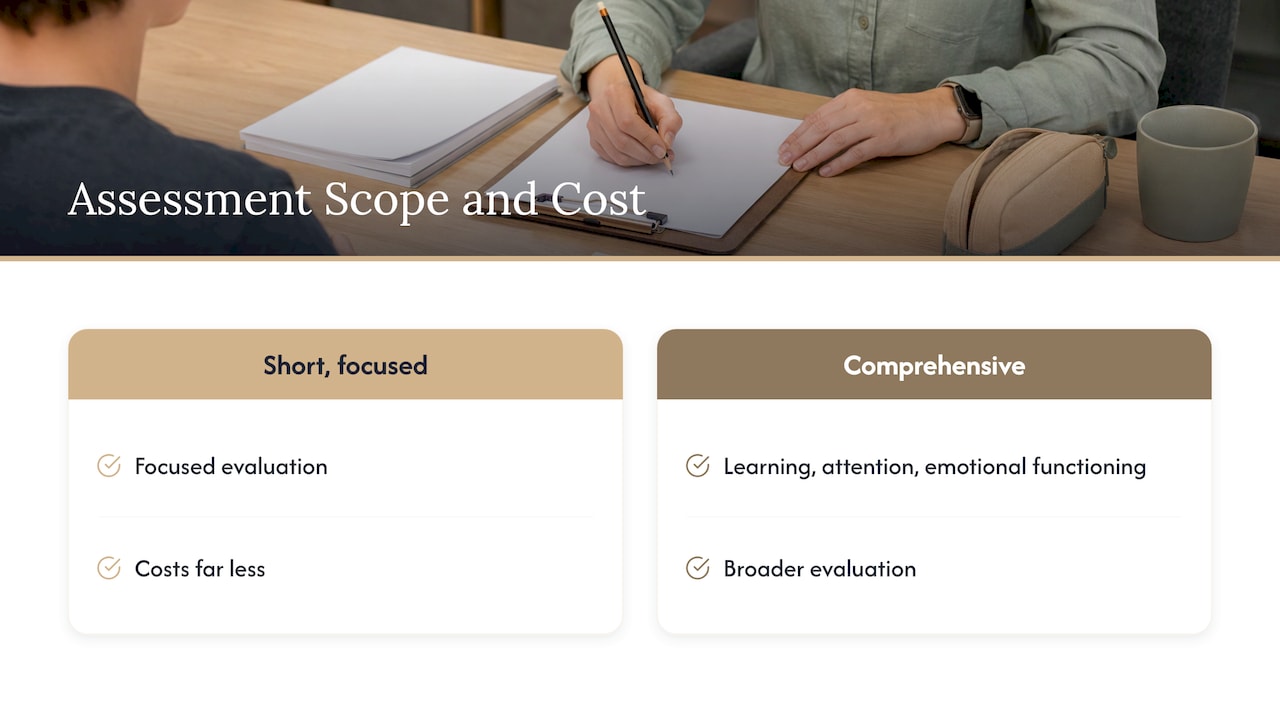
Calgary psychologists set their own assessment fees, and published prices from clinics vary widely. A short, focused evaluation costs far less than a comprehensive one that covers learning, attention and emotional functioning. For that reason, a single “average” price can mislead you. The figure that matters is the price for the specific questions you want answered.
At Supporting Wellness, our psychoeducational assessments in Calgary are quoted individually. We do not list a fixed assessment price on our site, so we will not guess at one here. What we can tell you is how the quote is built, and that you will have it in hand before any testing begins.
If you are also exploring attention concerns, our ADHD assessments are a separate service with their own quote.
It is easy to think of an assessment as a few hours of testing. In reality, the testing day is one stage in a longer process, and each stage takes professional time.

The process starts with an interview about development, school history, health, family and concerns. School reports and earlier evaluations are reviewed. This shapes which tests are chosen, so it directly affects the quality of the results.
The psychologist or a trained team member administers standardized measures. For children, testing is often split into more than one shorter session so they stay fresh and can show what they can do.
Test results are scored, compared against age-based norms, and then interpreted together with the interview and observations. This is where the clinical judgment sits. Numbers alone never explain why someone struggles, so this stage takes careful, unhurried work.
The report brings everything together: results, a clear explanation of strengths and challenges, any diagnosis, and specific recommendations. A good report is something a teacher, a disability services office or a physician can actually use. Writing it well takes substantial time, which is why the fee reflects far more than the hours spent face to face with your child.
You sit down with the psychologist to go through the findings in plain language and ask questions. For children, this is also a chance to talk about how to share the results with them in an encouraging way.
The same pattern appears in how other health professionals build a fee from several stages of care. If a related concern such as anxiety turns up during assessment, a structured approach like CBT for teen anxiety is one of the next steps families often consider.
Two assessments can have quite different price tags for good reasons. These are the main factors.
| Factor | Why it affects the fee |
|---|---|
| Scope of the assessment | A focused cognitive or academic screen takes less time than a full evaluation of learning, attention, memory and emotional functioning. |
| Age of the person | Younger children often need shorter, more frequent testing sessions. Adults may need extra history gathering. |
| Number of questions | Asking about a learning disability, ADHD and giftedness together takes more testing than asking about one. |
| Complexity of history | Earlier reports, medical factors, language background or other conditions add review and interpretation time. |
| Report detail | A report built for school accommodations or university disability services can be more detailed than a brief summary. |
| Clinic location and overhead | Offices in large cities carry higher costs for rent, staff and insurance, which feeds into fees. |
When you compare quotes between clinics, compare like with like. Ask what is included: how many testing sessions, whether the written report and feedback session are part of the price, and whether any add-on measures are charged separately.
The price is one thing. What you actually pay out of pocket can be lower once you look at the supports available.
Many employer and private plans reimburse psychological services. Coverage differs from plan to plan: some include assessments, some set an annual dollar limit for psychology, and some require a specific provider type. Before you book, call your insurer and ask three things: whether psychological assessments are covered, what the annual maximum is, and whether you need a pre-authorization or a referral.
We offer direct billing to a wide range of insurers, which means that when your plan allows it, we can bill the insurer directly instead of you paying in full and claiming later. Our team can tell you what we are able to bill during your connection call.
In Canada, some health-related fees can be claimed as medical expenses on your tax return. The Canada Revenue Agency states that fees paid to a medical practitioner for completing a Disability Tax Credit application may be claimed that way. Whether the assessment fee itself qualifies depends on your circumstances, so confirm with the CRA or a tax professional before you file.
Students in college or university who are diagnosed with a disability may be able to apply for government grant funding that helps with part of the cost of an assessment, along with education costs. Alberta Student Aid and your school’s accessibility office can explain what applies to you and what documentation they require. Ask them first, so the report you pay for meets their requirements.
Schools can provide some in-school testing and supports, but wait times and scope differ between school authorities. Many families choose a private assessment when they want a comprehensive evaluation sooner, or when they want a report that covers attention, learning and emotional factors in one place. Talk with your child’s teacher or school learning team about what the school can offer, and whether a private report would complement it.
There is no single right age. A psychologist can usually assess a child once they can take part in standardized testing, and many families start when school struggles become clear, often in the early elementary years. Others come later, at the point where demands increase in middle school, high school or university, and earlier strategies stop working.
Waiting rarely helps if you already see persistent difficulty. Early understanding means the right supports can start sooner, and your child avoids months of feeling that they are simply not trying hard enough. If you are unsure, our child psychologist team in Calgary can talk through what you are noticing and whether an assessment is the right next step.
People often search for an “educational psychologist assessment” and wonder if it costs less than a psychologist’s. In Alberta, the title and scope of the professional matter more than the label. What counts is that the person completing the assessment is qualified to administer the tests, make diagnoses where needed, and sign a report that schools, insurers and funding bodies will accept. Ask any clinic who completes the assessment, what their registration is, and whether the report will be accepted by the school or institution you have in mind.
Our perspective
When families ask us about cost, we understand that the question underneath is often “Is this going to be worth it for my child?” We think the answer depends on whether the assessment leads to something you can use.
That is why we focus on the whole process. A thorough intake, careful testing, thoughtful interpretation and a report written to be used by a school or physician all take time, and they are what turn a set of scores into a plan. Our multidisciplinary, family-oriented team works this way because we believe a clear understanding of how someone learns is where support starts.
We also believe you should not have to guess at the cost or feel nervous about asking. Every therapist at Supporting Wellness offers a free 15-minute connection call, no physician referral is needed, and we offer evening and weekend availability so assessments can fit around school and work. We direct bill a wide range of insurers when your plan allows it.
Deane
Our psychoeducational assessments in Calgary come with a quote built around your questions. Here is how it works:
If an autism question is part of your concern, see our page on autism assessments in Calgary for how that evaluation works.
Whichever clinic you choose, a few questions make the price easier to compare:
Clear answers to these tell you more about value than the headline number does.
If you want to understand what an assessment would involve for your family and what it would cost, we are happy to help. Our team offers in-person appointments in Calgary and online options, with direct billing to many insurers.

Book a free 15-minute connection call through our Supporting Wellness services page and tell us what you would like to understand. There is no pressure and no obligation, and you will leave the call knowing your next step.
No. At Supporting Wellness you do not need a physician referral to book. You can start with a free 15-minute connection call and we will explain the process and the quote. Some insurers or schools have their own paperwork requirements, so it helps to ask them early.
Many extended health plans cover psychological services, but the details vary by plan and insurer. Some include assessments, others limit annual psychology spending. We direct bill a wide range of insurers, and we recommend asking your plan what it covers before you book.
Fees reflect the scope of testing, the time spent on scoring and report writing, the complexity of the history, and the clinic’s overhead. A brief screen and a comprehensive evaluation are very different services. Compare what is included, not only the total.
The process includes intake, one or more testing sessions, scoring, report writing and a feedback session. The timeline depends on the scope of the assessment and scheduling. We will give you an estimate during your connection call.