
There is no single number, but there are useful ranges. Short-term therapy for a specific issue often takes about 6 to 16 sessions, and longer-standing or more complex concerns can take longer. The real answer depends on what you want to change, the approach your therapist uses, and how the work unfolds. If you are wondering how long therapy takes overall, this guide gives you the numbers Canadian sources report, explains what they actually measure, and shows you how to decide together with your therapist when to continue, adjust or finish.
Start with the most common question: what do reported ranges look like? The Centre for Addiction and Mental Health (CAMH) describes cognitive behavioural therapy (CBT) as an intensive, short-term, problem-oriented approach that typically lasts six to 20 sessions.
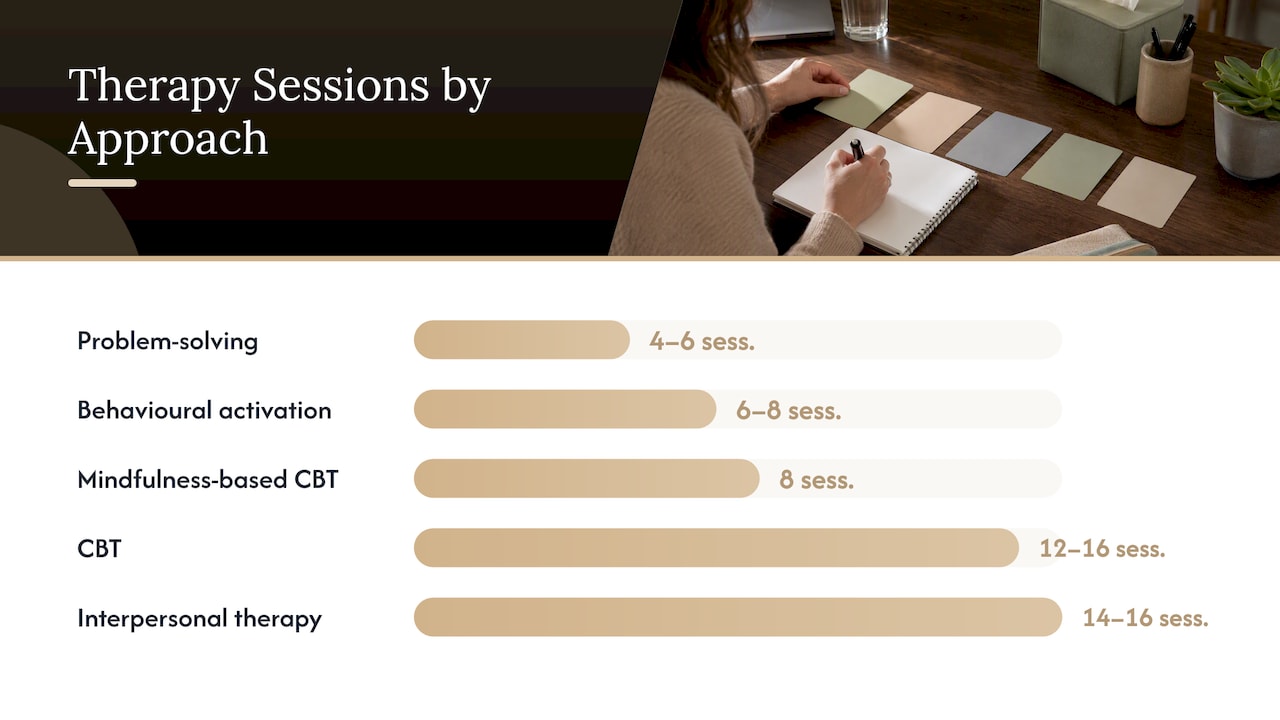
For depression, CAMH gives more specific ranges for different approaches. Problem-solving therapy usually involves four to six sessions, behavioural activation six to eight, CBT 12 to 16, interpersonal therapy 14 to 16, and mindfulness-based cognitive therapy eight sessions.
Here is that in one place:
| Approach (for depression) | Typical number of sessions |
|---|---|
| Problem-solving therapy | 4 to 6 |
| Behavioural activation | 6 to 8 |
| Mindfulness-based cognitive therapy | 8 |
| Cognitive behavioural therapy (CBT) | 12 to 16 |
| Interpersonal therapy | 14 to 16 |
These figures come from treatment guidelines for clinicians. They describe what a structured course looks like when it is delivered as designed. Your own course may be shorter or longer, and that is normal.
CAMH explains that short-term psychotherapy can involve up to 16 sessions for immediate issues, while long-term psychotherapy deals with more longstanding, complex issues.
So a useful first question is not “how many sessions?” but “what kind of problem am I bringing?”
Short-term therapy often fits when:
Longer-term therapy often fits when:
Some conditions have their own timelines. For example, a 2022 Canadian randomized clinical trial found that six months of comprehensive dialectical behaviour therapy (DBT) was noninferior to 12 months for borderline personality disorder, and the six-month group showed more rapid reductions in symptoms. More time is not automatically better, and a well-planned shorter course can work.
Studies of real-world therapy give wider ranges than the manuals do, and that is worth understanding before you compare yourself to a number.
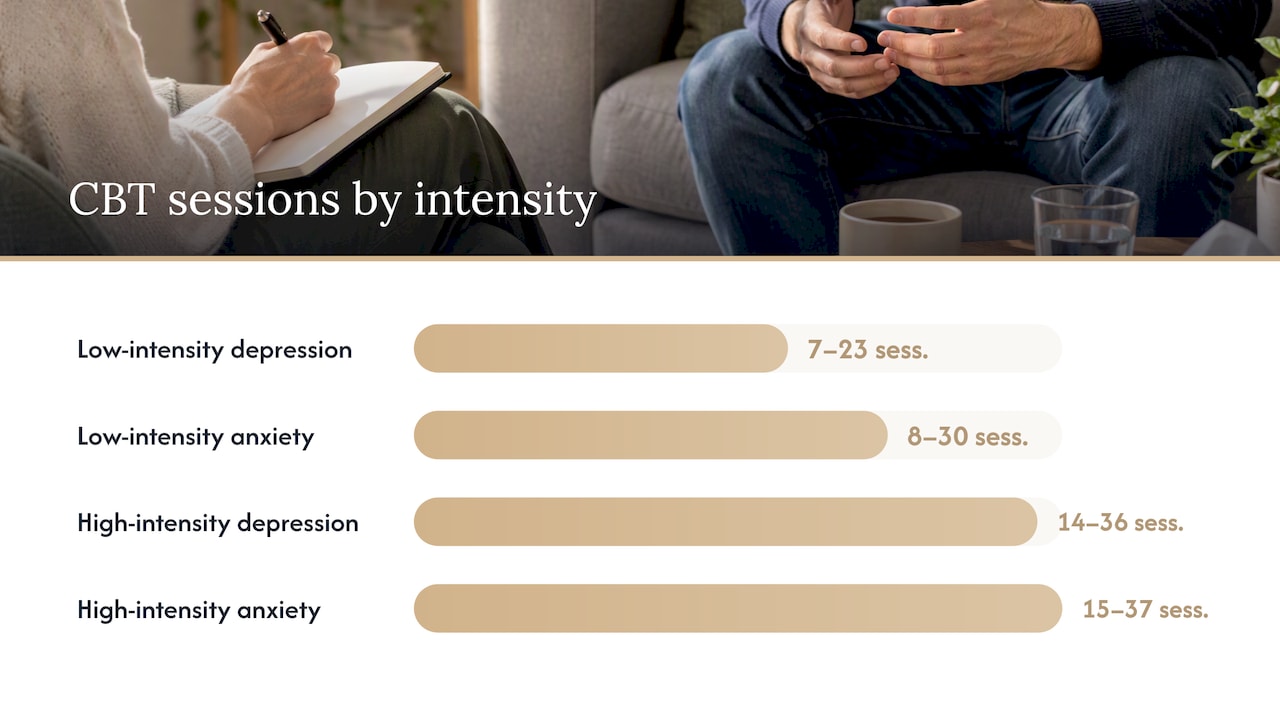
A 2026 observational study from Canada looked at dose-response for CBT delivered at two intensities. It reported ranges of 7 to 23 sessions for low-intensity CBT for depression and 8 to 30 for anxiety. For high-intensity CBT, the ranges were 14 to 36 sessions for depression and 15 to 37 for anxiety. The same study reported that half of the high-intensity responders had improved by about 14 sessions on a depression questionnaire (PHQ-9) and 15 sessions on an anxiety questionnaire (GAD-7).
Another angle comes from a 2019 paper in Psychotherapy Research, which found a curvilinear relationship between treatment length and outcomes, with optimal doses in routine settings ranging from 4 to 26 sessions.
What do these numbers tell you?
A 2020 systematic review in Psychiatry Research also notes that in everyday settings therapists and clients usually negotiate the number of sessions together, based on needs, progress, time and finances, rather than following a fixed count.
Length in weeks depends on frequency as much as on session count. Twelve sessions can be three months of weekly appointments or six weeks of twice-weekly ones.
Frequency. CAMH notes that CBT typically begins with weekly sessions, which may be spaced further apart as treatment progresses. “Booster” sessions are also common after the course ends, to maintain progress and prevent relapse. For anxiety, CAMH guidelines suggest that ideally CBT involves two sessions per week, each lasting 60 to 90 minutes. In practice, weekly is the most common starting point, and what suits you depends on your schedule, budget and the intensity of what you are working through.
Session length. Individual outpatient sessions generally run 45 to 55 minutes according to the CAMH CBT guide. CAMH’s general psychotherapy page mentions that individual sessions generally last 20 to 50 minutes, and family or group appointments may be longer. Some programs are longer still. A Canadian multisite randomized trial of a community-based CBT program used 12 weekly sessions of two hours each. Some specialized approaches, such as EMDR, may use longer appointments, so ask your therapist what to expect.
Putting frequency and count together gives a rough picture of calendar time:
| Plan | Sessions | Weekly pace | Approximate time |
|---|---|---|---|
| Brief, skills-focused | 6 to 8 | Weekly | About 6 to 8 weeks |
| Structured course (e.g. CBT for depression) | 12 to 16 | Weekly | About 3 to 4 months |
| Longer structured course | 20 or more | Weekly, then spaced out | About 5 months or more |
| Longer-term work | Ongoing, reviewed regularly | Weekly or every two weeks | Many months, set by your goals |
This table is simple arithmetic based on the ranges above, not a promise. Holidays, missed appointments, work schedules and breaks all stretch the timeline, and many people pause for a few weeks and return. Therapy can also have phases: an assessment phase at the start, the main work in the middle, and a tapering phase with spaced-out sessions at the end.
Your therapist should talk with you about all of these in the first sessions.
Good therapy is not a mystery. According to the CAMH CBT guide, clinicians and clients typically monitor progress session by session, often with short questionnaires that track symptoms. Decisions to continue, adjust the approach or finish are made together, by checking whether your agreed goals have been met or whether you feel able to keep your progress going on your own.
Some signs you are on track:
Some signs to raise with your therapist:
Talking about it openly is part of the work. A good therapist welcomes the question “is this helping?”
Ending therapy is rarely a single goodbye. Many people move from weekly to every two weeks, then monthly, and then stop. This gradual step-down lets you practise on your own with a safety net still in place. The CAMH CBT guide notes that booster sessions after the course are common, which helps you keep gains and lowers the risk of relapse.
If you have worked with a coach or counsellor and want practical ideas for staying consistent after formal sessions, this set of follow-up coaching exercises for adults shows how structured check-ins can keep new habits going. You can return to therapy any time life changes, and coming back for a few sessions is not starting over.
In Canada, coverage is often what determines how many sessions are practical, so it is worth knowing your limits early.
Private extended health plans usually set an annual dollar amount or a per-session limit, and those details vary by employer. Our guides to paying for therapy in Alberta, Blue Cross coverage, couples counselling coverage and claiming therapy on your taxes walk through the common questions. We also explain direct billing and insurance so you know what to expect before your first appointment.
Our perspective
At Supporting Wellness, we do not set a session count before we have met you. We would rather learn what you want to change, how long it has been going on, and what is realistic for your life, then build a plan together that we review as we go.
That is why we offer a free 15-minute connection call with every therapist. It lets you ask about approach, pace and what a first block of sessions might look like, before you commit to anything. Our team brings evidence-based methods such as EMDR, Brainspotting and the Gottman Method, along with culturally safe care for veterans, first responders and Indigenous clients, so the plan can fit the person rather than the other way around.
We also know cost shapes the pace of care. We direct bill a wide range of insurers, you do not need a physician referral, and we offer evening and weekend availability so weekly sessions are easier to keep.
Deane
If you are ready to begin, a first step can be small. We offer in-person and online counselling in Calgary, Red Deer and Cold Lake, and every therapist offers a free 15-minute connection call so you can see whether it feels like a fit. Our individual counselling and therapy in Calgary page explains how to book.
If budget is a concern, our affordable counselling options are listed at $100 in Calgary and $80 in Red Deer. You can also see everything we offer, from couples and family counselling to assessments, on our services page.
Many people begin with a block of about six to eight weekly sessions, then review. That gives you and your therapist enough time to see whether the approach suits you and whether your goals need adjusting. Structured courses for conditions like depression often run 12 to 16 sessions, according to CAMH.
Sometimes a single session helps you get clarity or a plan for a specific decision. For ongoing concerns such as anxiety, low mood or trauma, most guidelines describe courses of several sessions. You can always start with one and decide afterward.
Individual sessions in outpatient settings generally last 45 to 55 minutes, though some formats, including family sessions, group programs and certain trauma therapies, run longer. Your therapist will tell you the length when you book.
Yes. Therapy is voluntary. It helps to talk with your therapist about ending, even briefly, so you can review your progress, plan for setbacks and decide whether a spaced-out check-in or booster session would be useful.
Structured approaches usually fall within about 6 to 20 sessions, and the 2026 Canadian study above reported wider real-world ranges of roughly 7 to 37 sessions depending on intensity. Your own timeline depends on how long symptoms have been present, other stressors and the approach used.