
A bid for connection is any small attempt to get your partner’s attention, interest or affection. It can be a question, a sigh, a touch or a comment about the weather. Dr. John Gottman’s research suggests that how you answer these small moments matters more for a relationship than most grand gestures. This guide explains what bids look like, how to spot the quiet ones, how to respond, and what to do when it feels hard.
In Gottman Method couples therapy, a bid is any verbal or nonverbal attempt by one partner to connect with the other. The Springer reference entry by Navarra and Gottman defines turning toward as attending to that immediate need and responding to it effectively.
Bids are not always requests for a deep talk. The University of Washington’s 2001 account of Gottman’s work describes a bid as a question, a look, an affectionate touch or any expression that means “I want to feel connected to you.” The same pattern applies beyond marriage, to friends, parents and children, and colleagues.
Think of it this way: your partner is saying, in a very small way, “Are you there for me?” Your response is the answer.
Most couples don’t drift apart because of one big event. Gottman compares relationships to cars: they need regular maintenance, and that maintenance happens through small moments, bids and responses, as described in the University of Washington report.
The numbers from Gottman’s lab are striking. The Gottman Institute reports that in a six-year study, couples who stayed together turned toward bids 86% of the time, while couples who later divorced did so 33% of the time. The Institute also links turning toward to trust, emotional connection, passion and a satisfying sex life.
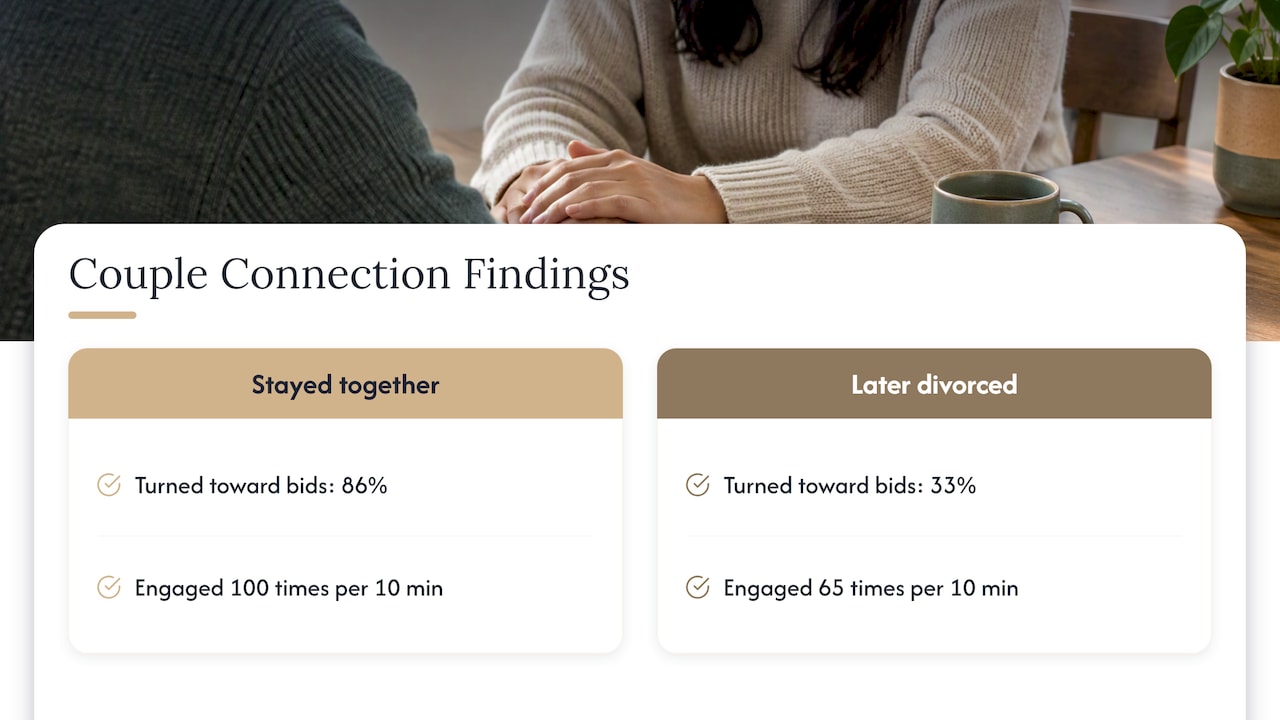
University of Georgia Extension adds a second observation from Gottman’s dinner-conversation research: happily married partners engaged each other about 100 times in 10 minutes, compared with 65 times for couples who eventually divorced. You can read it in their guide to bids for connection in marriage.
These are research findings about groups of couples, not predictions for yours. They do show a useful idea: connection builds up through many ordinary moments. The Springer reference describes it as a cumulative process, where nuanced daily interactions, and not only heart-to-heart conversations, create the deposits in what Gottman calls the emotional bank account.
Bids are usually ordinary. Here are examples drawn from Gottman Institute and university sources, plus a few common versions you may recognize.
Some bids look like something else entirely. “Did you see this video?” may mean “Share a laugh with me.” A heavy sigh at the kitchen table may mean “Please ask what’s wrong.” A question about your evening may really mean “I’d like some time with you.”
The Gottman Institute notes that a bid may be an obvious request for cuddling or a subtle, indirect comment about the weather. What matters is the response.
Why are so many bids indirect? Direct requests can feel vulnerable. “Can you hold me?” risks a no. “Long day, huh?” is safer, and it leaves the other person to read between the lines.
Gottman therapist Zach Brittle describes this as the difference between text and subtext. He suggests partners listen for the underlying attempt to get attention, affirmation, affection, advice or help.
A simple check can help. When your partner says something that seems minor, ask yourself:
If you’re unsure, you can simply ask: “Do you want to talk about it, or do you just want me nearby?”
The Gottman Institute describes three responses to a bid.
| Response | What it looks like | Example |
|---|---|---|
| Turning toward | You notice the bid and engage with it | “Sure, I’d love to go for a walk with you. Where would you like to go?” |
| Turning away | You miss or ignore the bid | A grunt while you keep scrolling or working |
| Turning against | You reject, attack or show irritation | “Why are you always interrupting me when I’m trying to get things done?” |
The turning away and turning against examples come from the Gottman Institute. The walk example is from University of Georgia Extension, which describes turning toward as acknowledging the bid and responding positively, so your partner hears “I hear you,” “I understand you” and “I want to be with you.”
Turning away is the most common and the least noticed. Nobody meant harm. You were tired, distracted or busy. But the Gottman Institute warns that missed bids may diminish later bids, or lead a person to look for attention, enjoyment or affection somewhere else.
Turning against is sharper. It can feel like criticism or contempt, and it connects to the patterns we cover in our guide to Gottman’s Four Horsemen.
Turning toward doesn’t need to be long or perfect. CNN’s 2024 reporting stresses that a bid’s size or apparent triviality matters less than whether the other person acknowledges and reciprocates it.
Here are a few sample exchanges.
Positive responses do more than feel nice. University of Georgia Extension says they communicate interest and care, encourage more bidding, and build an emotional bank account that helps couples handle conflict and crises.
If your bids keep landing flat, the issue may be how they are sent. The Gottman Institute suggests making unclear bids more recognizable: use words, ask specifically for what you need, and state the need positively rather than critically.
The Institute gives a clear contrast. Instead of “You’re never home,” try “I miss you. Can we schedule a date night?” or ask to have lunch together.
A few more rewrites in the same spirit:
| Instead of | Try |
|---|---|
| “You never listen to me.” | “I’d love 10 minutes of your attention after dinner. Can we sit together?” |
| A long sigh and silence | “I’m feeling a bit low tonight. Could I get a hug?” |
| “We never do anything fun.” | “Want to try that new walking trail on Saturday?” |
The direct version feels riskier. It is also much easier for your partner to answer well.
Every couple misses bids. The goal is not a perfect record. It’s noticing the pattern and repairing it.
The Gottman Institute points out that rejection, unlike a missed bid, leaves an opportunity for continued engagement and repair. If you snapped or zoned out, you can come back to it: “I’m sorry I brushed you off earlier. What were you going to tell me?”
Two habits help.
For a structured daily practice, our guide to the Gottman stress-reducing conversation walks through a way to turn toward each other after a hard day. If you’d like more practical ideas, try these communication exercises for couples. To understand your partner’s inner world better, see how to build Gottman love maps.
If you find yourself turning away often, there is usually a reason, and it isn’t that you don’t care. Some common ones:
None of this is fixed. Turning toward is a skill, and skills improve with practice and support.
At Supporting Wellness, many couples arrive saying, “We just don’t talk anymore.” When we look closer, they are usually talking all day. What’s missing is the small, warm reply to the small, tentative reach.
We see three things again and again. First, partners are often more willing than they appear. They simply didn’t realize the sigh, the story or the joke was a request. Second, learning the word “bid” takes blame out of the room. It is easier to say “I missed your bid” than “you never pay attention to me.” Third, the change that lasts is rarely a big one. It’s choosing to look up from the phone three more times a day.
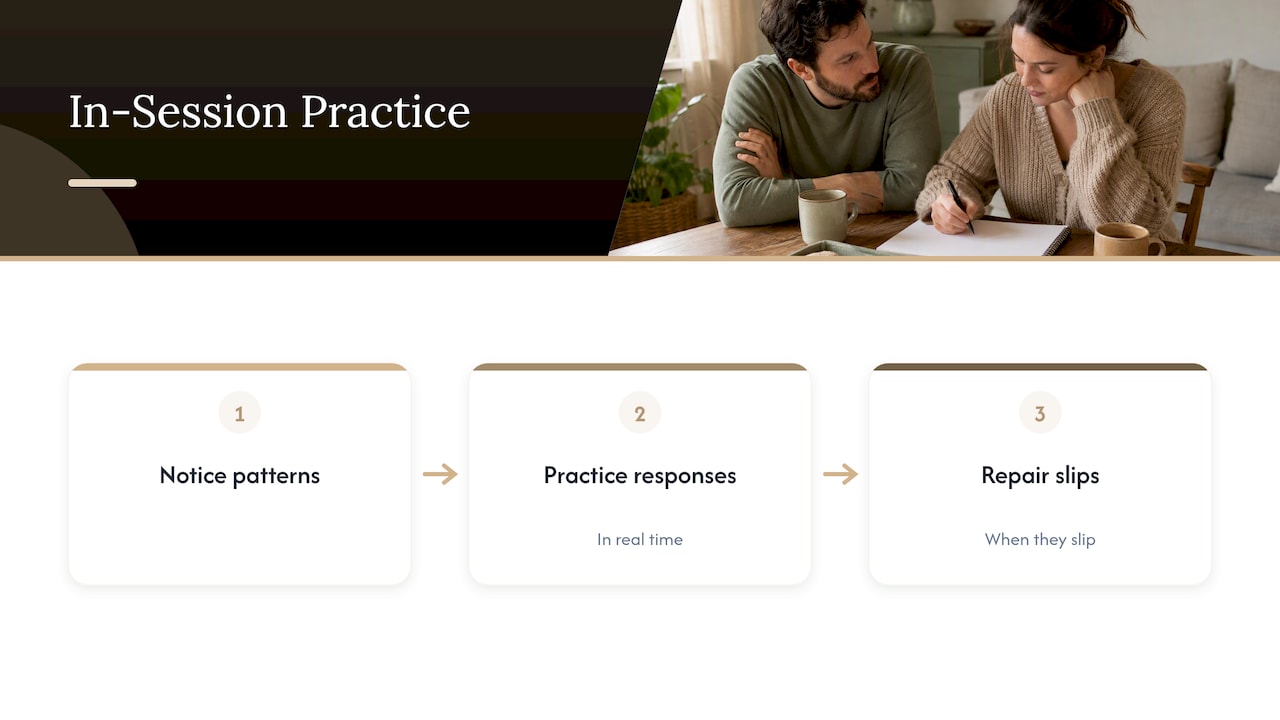
In session, we help couples notice their own patterns, practice responses in real time, and repair when they slip. Our approach is collaborative and non-judgmental, and we’ll go at a pace that feels safe for both of you. If you’re curious how the model works in practice, we’ve written about what research shows on the Gottman Method and how it compares in EFT vs Gottman.
— Deane
If reading this made you think, “We miss each other’s bids all the time,” you’re not alone, and you’re not too late. We offer marriage and couples counselling in Calgary, with evening and weekend availability, direct billing to a wide range of insurers, and no physician referral needed. You can also see everything we offer on our services page, including online sessions.
Every therapist offers a free 15-minute connection call, so you can ask questions and see whether it feels like a fit before you commit. Not sure whether now is the right time? Our article on whether it is too late for couples counselling may help, and so can how couples counselling improves communication and connection.
A simple one is “How was your day?” or pointing out a bird outside the window. Nonverbal examples include a hug, a smile, reaching for a hand or a wink. The size doesn’t matter. What counts is that your partner is reaching for your attention, and that you notice it.
Turning toward means you notice your partner’s bid and respond to it positively. You might answer a question, return a smile, or show interest in a story. It tells your partner, “I hear you, and I want to be with you.” It doesn’t have to be long to count.
Everyone does, so it’s not a sign your relationship is failing. Come back to it with a short repair, such as “Sorry, I was distracted. Tell me what you were saying.” Gottman Institute guidance notes that rejection still leaves room for continued engagement and repair. What matters most is the overall pattern over time.
Make them clearer and more specific, and state them positively. Instead of “You never talk to me,” try “I’d love to hear about your day. Can we sit together for 10 minutes?” You can also introduce the word “bid” together, so you both have shared language for it.
Yes. A Gottman-informed therapist can help you spot your patterns, practice turning toward in session, and work through whatever makes it hard, such as stress, old hurts or avoidance. You can start with a free 15-minute connection call to see whether it feels right for you.