
You should see a speech therapist when communication, speech sounds, voice, fluency or swallowing is getting in the way of daily life, or when a child misses the milestones listed below. For children, any loss of language or social skills at any age is a reason to be assessed right away. For adults, a sudden change after a stroke, brain injury or illness is the clearest signal. If you are simply unsure, a conversation with a speech-language pathologist costs you little and can settle the question.
This guide walks you through what to watch for at each age, what an evaluation involves, and how to get started in Alberta.
Speech therapist is the everyday name for a speech-language pathologist (SLP). In Alberta, SLPs assess, diagnose and treat communication and swallowing disorders, and the profession is regulated under the Health Professions Act, with mandatory registration through the Alberta College of Speech-Language Pathologists and Audiologists.
The work covers much more than a child who talks late. SLPs support:
The goal is not only to fix a sound. As the American Speech-Language-Hearing Association explains, speech therapy is fundamentally about participation: helping a person take part safely and independently in daily routines and relationships. That framing helps when you are deciding whether a concern is “big enough”. If the difficulty limits what you or your child can do, say or enjoy, it is big enough.
Most parents sense something before they can name it. A child who is frustrated because no one understands them, who goes quiet in groups, or who seems to hear but not follow directions is telling you something. Milestones give that instinct a frame.
According to Health Canada’s pediatric developmental guidance, a formal evaluation is warranted when a child:
| Age | Red flag |
|---|---|
| 12 months | No babbling, or no gesturing such as pointing or waving |
| 16 months | No single words |
| 24 months | No spontaneous two-word phrases |
| Any age | Loss of language or social skills they previously had |
The same guidance recommends developmental monitoring at 2, 4, 6, 12, 18 and 24 months, and again at 4 to 5 years of age. Those routine visits are a natural moment to raise any worry out loud.
Milestone charts are a floor, not a full picture. Consider an assessment if you notice:
We go through the most common signs in more detail in 7 signs your child might need a speech therapist.
It is the most common advice parents hear, and it is often well meant. MyHealth Alberta notes that mild, temporary delays do happen and some children simply learn to communicate faster than others. It also says you can contact your doctor, a nurse advice line or an SLP anytime you are concerned.
The trade-off is lopsided. If you wait and your child catches up, you lost some weeks of worry. If you wait and they do not, you may have lost time when early intervention is most effective, because the young brain is especially receptive to learning language. An evaluation that finds nothing wrong is still useful: you leave with a clear picture and ideas for home.
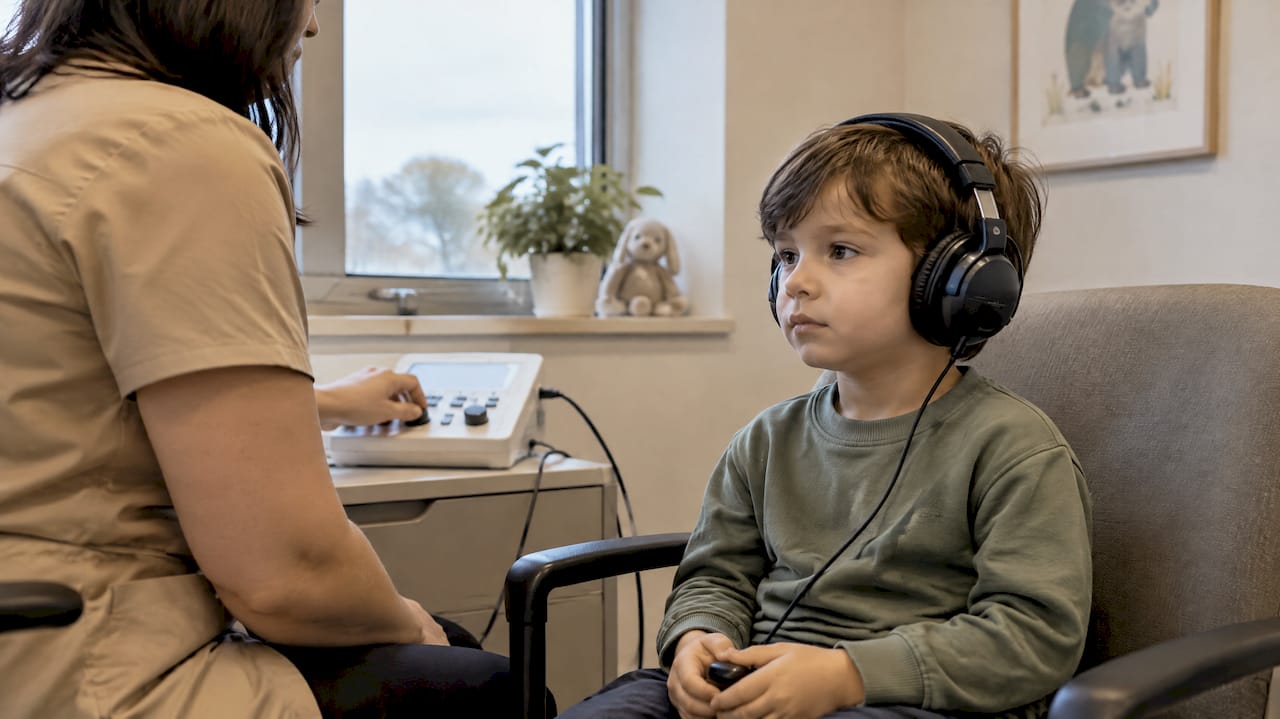
Hearing loss is a leading cause of speech delay, so a good evaluation checks it early. If your child has frequent ear infections, does not turn to familiar voices, or seems to “tune out”, mention it. It is one of the first things an SLP or doctor will rule out.
Parents often search for a way to tell a speech delay from autism. It is a fair question, and one that no checklist at home can answer for you.
In general, a speech delay concerns the mechanics of communication: sounds, words and sentences. An autism assessment looks at a broader set of markers. The Public Health Agency of Canada describes signs in areas such as social-emotional reciprocity, joint attention and repetitive behaviours. A child with a language delay can show warm back-and-forth connection, point to share interest and play imaginatively. A child whose delay comes with limited eye contact, little pointing or sharing, or fixed repetitive routines may need a wider look.
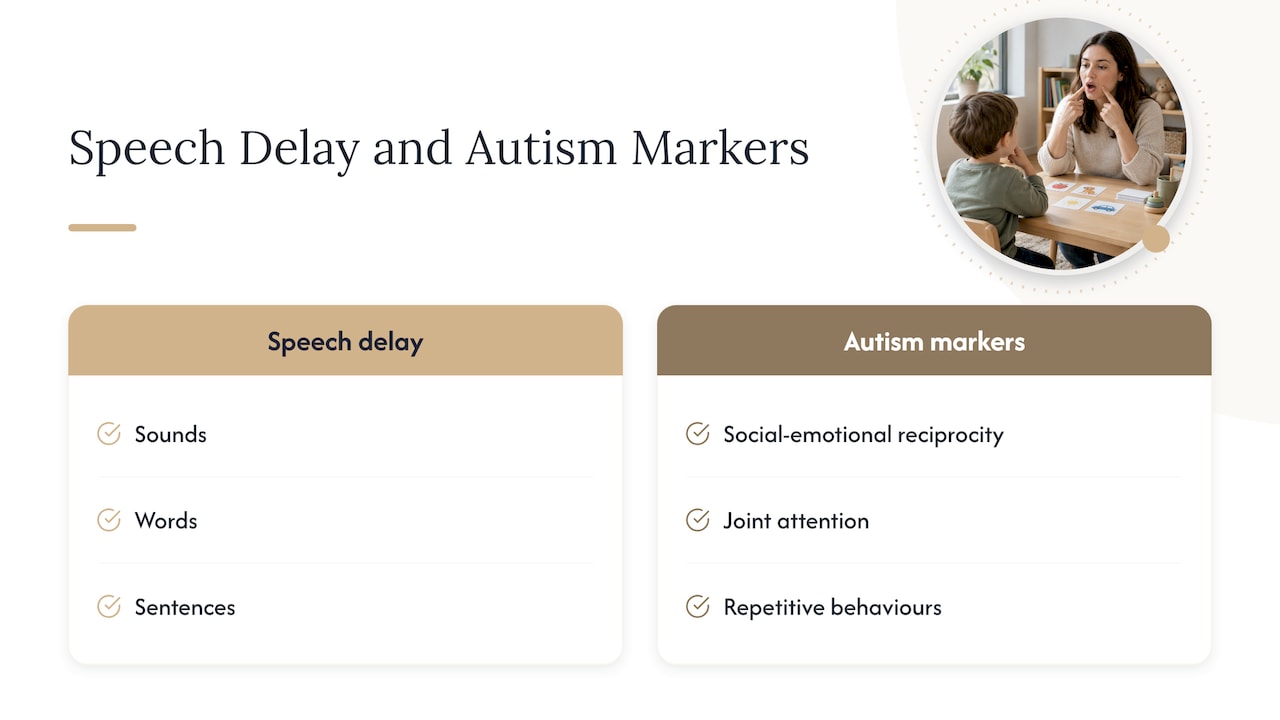
Because the picture can overlap, a team approach is standard, involving psychologists, SLPs and pediatricians. A comprehensive speech-language evaluation is also recommended for children who do not pass a developmental screen, as the American Academy of Neurology practice parameter notes. If your questions go beyond speech, our psychoeducational assessments in Calgary look at learning, attention and development as a whole.
Speech therapy is not only for children. Adults often wait years because they assume nothing can be done or that the problem is minor. See an SLP if you notice:
The measure is the same as for children: is communication or swallowing limiting how you live? If so, an assessment is worthwhile.
A typical speech evaluation is comprehensive. Alberta’s public referral card and clinical practice describe the same core steps:
Nothing about this should feel like a pass-or-fail exam. For young children it looks mostly like play.
You have several doors, and you do not have to use them in order.
Whoever you choose, confirm the clinician is a registered SLP. Registration with the provincial college is mandatory in Alberta.
In our practice, the families who tell us they wish they had called sooner far outnumber those who wish they had waited. We are not saying every late talker needs therapy. We are saying the worry itself is information, and it deserves a real answer from a trained professional rather than a guess from a friend or a search result.
We also see how communication difficulties rarely stay confined to speech. A child who cannot be understood may become withdrawn at school. An adult who avoids phone calls because of a stutter may start to avoid people altogether. That is why we work as a multidisciplinary team, with speech therapy sitting alongside counselling, assessments and family support, so no one has to piece the picture together alone. Our speech therapy in Calgary is one part of that.
We also believe in meeting you first. Therapy goes better when you feel comfortable, so we offer a free 15-minute connection call with every therapist before you decide anything.
— Deane
Therapy works best when home life reinforces it. Experts note that exaggerated tone and expression, often called baby talk, helps engage very young children, and that it should gradually shift to modelling normal speech once the child starts talking. A language-rich home matters as much as the sessions themselves.
Simple habits that help:
How you respond matters too. Corrections and constant prompting can make children avoid talking. If you want practical ideas for talking with kids in a way they actually hear, this guide on giving feedback kids actually hear is a helpful read, even though it is written for sports.
Good speech therapy is practical. Children often gain confidence in class and with friends, which we cover in how speech therapy can boost your child’s confidence in school and social situations. For apraxia of speech, frequency matters, and we explain why in why once-a-week therapy often falls short for apraxia of speech.
Adults often report relief of a different kind: speaking in meetings again, eating without fear, or being understood on the phone.
Supporting Wellness Psychological & Family Services offers speech therapy alongside counselling and assessments in Calgary, Red Deer and Cold Lake, with in-person and online options. Evening and weekend availability, direct billing to a wide range of insurers, and no physician referral needed make it easier to fit care into real life. Start with a free 15-minute connection call, or see everything we offer on our services page. If you are in Cold Lake, see our speech therapy page for Cold Lake.
If a communication worry is also weighing on you or your family, our team can help with family counselling in Calgary too.
Ask whether speech, language, voice, fluency or swallowing is limiting daily life, work, school or relationships. If you answer yes, or you are simply unsure, an evaluation is reasonable. Sudden changes, especially with face drooping, weakness or confusion, are emergencies: call 911.
Health Canada’s guidance points to no babbling or gesturing by 12 months, no single words by 16 months and no two-word phrases by 24 months. Loss of previously learned language or social skills is concerning at any age. Trust your instincts if something else worries you, and raise it at a routine checkup or with an SLP.
You cannot reliably tell at home. A speech delay focuses on sounds, words and sentences, while an autism assessment also looks at social reciprocity, joint attention and repetitive behaviours. A team of an SLP, psychologist and pediatrician gives the most accurate answer.
You do not need a physician’s referral to contact a health professional about your child’s development in Alberta. Some public programs and insurers have their own requirements, so check with your plan. At our clinic, no physician referral is needed.
Yes. Adults are helped after stroke or brain injury, and with voice problems, stuttering and swallowing difficulty. Your doctor should look at sudden or persistent changes first, then an SLP can assess and plan treatment.