
There is no single way to counsel someone through a loss. The main approaches are individual talk therapy (most often cognitive behavioral therapy, or CBT), grief-focused treatments built for prolonged grief, group and peer support, and body-based or trauma-focused methods. The right one depends on how heavy the grief is, how long it has lasted and what you want from support. A short conversation with a therapist is often the quickest way to sort that out. At Supporting Wellness, every therapist offers a free 15-minute connection call, so you can ask questions before you commit to anything.
Grief is a natural response to loss, not a mental illness. The Canadian Grief Alliance, a national coalition working on grief support, describes it as an expression of what it is to be human, and it describes a spectrum of care. Most people cope with support from friends and family who listen without judging. Peer groups suit people who want connection but not therapy. Specialized grief counseling is for people with higher-level needs.
Alberta Health Services says grief doesn’t usually require medical treatment, and it lists signs that it is time to contact a grief counselor or your doctor:
If you recognize yourself in that list, counseling is a reasonable next step, and you do not need to wait until things feel unbearable. Grief also does not follow a fixed schedule. Our article on why grief has no timeline looks at why the five-stage idea does not fit most people’s experience.
If you are in crisis or thinking about suicide, call or text 9-8-8, Canada’s Suicide Crisis Helpline, at any hour.
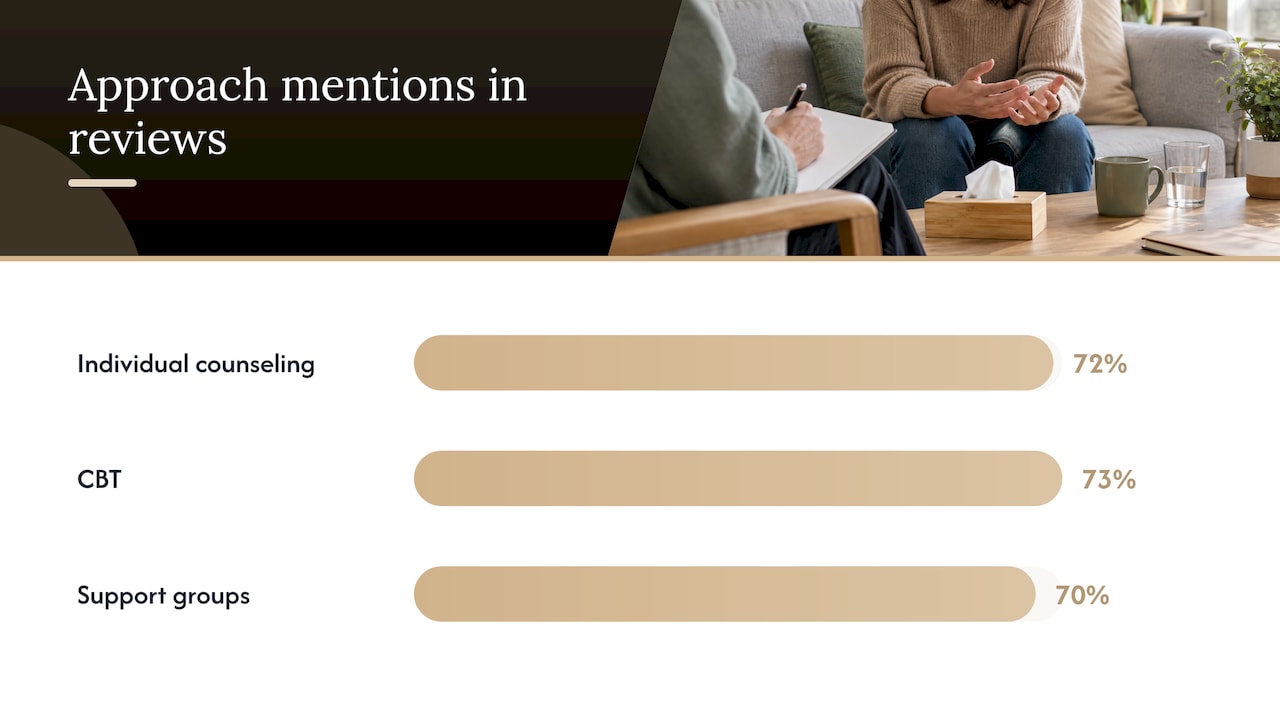
Canadian practice is varied. A 2017 study of Canadian practitioners who treat complicated grief found they drew on narrative, psychodynamic, behavioral, cognitive-behavioral, meaning-reconstruction, humanistic and holistic orientations, often adding mind-body techniques such as mindfulness and journaling. A 2025 scoping review of bereavement practice found that individual counseling appeared in 72% of reviews and support groups in 70%. CBT was the most cited specific approach, at 73%.
Here is how the main options differ in plain terms.
| Approach | What it focuses on | Often a good fit when |
|---|---|---|
| Supportive individual counseling | A safe space to talk, name feelings, normalize grief reactions | You want steady support after a recent loss |
| CBT-based grief therapy | How thoughts, avoidance and behaviors keep distress going | Grief feels stuck or is interfering with daily life |
| Complicated Grief Treatment | A structured 16-session program for prolonged grief | Intense yearning and distress persist well beyond a year |
| Meaning-centered and narrative work | Making sense of the loss and the story of the relationship | The loss has shaken your sense of purpose or identity |
| Mindfulness and acceptance-based work | Staying present with painful feelings rather than fighting them | You feel overwhelmed or numb |
| Trauma-focused methods (EMDR, Brainspotting) | Processing distressing memories tied to a sudden or traumatic loss | Images or reactions from the death keep intruding |
| Group and peer support | Shared experience with other grieving people | Isolation is the hardest part |
| Family counseling | How a household grieves together | Family members are grieving in different ways |
These are not rival camps. A therapist often blends them, moving from supportive listening to more structured work as your needs become clear.
CBT looks at the links between thoughts, feelings and actions. In grief work it helps with patterns such as avoiding reminders, harsh self-blame or withdrawing from people. A 2024 state-of-the-science review found that grief-focused CBT therapies have the strongest evidence for prolonged grief. A meta-analysis of 22 randomized trials with more than 2,900 participants showed a medium effect straight after treatment and a large effect at follow-up. These therapies average about 12 weekly sessions, and the review notes that 45% were delivered online.
That last detail matters if you live outside a city centre or have a demanding schedule. Online sessions are a real option, and you can read about online counselling in Calgary if travel or timing is a barrier.
Complicated Grief Treatment (CGT) was developed by Katherine Shear and colleagues at Columbia University. It is a manualized, 16-session therapy over about four months that combines attachment theory, CBT, interpersonal therapy and motivational interviewing. In trials, it outperformed interpersonal therapy alone.
It is designed for prolonged grief disorder. This is a diagnosis added to the DSM-5-TR in 2022, marked by intense yearning or preoccupation with the person who died, significant distress and reduced functioning. In adults, symptoms last more than a year. British Columbia’s Ministry of Health guideline describes it as grief whose intensity or duration is debilitating and adversely affects coping. The same guideline points people toward a bereavement counselor, psychologist or psychiatrist for targeted psychotherapy.
A CGT course follows three phases:
Techniques include a grief monitoring diary, revisiting the story of the death, returning to places and activities you have avoided, working with photos and memories, and an imagined conversation with the person who died.
A 2025 network meta-analysis of 40 trials found the most effective treatments for prolonged grief shared common elements: exposure, social support, narrative reconstruction, artistic expression and cognitive-behavioral work. Its authors suggest that hybrid or modified CBT may work better than standard CBT alone. The practical takeaway is that a therapist who can combine methods around your situation is more useful than one rigid protocol.
Some losses arrive with shock: an accident, a suicide, a death in service or an emergency response. Grief and trauma then overlap, and the memory of the event can feel as heavy as the absence itself. We offer EMDR (a therapy that helps the brain process distressing memories) and Brainspotting (which uses where you hold your gaze to access and work through difficult experiences). Both are part of our PTSD and trauma counselling. You can read more about EMDR therapy in Calgary or how Brainspotting differs from EMDR.
This matters in particular for veterans and first responders, who often carry losses of colleagues, patients or friends on top of everything else. We provide counselling designed for veterans and first responders, and we are happy to talk through whether a trauma-focused approach suits you on a connection call.
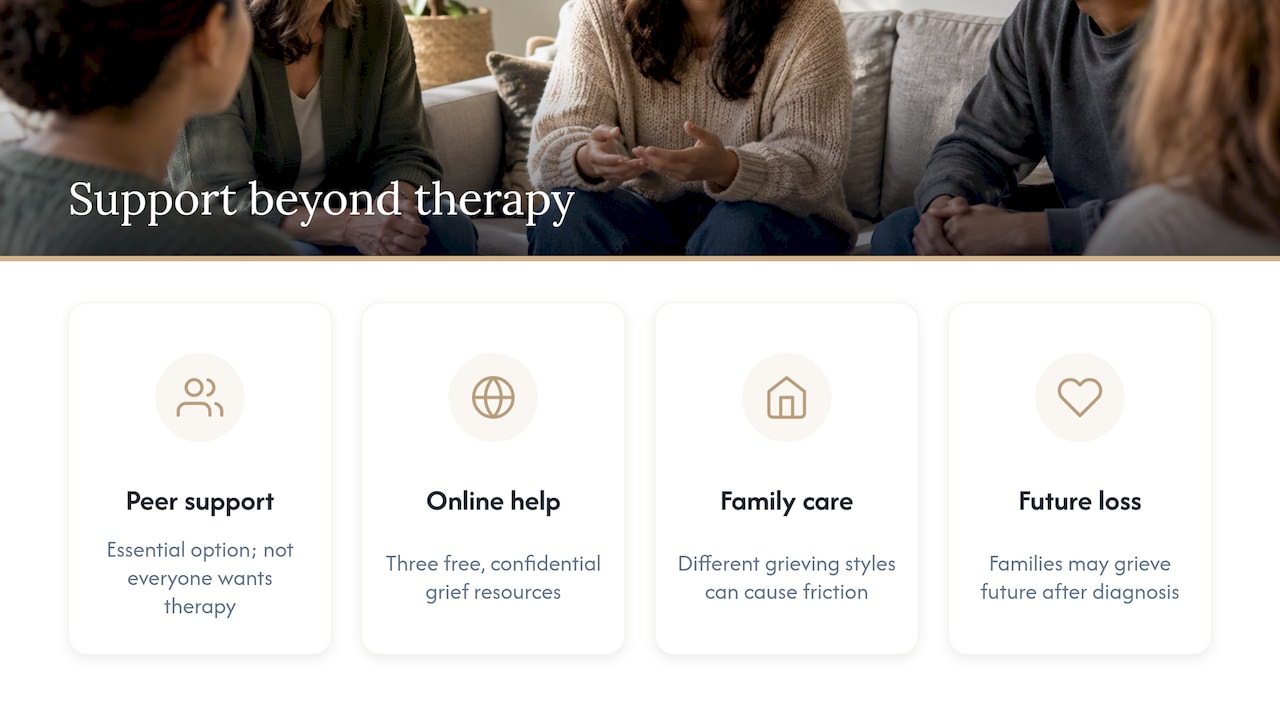
Therapy is one option among several. The Canadian Grief Alliance has said peer support is an essential part of a good system, because not everyone who is grieving needs or wants therapy. Its national site, AboutGrief.ca, lists hundreds of local, provincial and national programs. Canadian Virtual Hospice runs MyGrief.ca, KidsGrief.ca and YouthGrief.ca, which Alberta Health Services points to as free, confidential resources.
Grief also affects whole households. People grieve in different styles: some think it through, some feel it intensely, some stay busy. Those differences can cause friction between partners or parents and children. Family counselling helps everyone understand each other, and our family counselling in Calgary and couples counselling services are built for that.
Not every loss involves a death. Families can grieve the future they expected after a life-changing diagnosis, for example, and there are guides on coping with grief after an autism diagnosis for those facing that.
Children often grieve in bursts: strong emotion one moment, happy play the next. McMaster University’s Optimal Aging team recommends reassuring children with three messages: they will continue to be cared for, death cannot be caught, and they did not cause it. For teens, keep the door open for them to talk when they are ready. We offer child and adolescent counselling when a young person needs more than family support.
Canadian complicated-grief practitioners interviewed in the 2017 study stressed that creating a safe environment and instilling hope are central to treatment. In practice, a first session usually covers:
You are not expected to cry, to talk about everything or to be ready for exposure-style exercises. A good therapist sets the pace. The Canadian Mental Health Commission notes that finding the right therapist may take time, which is why we offer a free 15-minute connection call with every therapist before you begin.
Ask yourself three questions.
The McMaster team also recommends memory rituals such as letters, candles or memory boxes, physical activity and staying connected. These pair well with counseling at any stage.
The holidays can sharpen grief. If that is on your mind, see our piece on holiday loneliness and counselling.
Our perspective
We meet people at every point in grief: weeks after a death, years after, and sometimes after losses no one around them recognized. What we hope for each person is not a quick end to sadness, because love does not switch off. We hope for room to carry the loss and still live.
That is why we care about fit. Our team is multidisciplinary and works with individuals, couples and families, so the support can follow the person rather than a single method. When a loss carries trauma, EMDR and Brainspotting are part of what we offer. When the whole family is hurting, family counselling is there.
We also know that the first call is the hardest part. That is why every one of our therapists offers a free 15-minute connection call. You can ask how they work, what a session feels like and whether it seems right, with no referral needed.
Deane
Supporting Wellness offers in-person and online sessions, with evening and weekend availability, and direct billing with a wide range of insurers. No physician referral is needed. You can read about grief counselling in Calgary, Red Deer and Cold Lake, or start with a free connection call.
If cost is a concern, we list affordable counselling options: Calgary at a one-off $100 and Red Deer at a one-off $80. Reduced-rate intern sessions are also available for people without insurance.

Grief also overlaps with low mood. If sadness has begun to feel like depression, our depression counselling page explains how we can help.
Grief counseling is a form of talk therapy centred on loss. It can be supportive and short-term, or structured and focused on prolonged grief, depending on your needs. Many people simply call it grief therapy.
It varies. Grief-focused CBT programs average about 12 weekly sessions, and Complicated Grief Treatment runs 16 sessions over about four months. Supportive counseling can be shorter or open-ended, and your therapist will review progress with you along the way.
Contact a counselor or your doctor if grief keeps you from everyday tasks, eating or sleeping, or if you feel hopeless, as Alberta Health Services advises. You can also reach out earlier if you simply want support. If you are having thoughts of suicide, call or text 9-8-8 right away.
No. You can book directly with Supporting Wellness, and many insurers can be billed directly. Start with a free 15-minute connection call to talk through what you need.