
A relationship can recover after an affair, but it rarely does by itself. Repair happens through specific things both partners do: honest answers, visible remorse, steady reconnection, and a clear order in which the hard questions get asked. A therapist trained in couples work can hold that order for you when emotions run too high to hold it yourselves. At Supporting Wellness, our Calgary and Red Deer therapists work with couples at exactly this point, and you can book a free 15-minute connection call with any therapist before you commit to anything.
This guide is for both people in the relationship: the partner who was hurt and the partner who had the affair. It covers what repair involves, what the research says helps, how long it takes, and how to decide whether to try.
Many couples do stay together and rebuild. A narrative study of couples who remained together after infidelity (Abrahamson and colleagues, Journal of Family Issues, 2012) found that reasons for staying included a motivation to stay together, treasuring acts of kindness, making meaning of what happened, and social support. The couples’ reconciliation involved forgiveness, seeking counselling, managing painful memories and changing how they related to each other.
Notice what is on that list. None of it is “time heals.” Couples who recover are doing something, and the same study found that the power dynamic between partners often shifted in the process.
The chances also depend on what happens with the affair itself. Psychologist Dr. Galena Rhoades explains on the American Psychological Association’s Speaking of Psychology podcast that a strong connection with the affair partner can make ending it harder. She adds that the cheating partner’s own grief may take longer to resolve, which the hurt partner may find hard to understand. Knowing that in advance can prevent a lot of extra pain.
The Gottman Method, a research-based approach to couples therapy, describes recovery from an affair in phases. Its #AskGottman guide on affairs names the first two as atonement and attunement.
Most couples get stuck because they work in the wrong order. One partner wants to talk about the marriage’s problems on day three. The other is still trying to learn what happened. Neither is wrong about what matters. They are wrong about when.
The pain after discovering an affair is not an overreaction. The Gottman Institute notes that betrayed partners often struggle with PTSD-type symptoms such as nightmares, intrusive thoughts and triggers. If you are sleeping badly, replaying images, or flinching at a phone buzzing, that is a recognized response to betrayal, and it can be treated.
The Gottman guide says the hurt partner needs the story answered openly and honestly, including when, where and how. It warns that glossing over details risks a second betrayal when omitted facts surface later. It also notes that therapists may steer couples away from graphic sexual questions, because those answers can deepen trauma rather than ease it. A therapist helps you separate what you need to know to rebuild safety from what will only add to the images in your head.
The same guide advises the hurt partner to state their needs for repair. For most couples, transparency is a must: your partner is an open book about where they are and who they are with, and tells you right away if plans change or if there is any contact with the affair partner. It is okay to ask for access to email and text messages.
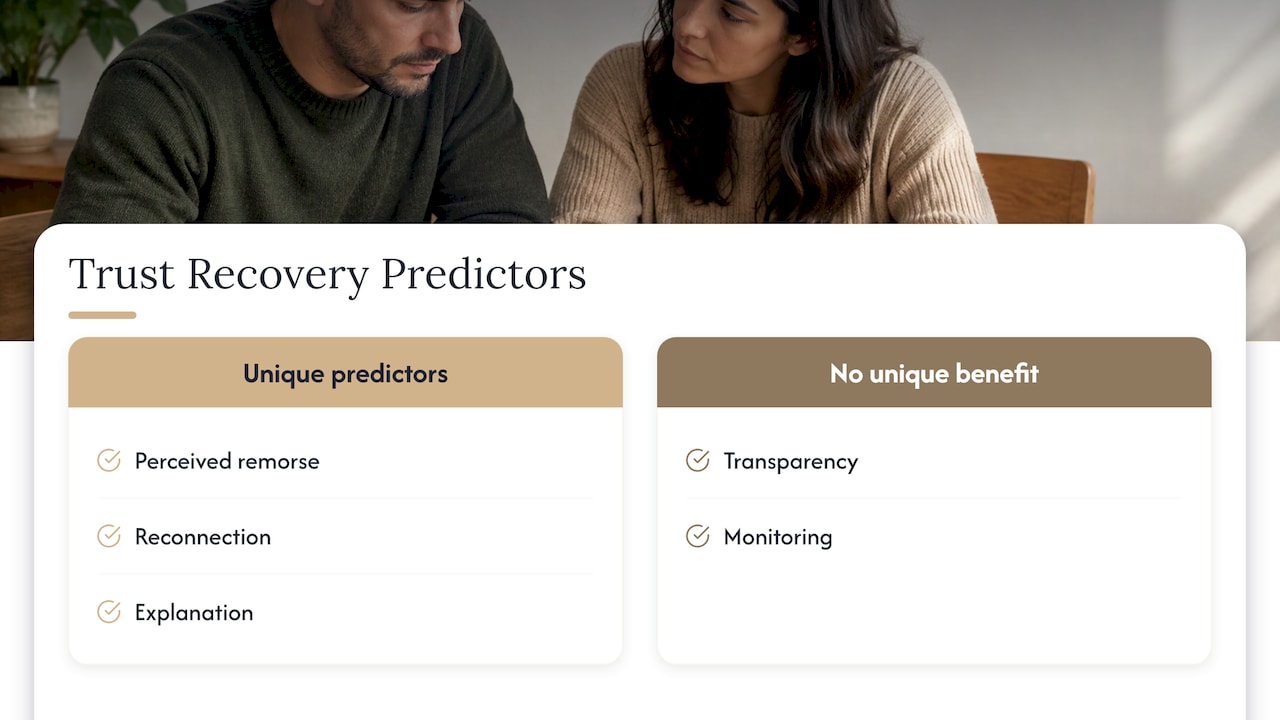
One finding is worth keeping in mind. In the 2025 survey of 263 betrayed partners who tried to reconcile, perceived remorse, reconnection and explanation uniquely predicted trust recovery. Transparency and monitoring added no unique benefit once those other behaviours were counted. The researchers also found that recovery was chiefly linked to what partners do, not to fixed personality traits. In practice, transparency can calm the first weeks, but trust grows mainly when you can see real remorse and feel connected again.
Individual therapy can run alongside couples work. Trauma-focused approaches such as EMDR therapy are used for distressing memories and triggers, and some people find them useful when intrusive images do not ease. If you ever feel unsafe at home, contact emergency services first. Couples sessions are not the right place to address violence or threats.
The Gottman atonement phase is direct about what is asked of you. Be open and honest. Answer questions truthfully without trimming the details. Express remorse and take responsibility. Do not blame problems that existed before the affair.
That last point is where many people stumble. The Gottman Institute warns that the partner who cheated often rushes ahead to talk about earlier problems in the relationship, and the hurt partner hears it as justification or blame. The question “why did this happen?” belongs to the second phase. In the first phase, the questions are about the facts of the story.
Here is what that looks like day to day:
A guide on a related theme, rebuilding trust after lying, speaks to the partner who broke trust and how to start repairing it.
When both partners are willing, these steps give repair a structure:
For more on how structured sessions improve everyday talking and closeness, see how couples counselling helps communication and connection.
No reliable single timeline exists, and anyone who gives you an exact number is guessing. Couples differ in how long the affair lasted, how the truth came out, whether contact has ended, and what support they have. What you can expect is a pattern: intense hurt and questions at first, then a long middle where good days and bad days alternate.
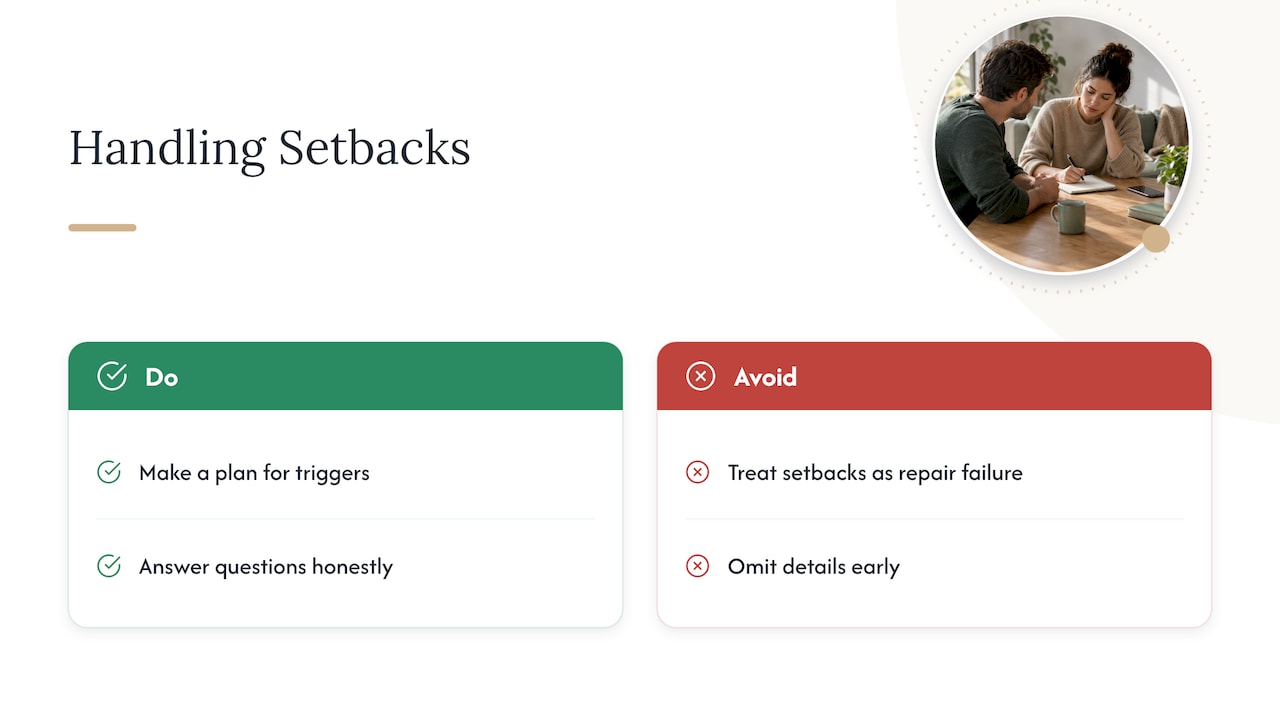
Setbacks are part of that middle. A song, a hotel lobby or a late text from a colleague can bring the first-week pain back. That does not mean repair has failed. It usually means a trigger needs a plan, or a question needs an honest answer. This is another reason the Gottman guide stresses full honesty early: an omitted detail that surfaces later can feel like a second betrayal and reset the clock.
You do not have to decide this week. The 2012 study of couples who stayed together points to the questions worth asking yourself: Is there still a motivation to be together? Are there kind acts you can still value? Can you make meaning of what happened? Do you have people supporting you?
For the partner who was hurt, a few more questions help. Is your partner answering honestly? Do you see remorse that feels real? Is contact with the affair partner over? If the answers are mostly yes, repair has something to build on. If you are unsure, a therapist can help you sort out your own thinking before you commit either way. Choosing to separate is also a legitimate outcome, and individual counselling can support you through it.
Couples therapy is most useful when you want a neutral person to keep the conversation in the right order, slow things down, and make sure both people are heard. Look for a therapist who:
We offer all of this. Our team uses the Gottman Method, EMDR and Brainspotting, and offers evening and weekend availability. You do not need a physician referral to start. Our marriage and couples counselling in Calgary page explains how it works.
We meet couples at one of the hardest points in their relationship. Both people are usually exhausted. One is in pain, the other is ashamed, and each is waiting for the other to move first.
What we try to do is give the process an order. The hurt partner gets honest answers and a voice. The partner who had the affair gets a clear, achievable role instead of a vague demand to “fix this.” Our collaborative, family-oriented team brings evidence-based methods, including the Gottman Method for the couple and EMDR or Brainspotting for the trauma symptoms that betrayal can leave behind.
We also know that picking up the phone is the hardest step. That is why every therapist offers a free 15-minute connection call. You can ask your questions and see whether it feels right before you book a session.
Deane
If you are in Calgary, Red Deer or Cold Lake, or want to meet online, you can start with a free 15-minute connection call with the therapist you may work with. We direct bill a wide range of insurers, and you do not need a physician referral. Our couples and family services cover marriage and couples counselling, individual therapy, trauma counselling and more. For individual support, our Affordable Counselling Calgary page lists a one-off price of $100 CAD, and the Red Deer page lists $80 CAD.
You can begin with the couples counselling page or the Affordable Counselling Calgary page.
Trust rebuilds through honest answers, visible remorse and steady reconnection. In the 2025 survey of betrayed partners, those three predicted trust recovery, while monitoring alone added nothing extra. A therapist can help you do them in a sensible order.
Not usually. The Gottman Institute places the “why” question in the second phase. Early on, the hurt partner needs the facts of the story. Raising earlier relationship problems too soon can sound like blame.
Yes. The Gottman Institute notes that betrayed partners often struggle with PTSD-type symptoms, including nightmares, intrusive thoughts and triggers. If they persist, speak with a therapist, or with your doctor if your sleep or mood is badly affected.
It works best with both of you. If your partner is not ready, you can start individual counselling for yourself, and your partner can join later. Either of you can book a free 15-minute connection call to ask how it would work.