
A psychiatrist is a medical doctor who can prescribe medication. A psychologist is trained in assessment and talk therapy and cannot prescribe. For most people in Calgary who are struggling with low mood, anxiety, trauma or relationship stress, the practical first step is therapy with a psychologist or another qualified therapist, because you can book it directly without a referral. At Supporting Wellness, you can start with a free 15-minute connection call with the therapist you are considering, and we direct bill a wide range of insurers.
The two professions sound alike and often treat the same conditions. This guide explains what each does, how to choose, what a provisional psychologist is, and how access and cost work in Alberta.
The main difference is training. According to the CMA, psychiatrists complete four years of medical school plus a five-year residency, while psychologists complete graduate school. That medical training is why only psychiatrists, of the two, can prescribe medication.
Here is how the two compare in practice.
| Psychologist | Psychiatrist | |
|---|---|---|
| Training | Graduate degree (master’s or doctorate) | Medical degree plus psychiatry residency |
| Diagnoses mental health conditions | Yes | Yes |
| Provides talk therapy | Yes, usually the main focus | Sometimes, often alongside medication |
| Prescribes medication | No | Yes |
| Typical way in (Alberta) | Book directly | Referral, usually from a family doctor |
| Typical funding (Alberta) | Extended health insurance or self-pay in private practice | Provincial health plan |
The CMA notes that both professions can diagnose, create treatment plans, teach skills and use non-medication treatments such as EMDR. So the real question is rarely “which is better”. It is “what do I need help with right now”.
In Alberta, the scope of psychology is set out in the Health Professions Act. The College of Alberta Psychologists describes it as assessing, diagnosing, treating, guiding and supporting people to prevent, remedy or ease mental, emotional, cognitive, behavioural and interpersonal difficulties. In plain words, a psychologist helps you understand what is happening and works with you on changing it.
That usually looks like:
Psychologists are not medical doctors, so they do not prescribe. When medication might help, they work alongside your family doctor or a psychiatrist.
Alberta registers psychologists with a master’s or a doctoral degree. The CMA lists Alberta among the provinces and territories that require a master’s degree, while others such as Ontario and British Columbia require a doctorate. The College of Alberta Psychologists says psychologists hold a master’s and/or doctoral degree involving 6 to 10 years of university study, and doctoral-degree holders can use the title “Dr.”
A master’s-level psychologist in Alberta is fully registered, and the title does not mean less qualified in this province. Rules differ elsewhere in Canada, so if you have seen a psychologist in another province, the credentials may not look the same.
A psychiatrist starts as a physician. They look at mental health through a medical lens: your symptoms, your physical health, other conditions and the medications you take. Psychiatrists can diagnose, prescribe and monitor medication, and some also provide therapy. The Canadian Mental Health Association, Alberta Division describes a psychiatrist as a medical doctor who can prescribe medication and use counselling.
Psychiatrists are often involved when symptoms are severe, when several conditions overlap, when a medication decision is complex, or when a family doctor wants a specialist opinion.
Depression is the most common reason people compare the two, so here is how to think about it.
If you are having thoughts of ending your life, or are in immediate danger, call or text 988, the Suicide Crisis Helpline in Canada, or call 911. Do not wait for an appointment.
You may see “registered provisional psychologist” on a clinic website and wonder what it means. It is a protected title in Alberta for someone who has finished the academic training and is completing the supervised practice needed for full registration.
The Psychologists Profession Regulation describes a provisional registrant as someone who has met the academic requirements but has not yet completed 1,600 hours of evaluated practice or passed the required examinations. They practise under the supervision of a fully registered psychologist.
The College of Alberta Psychologists explains that a provisional psychologist must complete:
Supervision is a formal activity led by a College-regulated psychologist with at least five years of experience as a registered psychologist in Alberta. The College’s registration FAQ sets a minimum of 107 hours of supervision, with a quarter of those hours in person at the practice location, at a ratio of one supervision hour for every 15 practice hours.
In short: the provisional psychologist has the degree and is finishing the hours and exams. The registered psychologist has completed them. Under the regulation, provisional registration expires five years after registration if requirements are not completed, so it is a time-limited stage and not a permanent category.
For you as a client, the supervision is a built-in layer of oversight. Your clinician is not working alone, and their cases are reviewed with an experienced psychologist. You are welcome to ask any clinician about their registration and who supervises them.
There is a third title you will see: counselling therapist. Alberta is working toward regulating this profession. The College of Alberta Psychologists reported in March 2024 that the Government of Alberta had announced it would develop a potential regulatory pathway for graduate-trained counselling therapists. In May 2025, the Association of Counselling Therapists of Alberta reported that the minister had reaffirmed the commitment, with exact timelines not yet clarified.
What that means for you: the titles are still evolving, so what matters most is the clinician’s training, registration, approach and how comfortable you feel with them. A good first conversation tells you a lot.
This is where the two paths feel different.
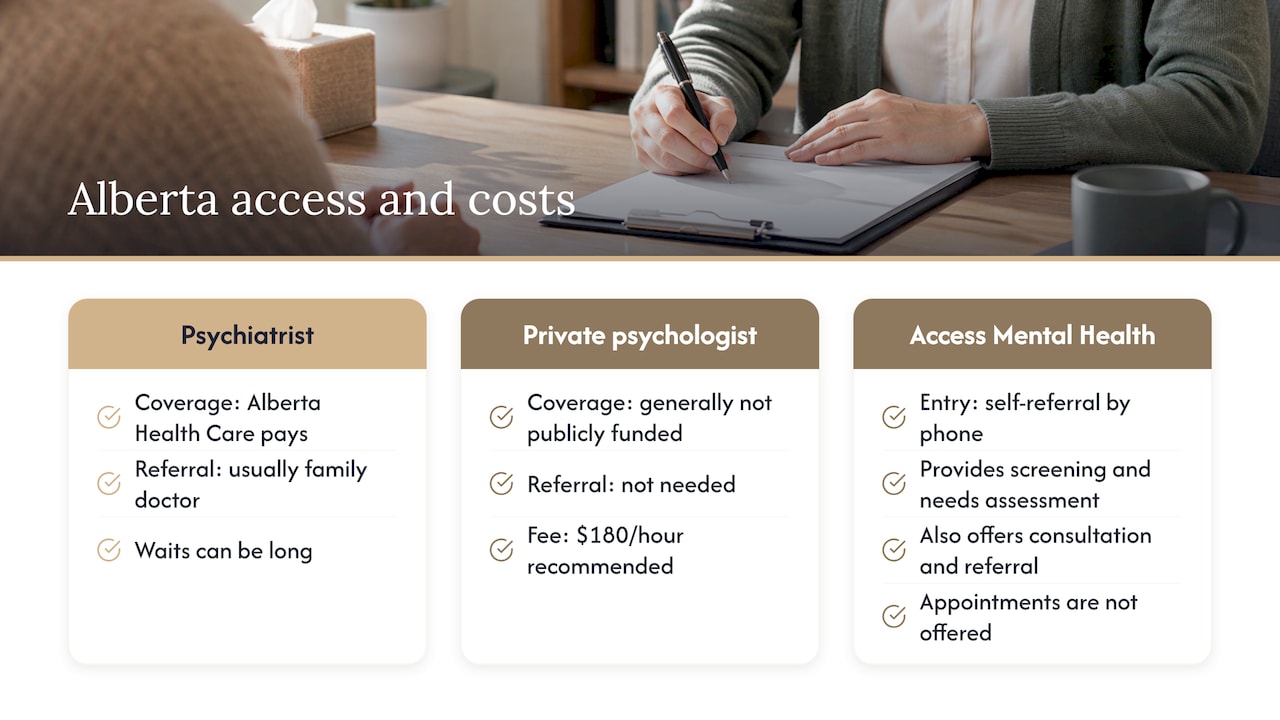
Psychiatrists. The Alberta Health Care plan pays psychiatrists. The CMHA Alberta Division says you usually need a family doctor referral, and the Calgary resource sheet above notes that with an Alberta Health Care card, access to private psychiatry is free. Waits can be long. An Alberta government report, Mental health in Alberta: issues and recommendations (1998), noted that the limited number of specialists such as psychiatrists results in long waiting lists.
Psychologists. Psychologists in private practice are generally not publicly funded. The Canadian Mental Health Association explains that psychologists employed by public institutions such as hospitals and schools are covered by the public system, while community practitioners are typically covered through extended health insurance plans from work. You do not need a referral to book one. The College of Alberta Psychologists generally recommends a fee of $180 per hour, according to the Calgary resource sheet (January 2024), and psychologists who charge more must tell clients in advance.
Public intake. If you are not sure where to begin, Access Mental Health in the Calgary Zone is a single point of entry. You can self-refer by phone at 403-943-1500 or 1-844-943-1500 (closed weekends and statutory holidays). It provides screening, needs assessment, consultation and referral, and it does not offer appointments itself.
For a closer look at what insurance and public plans do and do not cover, see our guide to paying for therapy in Alberta and our answer to whether therapy is free in Alberta.
Use these situations as a starting point.
None of these is a permanent choice. Starting with one does not close the door on the other.
We offer in-person and online counselling in Calgary, Red Deer and Cold Lake, with a multidisciplinary team. Our services include individual therapy, couples counselling, family counselling, child and adolescent counselling, counselling for veterans and first responders, Indigenous (NIHB) counselling, anxiety, depression and PTSD and trauma counselling, EMDR, Brainspotting and assessments.
Several things make the first step easier:
If cost is a concern, our Affordable Counselling pages list $100 in Calgary and $80 in Red Deer. You can read the details on the Affordable Counselling Calgary page and the Red Deer page.
Ready to start? Book your free connection call through our individual counselling page.

When people come to us, they often ask whether they “should” see a psychologist or a psychiatrist, as if they have to get it right the first time. You do not.
What we care about is that you feel heard, that you understand the plan, and that the care fits your life. That is why every therapist on our team offers a free 15-minute connection call. It lets you ask questions and get a sense of the person before committing to anything.
We work as a collaborative, family-oriented, multidisciplinary team, using evidence-based approaches such as the Gottman Method, EMDR and Brainspotting, and culturally safe care for veterans, first responders and Indigenous clients. If medication becomes part of your plan, we encourage you to talk it through with your family doctor, and we are glad to keep supporting you in therapy alongside it.
Reaching out is the hardest part. We would be glad to help with the next step.
Deane
Neither is better in general. They do different jobs. A psychologist is a strong first choice for assessment and therapy, and you can book one directly. A psychiatrist is the right person when medication is a question, and the path there usually starts with your family doctor.
Yes. Alberta’s scope of practice for psychology includes assessing and diagnosing mental, emotional, cognitive, behavioural and interpersonal difficulties, according to the College of Alberta Psychologists. Diagnosis usually follows interviews and, when needed, psychological testing.
No. In Canada only psychiatrists, of the two, can prescribe medication, as the CMA notes. If you think medication might help, ask your family doctor, who can prescribe or refer you to a psychiatrist.
No. CMHA Alberta explains that you can book a psychologist in the community without a doctor’s referral. A referral is usually needed for a psychiatrist covered by provincial health insurance. At Supporting Wellness you can book without a physician referral.
A registered provisional psychologist has completed the academic training required in Alberta and is finishing supervised practice under a fully registered psychologist, as set out in the Psychologists Profession Regulation. Their work is overseen as part of that process.