
What you say in couples therapy is protected, but the rules work differently than in individual counselling. In Alberta, your therapist has a duty to explain the limits of confidentiality to both partners at the start, and a therapist cannot pass one partner’s information to the other without that person’s consent. The most useful thing you can do before your first session is ask how your therapist handles individual conversations, records and legal limits, so you both know where you stand.
If you are nervous about opening up in front of a stranger, with your partner sitting beside you, that is a very normal feeling. Knowing the ground rules usually makes it easier to speak honestly.
In individual therapy, the answer is simple: you are the client, and your information is yours. In couples therapy, the answer changes. The therapist is working with two people and with the relationship between them. That is why a good couples therapist talks about confidentiality before doing anything else.
The College of Alberta Psychologists, the body that regulates psychologists in the province, says in its Standards of Practice that psychologists must explain the limits of confidentiality and safeguard confidential client information (College of Alberta Psychologists, Standards of Practice, May 31, 2023). Its earlier December 31, 2022 edition is more specific about services with more than one client, such as couples therapy: the psychologist should clarify the limits of confidentiality to all parties beforehand and address confidentiality, disclosure and release at the beginning of the relationship (College of Alberta Psychologists, Standards of Practice, December 31, 2022).
In plain terms, that means:
Counsellors who are not psychologists, for example those who belong to the Canadian Professional Counsellors Association, follow their own association’s standards, and those speak to the same point, which we cover below.
For most couples, the practical answer is reassuring. What you share in sessions is treated as confidential. Your therapist does not discuss your sessions with your employer, your family, your friends or other professionals without your permission.
The Alberta standards generally require informed, written, signed and dated consent from the client before information is disclosed to someone other than the client. The exceptions are where the law or the standards permit or require disclosure (College of Alberta Psychologists, Standards of Practice, May 31, 2023).
That consent step matters in everyday situations such as:
In a couple, consent usually needs to come from both people when the information involves both of you. A good therapist will explain this in the first session so that neither of you is surprised later.
This is the question most couples worry about, and it is the one where therapists differ most. Many people assume that if one partner tells the therapist something in a private call or a one-on-one session, the therapist will keep it from the other. Others assume the opposite.
The professional standards do not treat these as the same thing. The Canadian Professional Counsellors Association’s 2025 standards separate confidentiality from secrecy between the people in a session. A counsellor must explain the limits of confidentiality in couples sessions, and cannot disclose one participant’s information to the other without that participant’s prior consent (Canadian Professional Counsellors Association, Standards of Practice, 2025).
So the standard protects each person’s information from being passed on without consent. It does not promise that your therapist will be comfortable holding a secret that works against the couple’s therapy. Some therapists tell couples at the outset that they do not keep secrets between partners, and that anything relevant to the relationship needs to come into the shared conversation. Others allow individual sessions with clear rules. Both approaches can be sound, as long as they are explained before anything is shared.
Here is a simple way to think about it:
If you are carrying something heavy, such as an affair, a financial secret or a health concern, it is better to discuss how the therapist handles it than to hold it back and hope it does not come up. A therapist who knows their own policy can guide you through it gently.
Confidentiality in therapy is strong but not unlimited. The Alberta standards allow or require disclosure where the law or the standards say so, and therapists are expected to tell you about these limits at the start (College of Alberta Psychologists, Standards of Practice, May 31, 2023). In general terms, these are the situations people usually ask about:
These limits are narrow. They exist for safety and legal reasons, and they are the same ones your therapist should walk you through before your first real conversation. If you have a specific legal situation, such as a separation, a custody dispute or an upcoming court date, speak with a lawyer about how therapy records could come into it, and tell your therapist so they can explain how they handle that.
You may also wonder where your information is kept and which privacy laws apply. In Alberta this depends on how your therapist works.
The College of Alberta Psychologists’ January 23, 2026 interpretive guide on privacy legislation explains that the Health Information Act does not generally designate psychologists as custodians. Psychologists who are employed or contracted by a custodian, such as a hospital or Alberta Health Services, are affiliates and must follow the Act in that role (College of Alberta Psychologists, Privacy Legislation in Alberta, 2026).
For private organizations, the Office of the Information and Privacy Commissioner of Alberta says the Personal Information Protection Act governs how personal information is collected, used and disclosed. It generally requires consent and a reasonable purpose, subject to exceptions set out in the law (Office of the Information and Privacy Commissioner of Alberta, Privacy laws in Alberta).
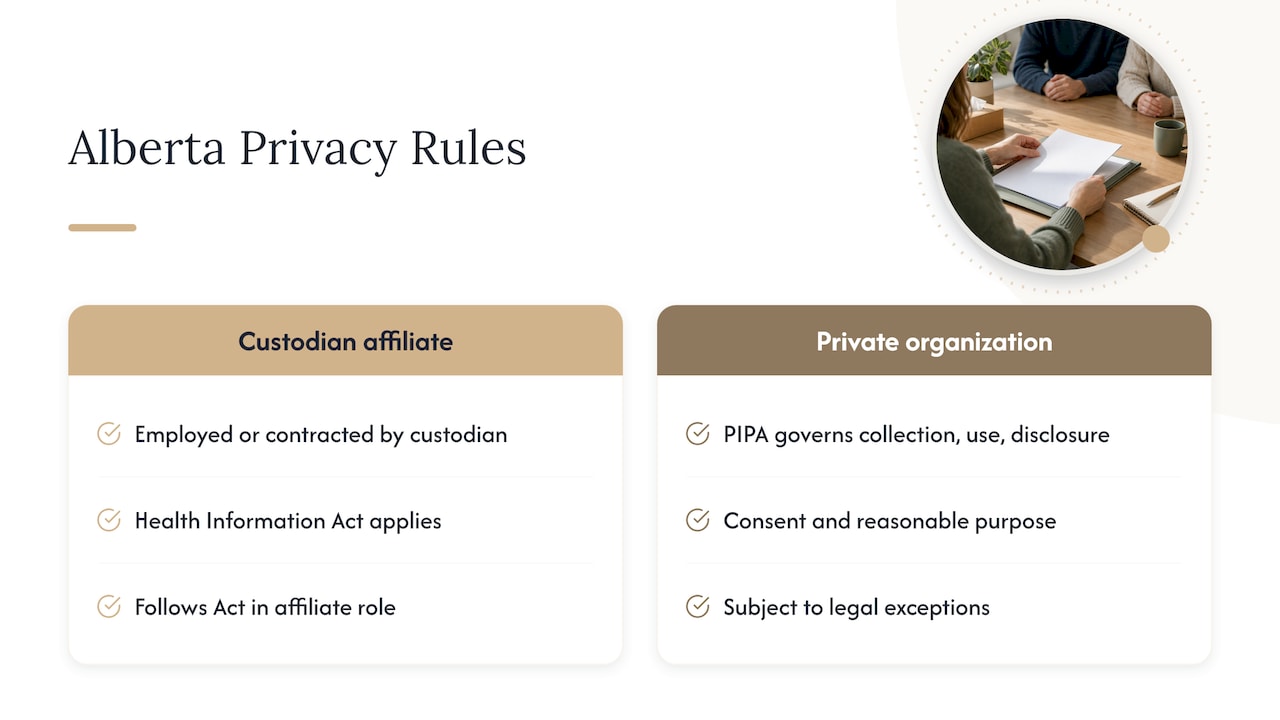
You do not need to memorize any of this. What matters is that a private-practice therapist is expected to collect only what is reasonably needed, use it for the purpose you agreed to, and release it with your consent unless a legal exception applies. If you want to know which rules govern your records, ask your therapist or clinic to explain it. That is a normal question.
A first conversation with a therapist is the right moment to settle privacy. Here is a short list you can use with any provider, and bring to a call or first session together:
Write down the answers or ask for them in writing. A therapist who is glad to explain is showing you how they work.
Many couples now meet their therapist by video. Confidentiality still applies, but the room is yours, so part of the privacy is your responsibility. Choose a space where you will not be overheard, use a private connection rather than public Wi-Fi, and agree on how you will each handle the session afterward. If you want to understand what good digital privacy practice looks like in a session held over video, what to ask about online session privacy gives a useful set of questions that apply to online sessions in general.
Also agree with your partner on a simple rule: what is said in the session is not used as ammunition afterward. Therapy works best when both people feel safe saying what is true.
Couples come to therapy at a vulnerable point. You may be talking about trust, intimacy, money, parenting or past hurts. Honest conversation about those topics depends on feeling safe, and feeling safe depends on knowing the rules.
When privacy is clear from the beginning, three things usually get easier:
The approach a therapist uses also shapes how this works in practice. Therapists trained in structured methods, such as the Gottman Method, often set clear ground rules for joint sessions early on. Ask your therapist how their approach shapes the way they handle privacy.
We hear the same worry again and again from couples who call us: “What if I say the wrong thing, and what happens to it?” It is a fair question, and it deserves a clear answer before anything else.
Our view is that privacy should never be a mystery. You should know who your therapist is working for, what the limits are and what happens to your information before you share a single detail. That is why we offer a free 15-minute connection call with every therapist. It is a chance to ask these questions, hear how a therapist works and decide whether you both feel comfortable.
We are a collaborative, family-oriented practice with a multidisciplinary team, and we offer evidence-based and culturally safe care. Couples do not need a physician referral to begin, and we offer evening and weekend availability so that both partners can attend together.
If you are unsure whether couples therapy is right for you, start with the call. Bring your questions about confidentiality. A good first step is one you can take without pressure.
Deane
If you are ready to talk to someone, our marriage and couples counselling in Calgary is available in person and online, with direct billing to a wide range of insurers. Our full list of services includes family counselling, online counselling and support for veterans and first responders, with locations in Calgary, Red Deer and Cold Lake.

Book a free 15-minute connection call, and bring this article’s list of questions with you. If cost is on your mind, our pages on whether couples counselling is covered by insurance and paying for therapy in Alberta explain how coverage and payment commonly work.
Not without your consent, under the professional standards that apply to Alberta counsellors. The Canadian Professional Counsellors Association’s 2025 standards say a counsellor cannot disclose one participant’s information to another without prior consent. Therapists can still have their own approach to private information in couples work, so ask how yours handles it before you share.
Often yes, when the information involves both of you. Alberta’s psychology standards generally call for informed, written, signed and dated consent before information goes to someone outside the therapy. Ask your therapist how consent works for your situation, especially if you may separate.
In narrow situations set by law or professional standards, such as a serious risk of harm, concerns that a child needs protection, or a lawful court demand for records. Your therapist should explain these limits to both of you at the start. If you have a legal matter underway, speak with a lawyer as well.
Yes. Many people feel nervous before a first session, especially about being honest in front of a partner. Knowing how confidentiality works often eases that. A short call with a therapist beforehand lets you ask questions without committing to anything.
Not with us. You do not need a physician referral to begin at Supporting Wellness. You can start with a free 15-minute connection call and book from there.