
Trauma-informed therapy is counselling built around one question: what has happened to you, and how can therapy feel safe while you work through it? It does not require you to retell your story on day one. It gives you choice and control, and it treats symptoms such as anxiety, anger or numbness as adaptations, not flaws. At Supporting Wellness, you can start with a free 15-minute connection call with a therapist, so you can judge how safe the fit feels before you book a session.
The Public Health Agency of Canada describes trauma and violence-informed approaches as ones that recognize the links between violence, trauma, negative health outcomes and behaviours. Their aim is to increase safety, control and resilience for the people using a service.
The Centre for Addiction and Mental Health (CAMH) puts it in everyday terms: care that is non-judgmental, validating and tailored to the unique experiences of a person coping with trauma. It also recognizes that someone who has lived through trauma may have developed behavioural, emotional or physical ways of coping with the harm.
That last point matters in practice. Many people arrive at therapy believing something is wrong with them: they startle easily, shut down in arguments, avoid certain places or struggle to sleep. A trauma-informed therapist starts from a different question. Instead of asking what is wrong with you, they ask what happened and what your mind and body learned to do to protect you.
Trauma also does not need to be a single dramatic event. It can come from an accident, an assault, military or emergency work, childhood experiences, a harmful relationship or years of ongoing stress. If you are unsure whether what you went through “counts”, our guide to signs you may be living with unprocessed trauma can help you recognize the patterns.
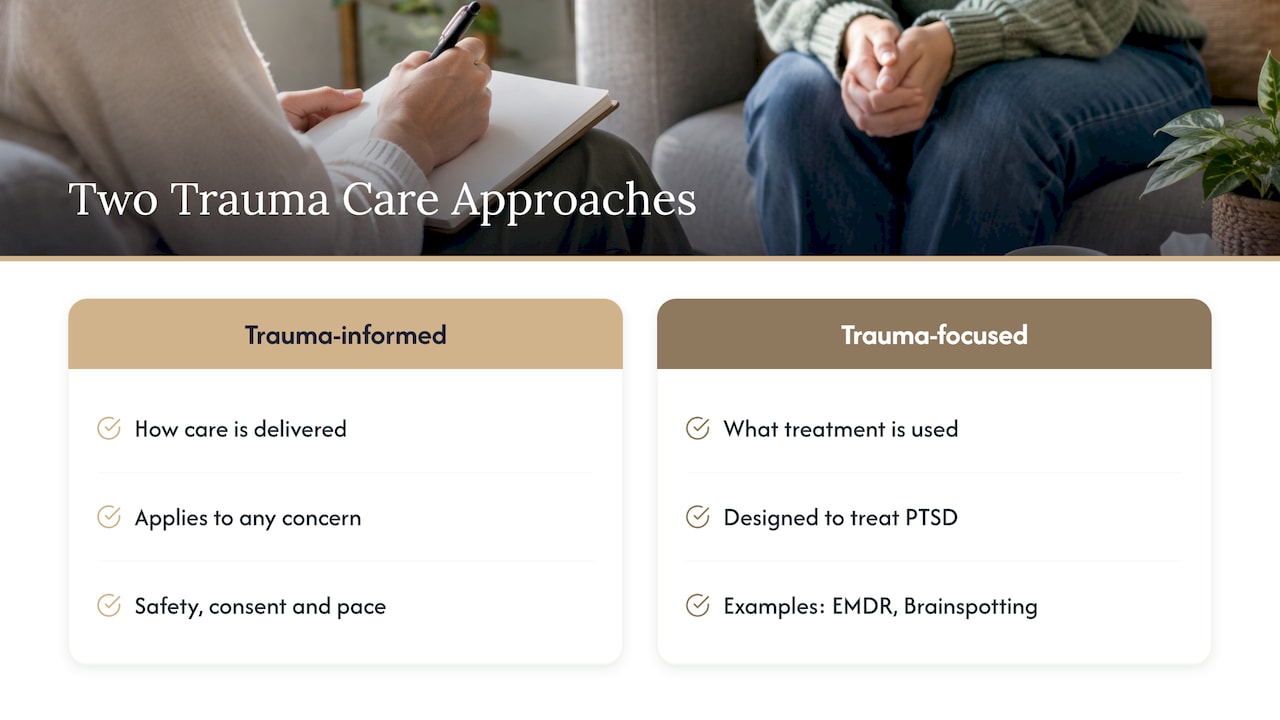
These two phrases are often mixed up, and the difference helps you choose well.
Trauma-informed describes the way care is delivered. Researchers at Orygen describe trauma-informed care as a systems-level approach that combines organizational culture with trauma-informed clinical practice. It applies whether you came for anxiety, depression, a relationship problem or trauma itself.
Trauma-focused describes specific treatments designed to treat PTSD. The same source distinguishes these therapies from the broader approach. EMDR (eye movement desensitization and reprocessing), which helps your brain process distressing memories so they lose their charge, is one example. Brainspotting, which uses where you look to help access and process stored distress, is another.
A simple way to hold it: trauma-informed is the how, and trauma-focused is the what. The how shapes everything around the treatment: the way you are greeted, how consent works, how fast you move and what happens when a session becomes overwhelming. The what is the technique used to process the trauma.
You want both. A highly effective technique delivered without safety and choice can feel like a repeat of what hurt you. A gentle environment with no pathway toward processing can leave you comfortable but stuck.
Federal guidance lists the aims clearly. Trauma and violence-informed approaches aim to minimize harm and retraumatization by creating emotionally and physically safe environments and fostering choice, collaboration, control and resilience. Here is what that looks like in a counselling office.
Safety is both physical and emotional. You know where the exits are, the room is calm, and the therapist explains what will happen before it happens. Practical details matter too, such as appointment times that fit your life. Evening and weekend availability at Supporting Wellness exists partly for this reason: a session squeezed between work and a school pickup rarely feels safe.

You decide what to talk about, how much to share and when to pause. Your therapist offers options and does not issue orders. Guidance for trauma-informed practice also advises listening without judgment and avoiding touch without warning or permission. Control is not a nice extra. For many people, trauma was the experience of having none, so getting it back in a small way is part of recovery. If you want to read more on why choice matters in care settings, this piece on freedom of choice in care explains the principle from a family point of view.
Goals are set together. Your therapist explains why they suggest a method, checks that it makes sense to you and adjusts if it does not. You are the expert on your own life.
A trauma-informed therapist notices what has helped you survive and builds on it. Coping habits that now cause trouble, like avoidance or hypervigilance, are understood as skills that once protected you.
Trauma is not only a thought pattern. Researchers reviewing the field note that traditional “top-down” talk therapy may benefit from “bottom-up” approaches that address the body’s sensorimotor traces of trauma. This is one reason methods such as EMDR and Brainspotting sit alongside conversation in a trauma-informed practice.
Clinical researchers describe trauma healing as a dynamic, natural process that adverse events can block. They note that a non-judgmental therapeutic relationship is needed so that survival behaviours are not triggered again. In plain terms: if you do not feel safe with your therapist, your nervous system stays on guard, and processing becomes harder.
This is why fit matters as much as credentials. It is also why a short, no-pressure first conversation is useful. You can hear how a therapist talks, how they respond to a hard question, and whether your shoulders drop or tighten.
CAMH explains that an assessment is usually the first step to identify the problem and the services that could help. During therapy, you set goals, and a good relationship with your therapist is key. Progress can take time, and issues can feel worse at first before they ease.
Here is how that often unfolds.
If a session leaves you tired or stirred up, that is common. Tell your therapist, who can adjust the pace. If you ever feel in immediate danger or are thinking of harming yourself, contact emergency services right away.
Posttraumatic stress disorder (PTSD) is a condition that can follow a frightening or life-threatening experience, with symptoms such as intrusive memories, avoidance, negative mood and feeling constantly on edge. The Federal Framework on PTSD describes trauma-informed care as central to managing PTSD, because it provides the emotional, cultural and physical safety effective treatment depends on. It is used alongside the first-line evidence-based treatments identified in clinical practice guidelines.
The same framework stresses individualized plans that take into account cultural, occupational and gender-based differences, along with social factors that affect health. That matters if you are a veteran, a first responder, an Indigenous client or a newcomer: care should fit your life, not the other way around.
If you are weighing which treatment to ask about, our comparison of EMDR and CBT, drawing on evidence from 114 trials walks through the research. If your experience involved prolonged or repeated harm, what complex PTSD is explains how it differs from single-event PTSD. And if a relationship pattern feels impossible to leave, what a trauma bond is may describe what you are experiencing.
A label on a website is not enough. CAMH’s guidance on choosing a trauma therapist suggests checking that the person has at least a graduate degree in clinical counselling from a recognized university, plus specialized trauma training. It also recommends asking about professional affiliations, experience with abuse-related trauma, and approaches to simple and complex PTSD.
The same guidance encourages you to notice how the therapist responds. Do you feel respected and heard? Do they answer questions about their background openly, without defensiveness?
Use this checklist on a connection call:
At Supporting Wellness, the free 15-minute connection call exists so that you can ask exactly these questions before committing to anything. No physician referral is needed to book.
Trauma rarely stays with one person. It shows up in how partners argue, how parents respond to a child’s distress and how a family copes with someone who has changed.
Couples. When one or both partners carry trauma, conflict can set off survival reactions: shutting down, lashing out or leaving. Couples work grounded in the Gottman Method, which the clinic offers, focuses on building communication and connection. Our article on how couples counselling improves communication and connection explains what that looks like, and our marriage and couples counselling in Calgary page covers booking.
Families. Children and teens express distress through behaviour more often than words. When one member is struggling, the whole household feels it. Read more about when one family member is struggling, or see our family counselling in Calgary page.
Veterans and first responders. Repeated exposure to danger and loss calls for care that understands your work culture. We offer veterans and first responder counselling, with local pages for Red Deer and Cold Lake.
Indigenous clients. Culturally safe counselling is part of what we offer, including Indigenous (NIHB) counselling.
CAMH notes that psychotherapists in private practice are not covered by public health insurance, while providers at government-funded hospitals, clinics or agencies may be free. Private practice, including ours, is paid by you or through your benefits. Supporting Wellness offers direct billing to a wide range of insurers, which means the clinic bills your insurer for you where your plan covers it.
For people without coverage, our affordable counselling pages list $100 in Calgary and $80 in Red Deer per session. Check your own benefits booklet for what your plan reimburses, and ask us if you are unsure how direct billing works for you.
If you live in Calgary, Red Deer or Cold Lake, you can see a therapist in person, or you can meet online. Our team offers EMDR, Brainspotting and individual counselling for anxiety, depression, PTSD and trauma, and you choose the pace.
The easiest first step is a free 15-minute connection call. You talk with a therapist, ask your questions and decide whether it feels right.
You can learn about PTSD and trauma counselling in Calgary, or see individual counselling and therapy to book. In Red Deer, visit PTSD trauma counselling in Red Deer, and in Cold Lake, PTSD trauma counselling in Cold Lake. For EMDR specifically, see EMDR therapy in Calgary.
Many people tell us they waited years to call because they feared being asked to relive the worst moment of their lives in the first hour. That is why we believe the first thing therapy should deliver is not a technique but safety.
Our practice is collaborative and family-oriented, with a multidisciplinary team offering evidence-based and culturally safe care. That is why we pair a free 15-minute connection call with every therapist, evening and weekend availability and no physician referral. Each removes one small barrier between you and a first conversation.
We also believe trauma-informed care works best when it has real tools behind it. EMDR and Brainspotting give your body and mind a way to process what talking alone may not reach, and the Gottman Method gives couples a practical route to rebuild trust. You decide the pace, and we follow it.
If you are unsure where to begin, begin with the call. You can ask anything, and you owe us nothing afterward.
Deane
No. A trauma-informed therapist lets you decide what to share and when. Many people begin with current symptoms, such as sleep problems, anxiety or relationship strain, and move toward the harder material only once they feel steady and ready.
No. It is an approach to how care is delivered, so it suits anyone, including people seeking help for anxiety, depression or relationship difficulties who have a history of hard experiences. PTSD treatment adds specific trauma-focused methods, but safety, choice and collaboration apply to everyone.
It varies from person to person. CAMH notes that progress may take time and that things can feel harder at first. Your therapist should review your goals with you regularly and adjust the plan as you go.
No physician referral is needed. You can book a free 15-minute connection call, talk with a therapist and decide whether to go ahead. Sessions are available in person in Calgary, Red Deer and Cold Lake, and online.
Tell your therapist. Pacing is part of trauma-informed care, so they can slow down, return to grounding skills or change the approach. If you feel in immediate danger or at risk of harming yourself, contact emergency services right away.